


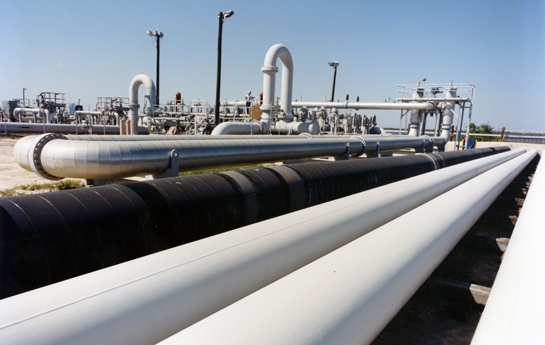
First, some history. The SPR was created in 1975 when then-President Gerald Ford signed into law the Energy Policy and Conservation Act, which included a mandate to establish a reserve of up to 1 billion barrels of oil. The first OPEC-led oil embargo in 1973–74 created an economic earthquake in the United States, and Congress figured that something had to be done to mitigate any further similar disruptions.
The reserve itself was created in some of the 500 salt domes along the Gulf Coast of Texas and Louisiana. Storing crude in the impermeable domes is both cheap — about 10% of the cost of above-ground storage tanks — and safe. Proximity to about a quarter of U.S. refining capacity was also a consideration.
The cost for the oil currently held in the SPR was $20.7 billion. That works out to an average of about $29.75 a barrel. The last purchase of crude for the SPR came in January 2009 when the U.S. Department of Energy acquired 10.7 million barrels at a cost of $553 million, or about $51.68 a barrel.
Most of the oil in the SPR comes from what is known as royalty-in-kind payments from producers on federally managed leases in the Gulf of Mexico. The producers paid a royalty in barrels of 12.5% to 16.7% for the right to explore and produce in the Gulf.
Combining the SPR with commercial stockpiles of crude and refined products in storage tanks around the country, the United States had 1.73 billion barrels of oil and product inventory in the week ending March 21. Even excluding the SPR, U.S. inventories totaled more than 1 billion barrels.
Why so much? That’s a very good question. The main reason is, “Just in case we need it.” Fair enough, but the situation is significantly different today from what it was in 1975, or even 2005. The newfound ability of oil producers to wring oil out of shale and other tight rock formations has absolutely changed the oil equation in the United States.
The developed countries that are members of the Organization for Economic Cooperation and Development (OECD) have each agreed to maintain a petroleum reserve equal to 90 days of net imports. According to the International Energy Agency’s (IEA) calculation, the United States should maintain a strategic reserve of 204 million barrels, based on average 2013 net imports.
The U.S. SPR was filled to its capacity in December 2009. In 2011 the U.S. sold 30 million barrels from the SPR in a coordinated action with other countries to reduce the impact of the total shutdown of supply from Libya. Before that, the federal government released 11 million barrels following Hurricane Katrina to stabilize domestic prices. The main point of each of these releases was, “There’s plenty more where that came from and we’ll use it if we have to.”
Much of that plenty comes from daily production, now nearly 8.2 million barrels a day in the United States, up 15% from a year ago. Net imports of crude are set to sink to 25% of U.S. demand for liquids next year.
Last month, the president authorized the sale of 5 million barrels from the SPR as a test that SPR distribution operations were in order. Crude prices dropped $2 a barrel.
If the United States were to release say, 500,000 barrels a day, for six months on the open market, what impact would that have on crude prices? And, especially, what impact would that have on Russia’s export revenues? Some analysts think that would drive crude prices down by $12 a barrel, costing Russia $40 billion in export revenues or about 2% of its gross domestic product. Investor George Soros even suggested the United States should consider such a move.
The main argument against using the SPR as an economic weapon against Russia or any other country is that the reserve is there to offset shortages in an emergency, not to use as a tool to manipulate markets. One analyst told Bloomberg News, “If you use oil and aim it at Russia, you’ll hit Texas.”







 Top Gaining Stocks
 Top Losing Stocks