



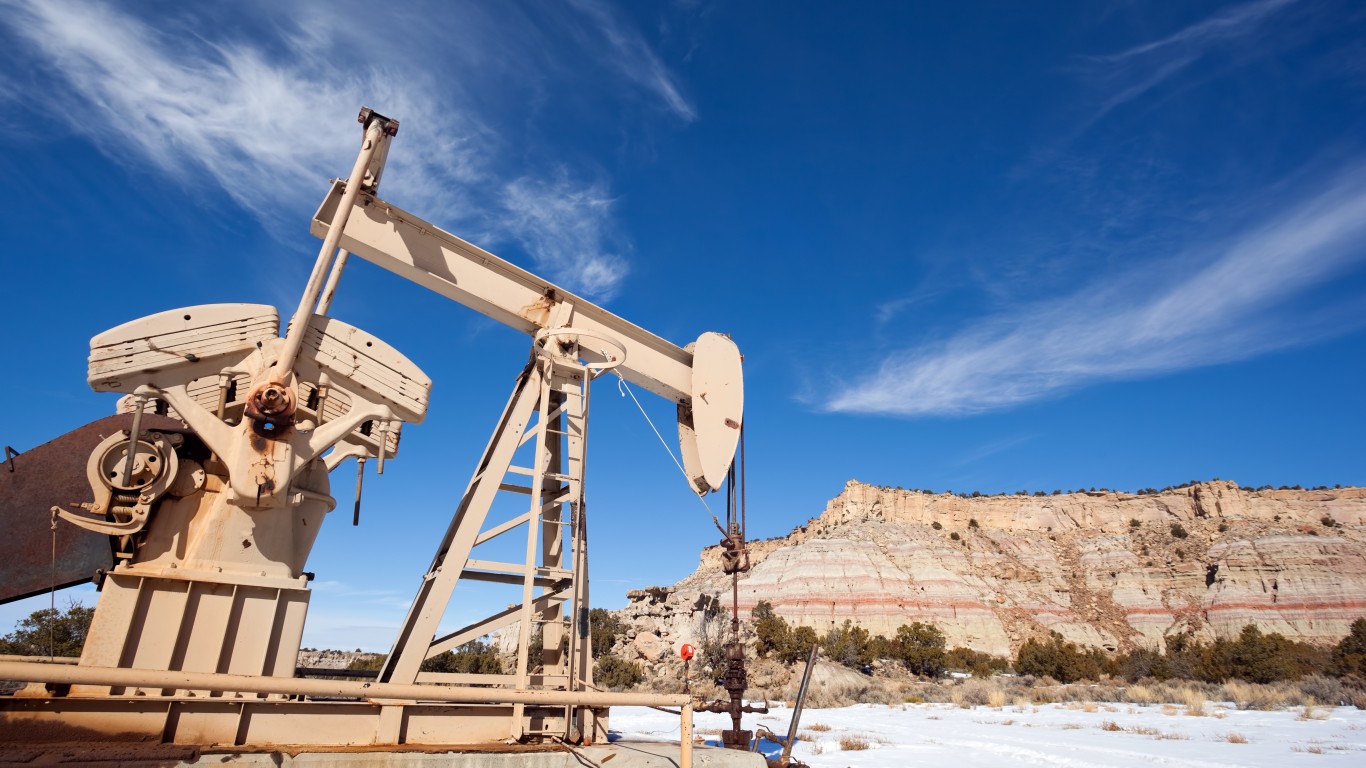
In the March revision to its Short-Term Energy Outlook (STEO) released Tuesday, the U.S. Energy Information Administration (EIA) reported that the nation’s crude oil production dropped to 9.1 million barrels a day in February, a decline of 80,000 barrels a day. For 2016, the EIA is forecasting average production of 8.7 million barrels a day, down from an estimated 9.4 million barrels a day in 2015.
On the pricing front, Brent crude prices rose by $1 a barrel in February to $32 and are now forecast to average $34 a barrel in 2016 and $40 a barrel in 2017. Those forecasts are lower by $3 and $10 a barrel, respectively, from the prior estimates. The agency said that producers’ resilience to the low-price environment and lower expectations from demand growth are holding down the price of crude.
The forecast for 2016 and 2017 average West Texas Intermediate (WTI) crude oil prices are the same as those for Brent crude. In the near term, uncertainty reigns. The EIA notes that the June futures contract now sits at $35 a barrel, nearly $3 a barrel below Monday’s closing price. In its Market Prices and Uncertainty Report, also issued Tuesday, the EIA researcher noted:
Crude oil prices began to increase during the second half of February in response to potential future supply reductions and better economic data in the United States. … The rise in front month [April 2016] crude oil prices toward the end of February was largely responsible for the decline in the price discount of near-term contracts to further-dated ones (contango) in the Brent market.
[nativounit]
In other words, traders don’t think the price increases of the past week or so represent the market’s longer-term direction.
The EIA also forecast that natural gas inventories will close the heating season (March 31) at 2.288 trillion cubic feet, some 54% higher than last year. Spot prices at the Henry Hub pricing point are forecast to average $2.25 per million BTUs in 2016 and $3.02 per million BTUs in 2017. Natural gas averaged $2.63 per million BTUs in 2015.
Natural gas is also forecast to account for 33% of all U.S. electric power generation in 2016, beating coal’s 32% of generation. If this forecast comes true it would be the first time ever that natural gas has provided more electricity generation than coal. Excluding hydropower, renewables are forecast to rise from 8% of all electricity generation in 2016 to 9% in 2017. Including hydropower, total generation from renewables is forecast to rise from 6% this year to 7% in 2017.











 Top Gaining Stocks
 Top Losing Stocks