


In 2016, U.S. utilities invested about $7.6 billion in energy efficiency programs and saved approximately 25.4 million megawatt-hours (MWh) of electricity. The U.S. Energy Information Administration (EIA) reported that in July of this year, the average cost of a kilowatt-hour in the United States was 13.12 cents, or $131.20 per MWh. That’s a savings of $3.33 billion.
Energy efficiency efforts vary among states, but in 2016 about half the states reported saving more as a result of energy efficiency programs than they did in 2015.
The American Council for an Energy-Efficient Economy (ACEEE) just published its annual “State Energy Efficiency Scorecard” that ranks the 50 states and the District of Columbia in six categories: utility programs, transportation, building energy codes, combined heat and power, state initiatives and appliance standards. Scores are assigned in a range of 1 to 50.
[nativounit]
The 10 states with the highest (best) energy efficient scores last year were:
- Massachusetts: 44.5
- California: 42.0
- Rhode Island: 41.5
- Vermont: 39.0
- Oregon: 36.5
- Connecticut: 35.5
- New York: 34.5
- Washington: 34.5
- Minnesota: 33.0
- Maryland: 31.0
In only one state, Maryland, did the cost of a kilowatt hour fall in the period between July 2016 and July 2017.
The 10 states with the lowest energy efficiency scores were:
- North Dakota: 3.5
- Wyoming: 5.0
- South Dakota: 5.0
- Kansas: 6.0
- West Virginia: 6.5
- Mississippi: 7.5
- Nebraska: 8.5
- Louisiana: 8.5
- Alabama: 9.0
- South Carolina: 9.5
Only Nebraska showed a year-over-year decline in the price of a kilowatt-hour.
Here’s a map with scores for all 50 states and D.C.
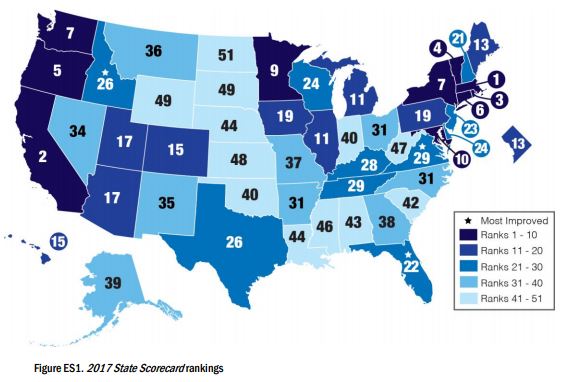
The full ACEEE 2017 Scorecard is available at the organization’s website.
[recirclink id=414025]
[wallst_email_signup]








 Top Gaining Stocks
 Top Losing Stocks