


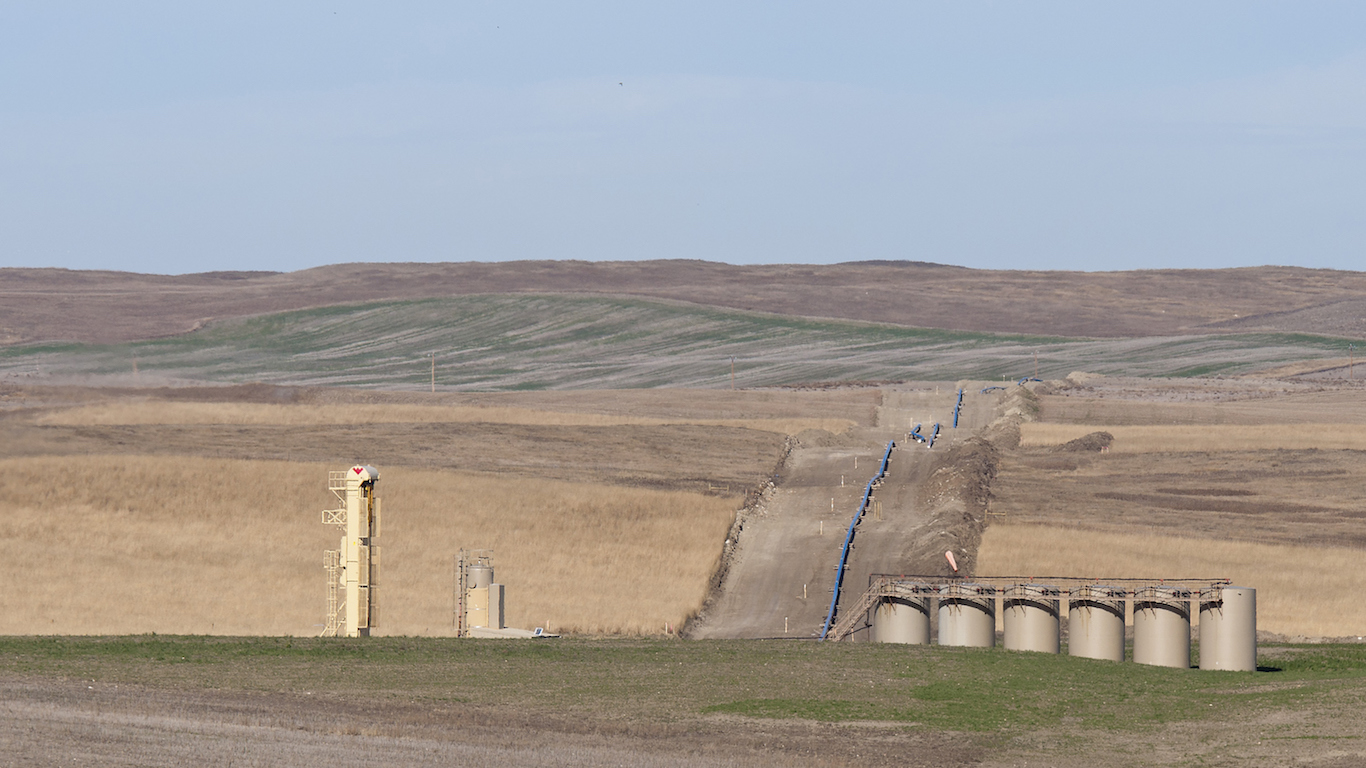
A federal district court judge in Montana has blocked construction of the Keystone XL pipeline and required the government to review again its environmental impact. The ruling overrides an executive order signed by President Trump just two days after he took office in January 2017.
TransCanada Corp. (NYSE: TRP) first proposed the 830,000 barrel-per-day pipeline expansion 10 years ago, and in 2016 the Obama administration refused to approve the project. Trump’s executive order reversed that decision but spawned more lawsuits seeking to stop the pipeline’s construction.
Thursday’s ruling came in a lawsuit filed by the Indigenous Environmental Network, the North Coast River Alliance and the Northern Plains Resource Council, alleging that the U.S. Department of State violated federal law when it issued a presidential permit to allow TransCanada to construct the Keystone XL pipeline.
In his ruling, Judge Brian Morris sided with the plaintiffs on the need for a new supplemental environmental impact statement (SEIS) based on factors including a drastic change in crude oil prices between 2014, when the most recent SEIS was completed, and 2017. The 2014 study assumed crude prices of $100 to $140 a barrel over 20 years. Since then, prices have dropped to around $60 a barrel and the impact of that change needs to be addressed again. In fact, Western Canadian Select crude sold for a mere $13 a barrel Friday morning, a discount of $46 a barrel to benchmark West Texas Intermediate.
[nativounit]
That’s not all. When the Obama State Department denied a permit for the pipeline in 2015, it “relied heavily on the United States’s role in climate leadership,” according to Morris’s decision. When the Trump State Department issued a new decision in 2017, it argued that a decision to approve the pipeline “would support U.S. priorities relating to energy security, economic development, and infrastructure.” The Trump State Department argued that this reversal was merely a policy shift and not “arbitrary and capricious” as plaintiffs had alleged.
Citing a 2015 ruling by the Ninth Circuit in different cases (referred to as Kake and State Farm in Thursday’s ruling), Judge Morris writes:
The [State] Department possesses the authority to give more weight to energy security in 2017 than it had in 2015. … Kake and State Farm … make clear, however, that “even when reversing a policy after an election, an agency may not simply discard prior factual findings without a reasoned explanation.” … The Department did not merely make a policy shift in its stance on the United States’s role on climate change. It simultaneously ignored the 2015 [State Department decision’s] Section 6.3 titled “Climate Change-Related Foreign Policy Considerations.”
In other words, the Trump State Department can neither discard nor ignore legal precedent.
Neither TransCanada nor the Trump administration has issued a statement on the court’s Thursday ruling.
The New York Times has made the 54-page written decision available.
TransCanada’s stock traded down nearly 2% shortly after Friday’s opening bell, at $38.95 in a 52-week range of $37.24 to $51.07.
[recirclink id=504201]
[wallst_email_signup]






 Top Gaining Stocks
 Top Losing Stocks