


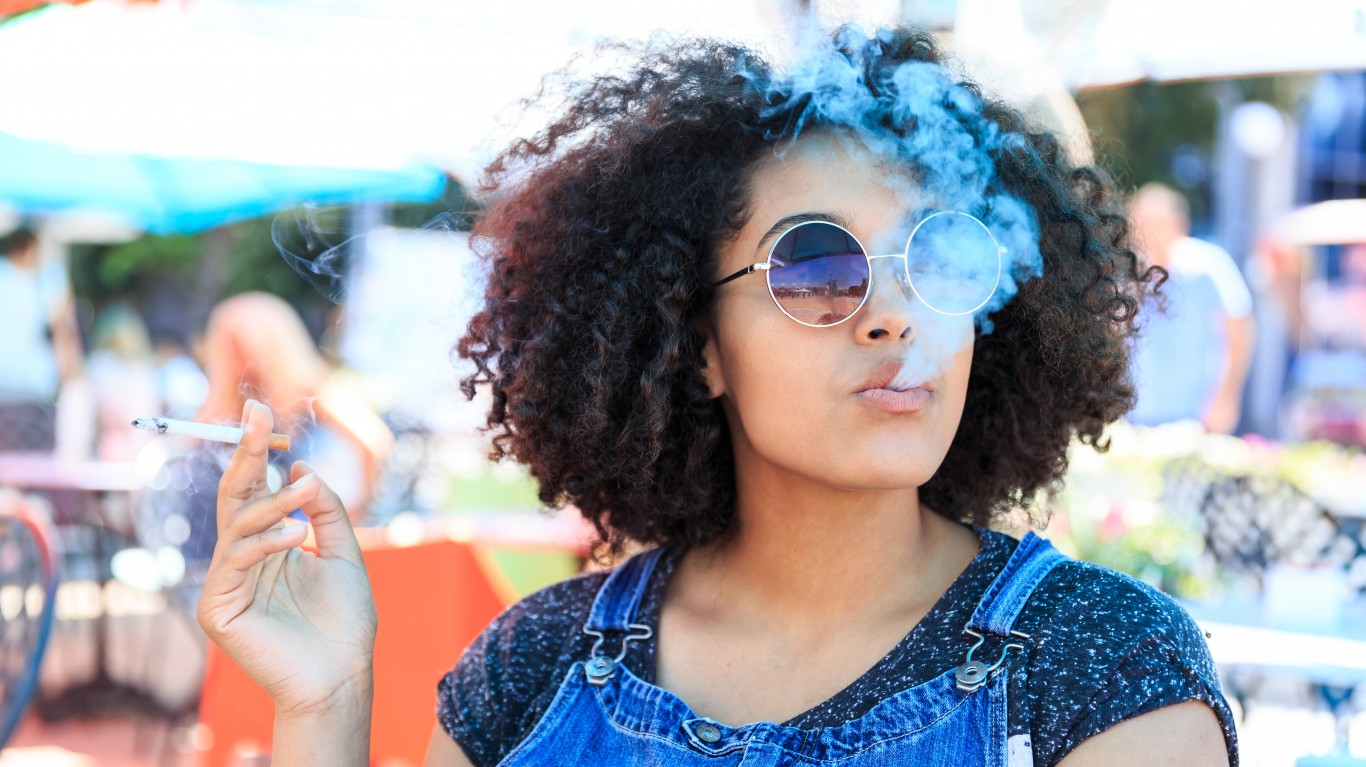
It has been known for years that smokers are not the only people whose health is damaged by their smoking. Tens of millions of Americans are exposed to secondhand smoke, which is smoke from burning tobacco or smoke that smokers exhale. According to new Centers for Disease Control and Prevention (CDC) data, the number of people affected was 58 million over the most recent period measured.
The information comes from the National Health and Nutrition Examination Survey, released in the CDC’s Morbidity and Mortality Weekly Report. The period covered was 2013 to 2014. The researchers “assessed exposure using serum cotinine, a marker of secondhand smoke found in the blood.” CDC Director Robert R. Redfield, M.D., commented about the study, “We know there’s no safe level of secondhand smoke exposure. These findings reveal that there is still much more to do to protect everyone—especially children—from this completely preventable health hazard.” The organization reported secondhand smoke has more than 7,000 chemicals in it. Approximately 70 of these can cause cancer.
The effect on the population is uneven: 38% of children ages 3 to 11 are affected, 48% of those in poverty are, and 39% of those living in rental properties are affected as well.
More Americans have escaped secondhand smoke because of laws that block smoking in public places. The CDC reports this includes 27 states and the District of Columbia. The CDC points out, however, that adoption of these laws has been slow. Most of the advances in new laws have moved to the local level. The study shows that “during 2015–2017, 199 communities adopted comprehensive smoke-free laws, and 21 have implemented such laws as of July 2018.”
[nativounit]
One problem that has been a hurdle is curtailing exposure in private areas, which is not regulated. The CDC points out that the U.S. Department of Housing and Urban Development has set a rule that public housing had to be “smoke-free” by July 31, 2018. Corinne Graffunder, DrPh, MPH, director of CDC’s Office on Smoking and Health, commented, “We know what works to reduce secondhand smoke exposure. Smoke-free environments are the best way to fully protect all people from the dangers of secondhand smoke in the places they live, work, and gather.”
The most affected groups based on percentages tend to be young, black and poorly educated, as well as people who live with smokers. The data show that “half of black nonsmokers are exposed to secondhand smoke, including 2 of every 3 black children. More than 3 in 10 nonsmokers with less than a high school education are exposed to secondhand smoke more than 7 in 10 nonsmokers living with someone who smokes inside the home are exposed to secondhand smoke.”
Among the worst news from the CDC report is that improvement in the secondhand smoke problem has been less than modest recently. There was very little improvement from 2011 to 2014, the ending year of the new report.
[wallst_email_signup]








 Top Gaining Stocks
 Top Losing Stocks