


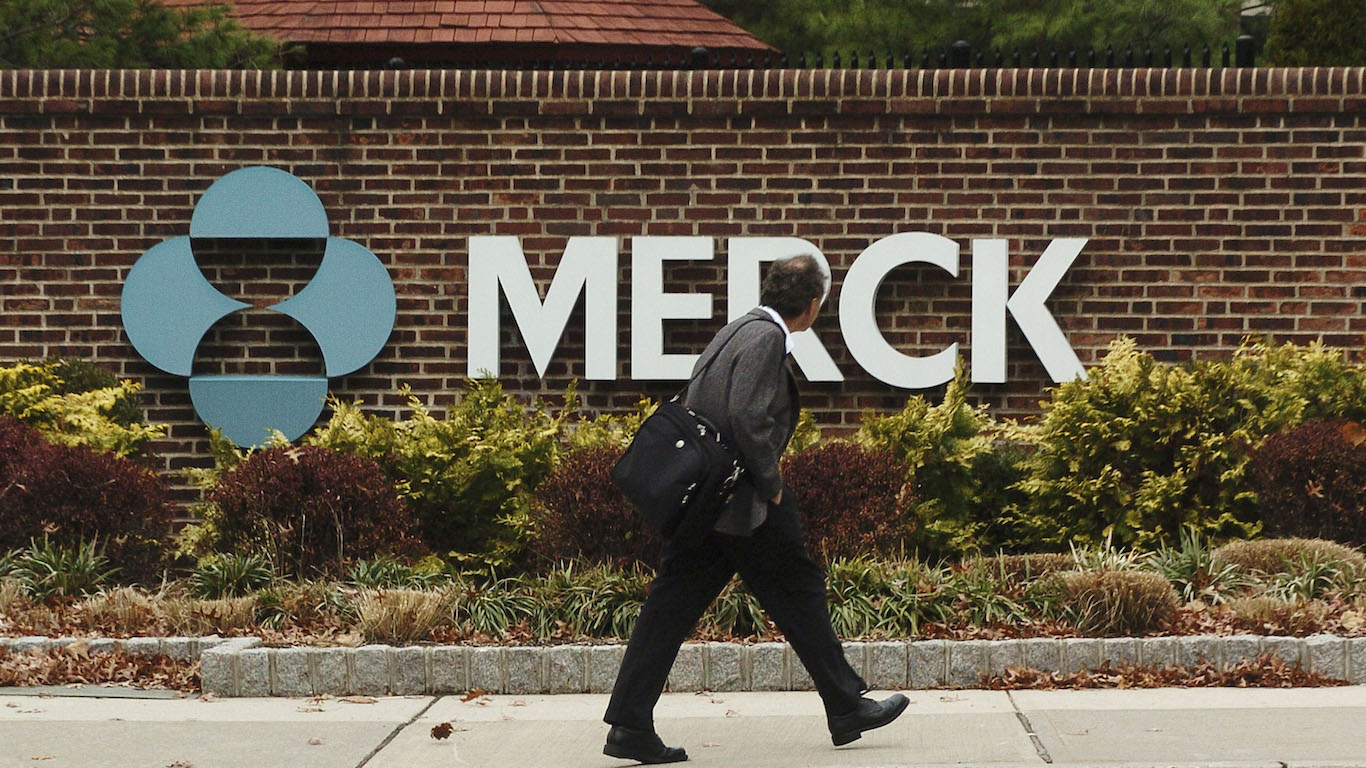
In recent years, investors frequently have run into issues being invested in major pharmaceutical companies. On top of drug pricing concerns brought up in endless political debates, many of the great drugs that helped build the Big Pharma giants either have already gone off-patent or are facing patent expiration sooner rather than later. Merck & Co. Inc. (NYSE: MRK) remains as a member of the Dow Jones industrial average, but unlike rival and fellow Dow member Pfizer Inc. (NYSE: PFE), Merck had seen its shares perform better than many drug companies in recent years.
Some companies are greatly rewarded for their restructuring efforts. Other times they can be challenging or difficult to understand. Now Merck finds itself in a position of being an acquirer of sorts at the same time it wants to spin out part of its operations. This brings up questions about potential M&A, partnerships, share buybacks, dividends and other issues. Moreover, the prolonged duration of executing this effort may create some operational uncertainty inside of Merck’s operations for a year or more.
While a 45% gain in Keytruda sales brought it to $3.1 billion in the fourth quarter of 2019, that was less than a loose consensus target of about $3.3 billion. Merck’s total sales gain of 8% and adjusted earnings gain of 26% failed to create enthusiasm for Merck’s shares. One issue at play is that financial engineering of sorts will be used in a reorganization that will make the company look like it is growing faster.
Merck plans to spin off about $6.5 billion in assets that represent close to 15% of its total revenue base. That will involve a spin-off of its women’s health business, older cholesterol drugs that are now off-patent and biosimilars. The remaining Merck will be focused on oncology and vaccines, as well as its animal-health and hospital medicines, with other drugs in the pipeline. One issue that may continue to act as a drag is that Merck is targeting a spin-off completion for the first half of 2021. in short, shareholders and employees alike may have to deal with all sorts of changes for a year or more.
Merck has made acquisitions of its own, but the company also has partnerships and is involved in licensing. CEO Ken Frazier said on the earnings conference call that Merck will continue to look for deals and that its business development remains a key priority.
[nativounit]
Merck also noted that the spin-off would not threaten its dividend for existing shareholders. The current $2.44 per share payout will come with a payout ratio target of 47% to 50% of earnings through future dividend hikes. The NewCo is also said to have a meaningful dividend as well, and the realized tax-free dividend will be roughly $8 billion to $9 billion. Those funds to the parent will be available for business development or share buybacks.
With Merck separating the businesses and with Keytruda already accounting for about one-fourth of the company’s total revenues, the so-called NewCo Merck likely will increase Merck’s dependence on that blockbuster cancer drug. After 2018 earnings of $4.34 per share, the consensus from Refinitiv was showing $5.17 in 2019 and then $5.61 in 2020.
Executing a spin-off or divestiture is not always as easy as it might seem. While it creates an apples-to-oranges comparison for past versus future revenues, there is also the logistical aspect that has to be considered. Employees who have worked in the same place for years might have to move their work location and potentially where they live. There may be a change in how companies manage themselves, including co-worker and supervisory changes. These are just some of the risks that companies have when undergoing a change of this sort.
Merck stock had rallied about 75% since mid-2015, and that was up more than 50% over the past two years. Merck closed out 2019 at $90.95, and its shares have posted a 19% gain over the past year. Its shares still have a 52-week high of $92.64. Analysts had a consensus price target of $97.94 at the start of 2020, but that latest consensus target was up at $99.35. The total estimated return coming into 2020 was just over 10% for the year, but the shares are now closer to $85.50.
Pfizer, which has undergone restructuring and spin-out efforts of its own, closed 2019 at $39.18, for a loss of 10% for the year. Pfizer stock traded between $33.97 and $44.56 a share last year. It had a consensus price target of $41.91 at the end of 2019, with a dividend yield of 3.9% and a total estimated return for 2020 of 10.9%. At the start of February, Pfizer’s consensus target price was up at $42.58, and the shares were trading closer to $38.50.
The post-earnings and spin-off news had Merck’s stock trading down 3% at $85.70 in midday trading on Wednesday.
[recirclink id= 643400]
[wallst_email_signup]







 Top Gaining Stocks
 Top Losing Stocks