


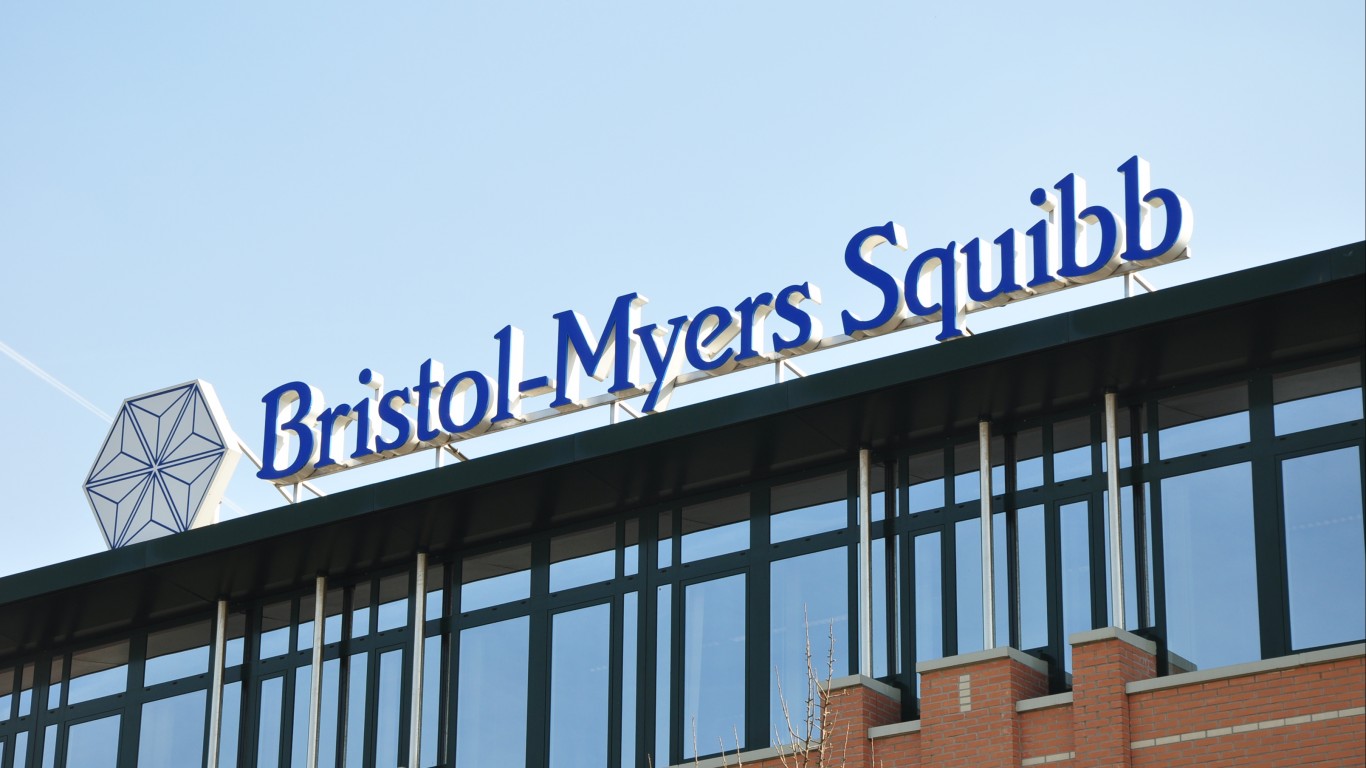
When Bristol-Myers Squibb Co. (NYSE: BMY | BMY Price Prediction) reported third-quarter 2020 results before markets opened Thursday, the pharmaceutical firm posted adjusted diluted earnings per share (EPS) of $1.63 on revenue of $10.5 billion. In the same period a year ago, the company reported EPS of $1.17 EPS and $69.0 billion in revenue. Third-quarter results also compare to consensus estimates for EPS of $1.49 on revenue of $10.3 billion.
Pro forma revenue rose 6% year over year, from $9.96 billion to $10.54 billion, when the $74 billion acquisition of Celgene and the sale of its Otezla drug (for $13.1 billion to Amgen) are included. The Celgene acquisition closed in November 2019 and was the primary driver of the year-over-year revenue increase.
Net income rose from $1.4 billion in the year-ago quarter to $1.9 billion, including costs and expenses resulting from purchase price accounting, contingent value rights fair value adjustments, equity investment gains and other acquisition and integration expenses.
[nativounit]
The company raised fiscal 2020 adjusted EPS guidance from a prior range of $6.10 to $6.25 to a new range of $6.25 to $6.35 and reaffirmed fiscal 2021 EPS guidance of $7.15 to $7.45. Fiscal year 2021 guidance includes dilution related to the $13.1 billion acquisition of MyoKardia. On a GAAP basis, earnings per share are expected in a range of $0.47 to $0.57. Analysts had projected 2020 earnings at $6.27 per share and 2021 earnings of $7.39 per share.
Revenue guidance for the year remained at $41.5 billion to $42.0 billion, compared to a consensus estimate of $42.0 billion. Gross margin is forecast at about 74% for 2020 and 80% for 2021.
The company’s multiple myeloma drug Revlimid (part of the Celgene acquisition) posted sales of $3.0 billion in the quarter, a boost of 10% year over year, and Bristol-Myers’s atrial fibrillation treatment, Eliquis, posted a sales increase of 9% to $2.1 billion.
On Tuesday, Bristol-Myers announced that the first Phase 3 trial of deucravacitinib, an inhibitor expected to treat several immune-related diseases including psoriasis, psoriatic arthritis, lupus and inflammatory bowel disease. CEO Giovanni Caforio commented that “promising results” from the trial, “strongly position the company to deliver our mission and help more patients.”
Cash and other liquid assets totaled $21.65 billion at the end of the quarter, up by about $5.5 billion in the first nine months of the year. Net debt of $23.3 billion is more than $7 billion lower than it was in December 2019.
Investors must be disappointed at the impact the expensive Celgene deal has had on revenue and profits. Not only that, the company’s own guidance for the current year and for next year don’t provide a boost to shareholder enthusiasm. Between 2019 and 2020, Bristol-Myers raised its quarterly dividend by four cents per share (almost 10%) to $0.45. A larger increase this time around may be necessary to raise investors’ spirits again. But can the company afford it?
Bristol-Myers Squibb stock traded down nearly 1.2% on Thursday to $64.66, in a 52-week range of $45.76 to $68.34. The consensus 12-month price target on the stock is $73.19, and the dividend yield is 3.03%.
[recirclink id=804615][wallst_email_signup]









 Top Gaining Stocks
 Top Losing Stocks