


More than five decades have passed since the Fair Housing Act of 1968 outlawed housing discrimination on the basis of race, sex, national origin and religion. Yet, segregation persists in some of America’s largest cities, with white Americans living in majority-white neighborhoods and Black Americans in majority-Black neighborhoods.
The patterns of segregation in many major metropolitan areas can be traced back to laws and legal racial housing policies of the early 20th century used to exclude Black residents from certain neighborhoods. Even after the U.S. Supreme Court began to ban explicitly racist zoning policies in the mid-20th century, governments used the federally-backed Home Owners’ Loan Corporation (HOLC) to continue segregation policies.
The HOLC created “residential security” maps according to investment risk, often redlining Black neighborhoods as “hazardous” areas. According to advocacy group National Community Reinvestment Coalition, 74% of the neighborhoods that the HOLC designated as high risk or “hazardous” are low-to-moderate income neighborhoods today and 64% are minority neighborhoods.
Many of the most segregated cities experienced a period of economic decline starting in the 1960s, as wealthy white families moved from the inner city to outlying suburbs, leaving behind families without the resources to move with a shrunken tax base and declining infrastructure.
[nativounit]
To identify the most segregated city in America, 24/7 Wall St. calculated the percentage of Black residents who live in predominantly Black census tracts, where at least 50% of the population is Black.
Nationwide, 19.5% of Black Americans live in majority-Black neighborhoods. Segregation often limits access to education and employment opportunities for residents of minority communities and contributes to racial disparities in urban areas.
One important lasting effect of the history of racial housing segregation is the resultant funding disparities between schools in primarily Black neighborhoods and those in primarily white neighborhoods. While schools today are integrated, housing segregation and district gerrymandering means that primarily white school districts in some parts of the country stayed mostly white and consequently received better funding.
Adult residents of majority-Black neighborhoods in highly segregated cities are less likely to have a college education than residents of predominantly white neighborhoods, and they are twice as likely to be unemployed or to live in poverty.
Pine Bluff, Arkansas
> Black pop. in Black neighborhoods: 80.8% (35,778)
> Black population: 48.7% (44,281)
> Black poverty rate: 27.7% (10,683)
> White poverty rate: 15.1% (5,738)
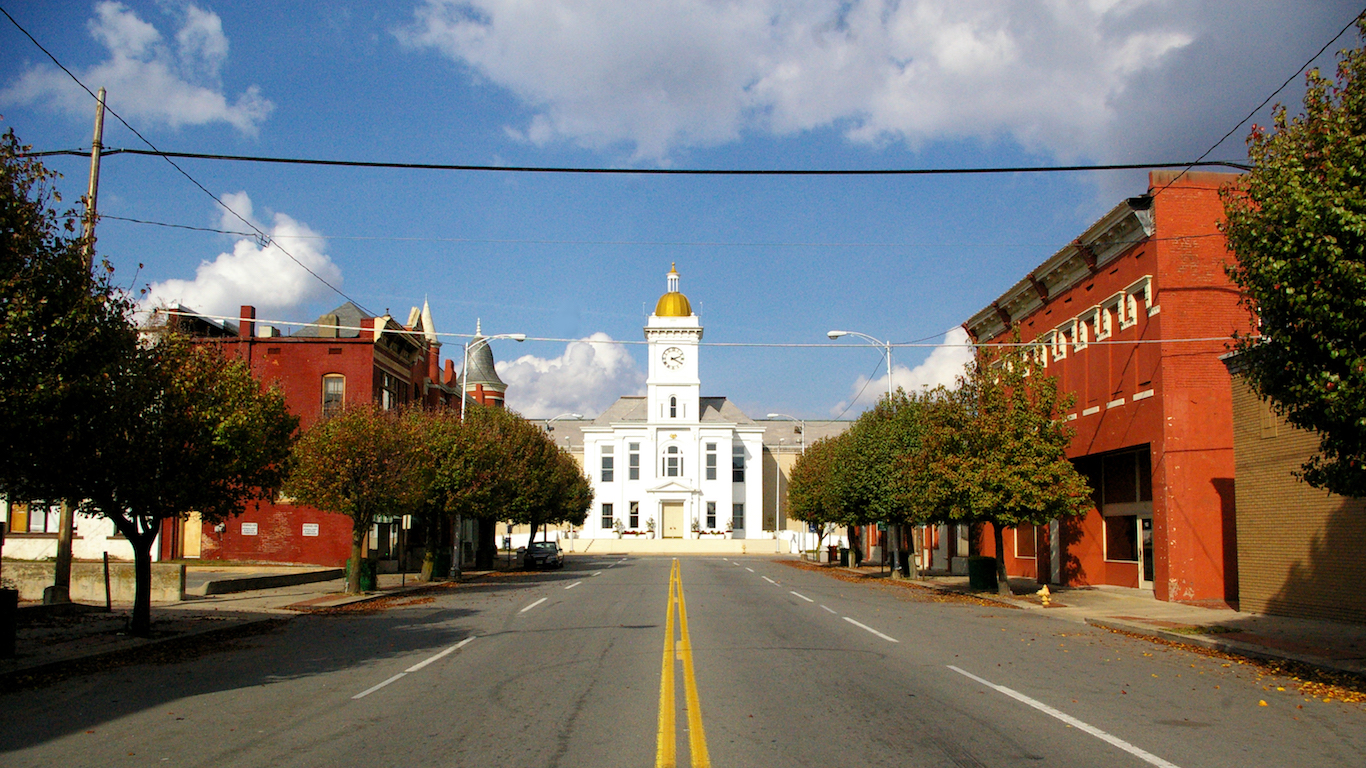
Pine Bluff, Arkansas, was the site of a student sit-in movement in 1963. Today, Pine Bluff is the most segregated metro area in the country. An estimated 80.8% of the Black population of Pine Bluff live in predominantly Black neighborhoods, more than four times the 19.5% national figure.
Although segregation often exacerbates racial inequality, Pine Bluff is one of America’s poorest cities and has relatively small achievement gaps between white and Black neighborhoods. For example, Pine Bluff is one of only two metropolitan areas in which a larger share of residents have a bachelor’s degree in Black neighborhoods than white ones.
To determine America’s fastest shrinking cities, 24/7 Wall St. reviewed data from the U.S. Census Bureau’s Population and Housing Estimates Program. Metropolitan statistical areas were ranked based on the percentage change in total population from July 1, 2010, to July 1, 2019. Data on population change due to natural change (the net difference between births and deaths) and to net migration also came from the Census Bureau. Supplemental data on median household income came from the Census Bureau’s 2019 American Community Survey. Data on annual unemployment rate and employment changes came from the Bureau of Labor Statistics. These data predate the COVID-19 pandemic.
Click here to see the most segregated cities in America.
[wallst_email_signup]









 Top Gaining Stocks
 Top Losing Stocks