
America’s Cheapest Housing Market

Photo of Douglas A. McIntyre
By Douglas A. McIntyre Published
This post may contain links from our sponsors and affiliates, and Flywheel Publishing may receive compensation for actions taken through them.
America’s Cheapest Housing Market

© peeterv / iStock via Getty Images

Home prices surged relentlessly during the first two years of the COVID-19 pandemic. Mortgage rates for 30-year fixed loans hovered around a low 3%. People moved, mostly out of big coastal cities, as “work from home” allowed them to relocate to metros that were more affordable and often had a perceived better quality of life. Bidding wars erupted on some homes, which increased prices on these more. Recently, however, the home price surge has slowed but not disappeared. America’s cheapest housing markets are clear.

Mortgage rates rose as high as 7% and should have killed the housing market. However, something else happened. Inventory dried up. One reason some real estate agents think this happened is because people with 3% mortgages did not want to sell their homes. The deals they had on their mortgage payments could not be replaced.

For a historical comparison, over the past two decades, home prices in some metros have tripled. Most of this has happened in the largest cities in Florida and California as the populations in those states jumped.

The Priciest and Cheapest Housing Markets
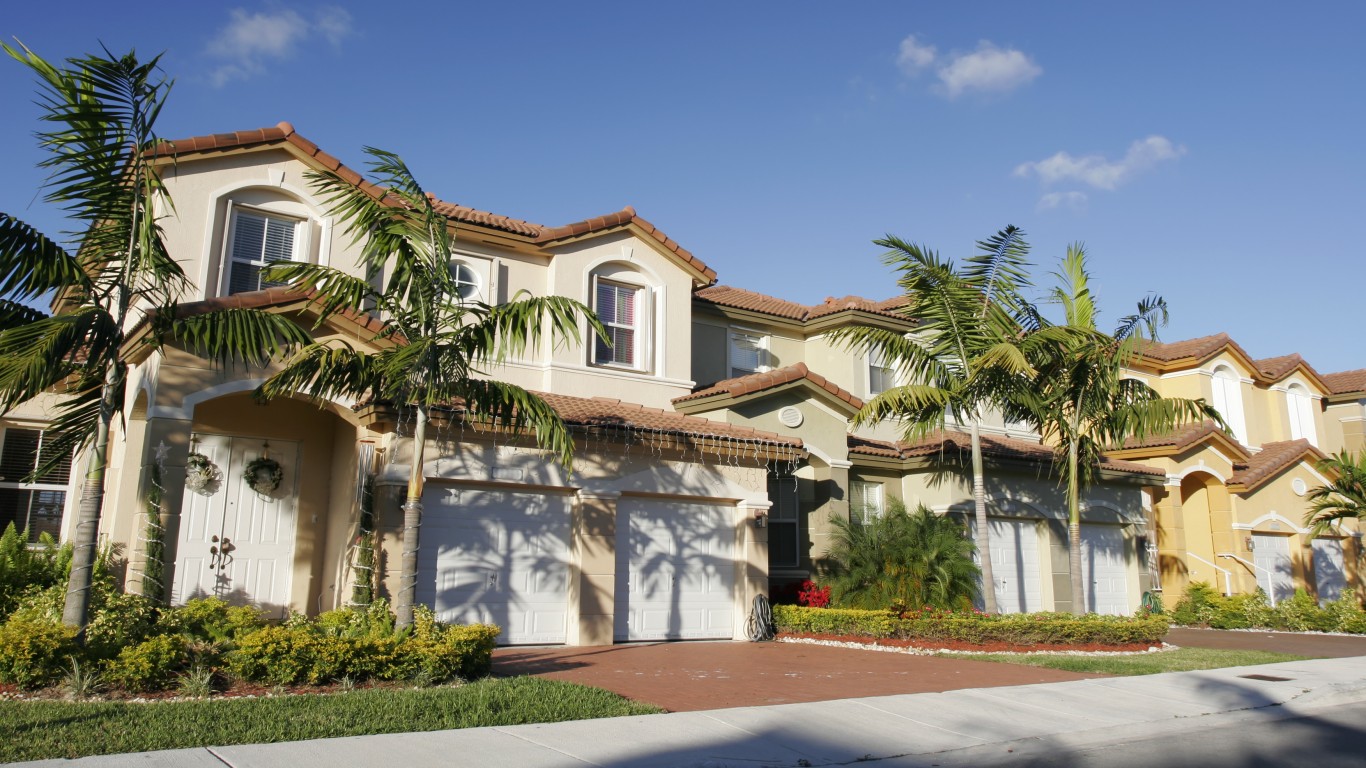
Miami housing
ntzolov / E+ via Getty Images
According to the new S&P CoreLogic Case Shiller Indices, which cover national home prices, they rose 4.8% nationwide in October. It was a particularly strong month. “U.S. home prices accelerated at their fastest annual rate of the year in October,” Brian D. Luke, Head of Commodities, Real & Digital assets at S&P DJI, remarked.

The Case-Shiller measurement of historical home prices tracks back to January 2000. That month, its researchers indexed the 20 largest home markets at 100. This allowed these researchers to track market prices and compare them month after month, market by market, as time passed.

The national index reached 312.95 in October, which means home prices across the country have more than tripled since the start of the century. The city with the highest indexed score in October is Miami, at 427.22. It is followed closely by Los Angeles at 419.90 and San Diego at 418.82.

The city with the lowest score is Detroit at 182.55. Cleveland is a close second at 183.69. The cities share something in common. Both were large industrial cities with peak populations in the 1950s, 1960s and 1970s. As American manufacturing dropped and often moved overseas, these cities lost more than half their mid-20th century populations. (Seven major American cities have lost half their populations.)

If home prices work on supply and demand, it is easy to see why Detroit’s housing market has done so poorly. Its population decline was too much of a headwind for a good housing market.


Photo of Douglas A. McIntyre
About the Author Douglas A. McIntyre →

Douglas A. McIntyre is the co-founder, chief executive officer and editor in chief of 24/7 Wall St. and 24/7 Tempo. He has held these jobs since 2006.

McIntyre has written thousands of articles for 24/7 Wall St. He is an expert on corporate finance, the automotive industry, media companies and international finance. He has edited articles on national demographics, sports, personal income and travel.

His work has been quoted or mentioned in The New York Times, The Wall Street Journal, Los Angeles Times, The Washington Post, NBC News, Time, The New Yorker, HuffPost USA Today, Business Insider, Yahoo, AOL, MarketWatch, The Atlantic, Bloomberg, New York Post, Chicago Tribune, Forbes, The Guardian and many other major publications. McIntyre has been a guest on CNBC, the BBC and television and radio stations across the country.

A magna cum laude graduate of Harvard College, McIntyre also was president of The Harvard Advocate. Founded in 1866, the Advocate is the oldest college publication in the United States.

TheStreet.com, Comps.com and Edgar Online are some of the public companies for which McIntyre served on the board of directors. He was a Vicinity Corporation board member when the company was sold to Microsoft in 2002. He served on the audit committees of some of these companies.

McIntyre has been the CEO of FutureSource, a provider of trading terminals and news to commodities and futures traders. He was president of Switchboard, the online phone directory company. He served as chairman and CEO of On2 Technologies, the video compression company that provided video compression software for Adobe’s Flash. Google bought On2 in 2009.

Continue Reading

Top Gaining Stocks

CBOE Vol: 1,568,143
PSKY Vol: 12,285,993
STX Vol: 7,378,346
ORCL Vol: 26,317,675
DDOG Vol: 6,247,779

Top Losing Stocks

LKQ
LKQ Vol: 4,367,433
CLX Vol: 13,260,523
SYK Vol: 4,519,455
MHK Vol: 1,859,865
AMGN Vol: 3,818,618