


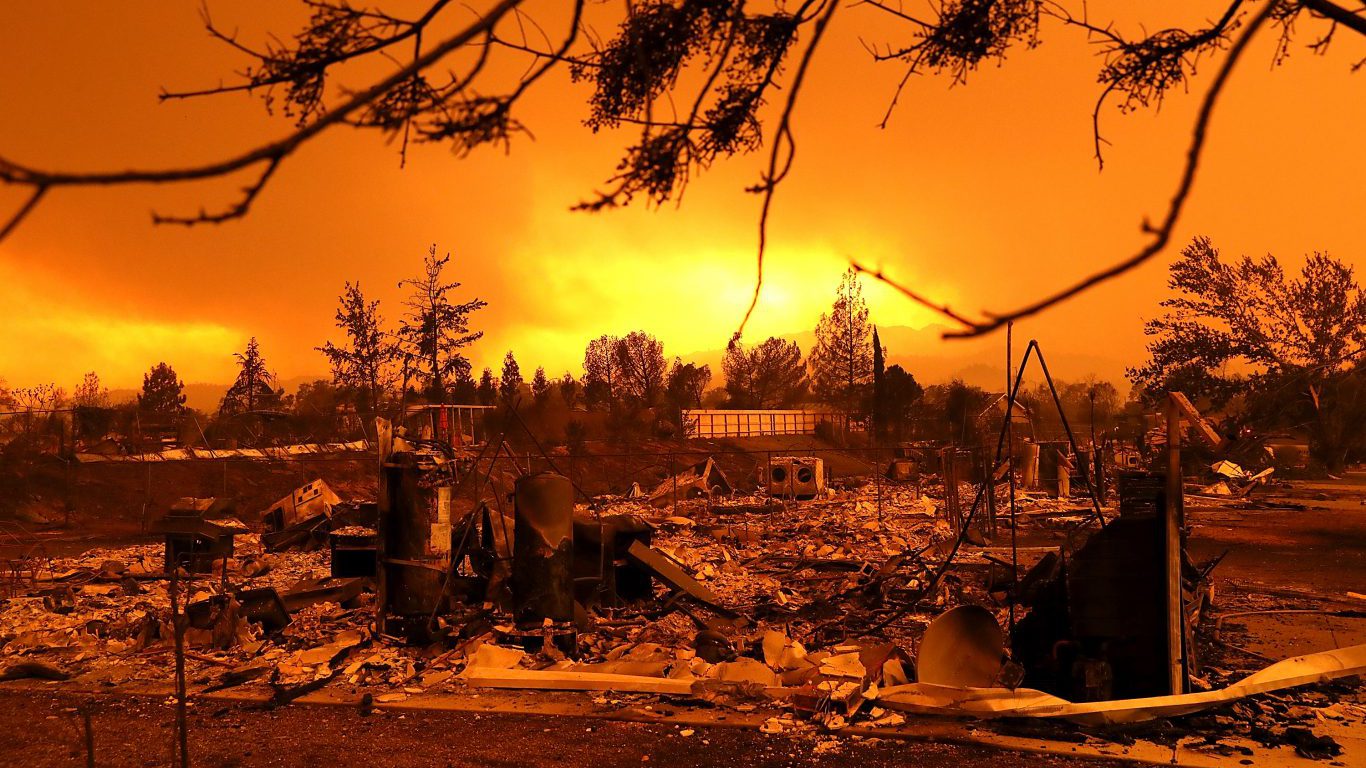
When a regulated utility’s share price falls by more than 60% in just five trading days, it’s a tell-tale sign that investors are expecting the firm to file for bankruptcy sometime in the future, and probably sooner rather than later. PG&E Corp. (NYSE: PCG) was in investors’ sights as fears mounted that the deadly Camp Fire in northern California would lead to the utility’s downfall.
After markets closed Thursday, Bank of America analysts arranged a conference call that included Michael Picker, the president of the California Public Utilities Commission (CPUC) and investors. According to Bloomberg News, during the call Picker told investors “the agency doesn’t want PG&E to go into bankruptcy.” Bloomberg later confirmed with Picker that he had made that comment.
Shares of PG&E immediately turned around and in Friday’s premarket session traded up over 40%, more than making up for Thursday’s 31% loss.
The electricity and natural gas provider also took a hit Thursday when Moody’s downgraded the company’s debt from Baa3 to Baa2, just two notches above junk status. Pacific Gas & Electric, PG&E’s principal utility subsidiary, saw its debt rating fall from Baa2 to Baa1, a mere one notch from junk. Moody’s noted further that “all of the ratings” of both PG&E and Pacific Gas & Electric are being reviewed for a downgrade with the comment, “The review could result in a multi-notch downgrade of both PCG and PG&E’s ratings.”
[nativounit]
The main issue is PG&E’s inability to issue state-authorized bonds in the event that the company is judged to liable for damages from the Camp Fire. Last year the state legislature agreed to allow the company to issue state-backed bonds to pay off 2017 claims related to wildfire damage that may have totaled as much as $17.3 billion. The legislature also authorized PG&E to issue similar bonds in 2019, but, for some reason, damages incurred in 2018 were not covered by the legislation.
In a Tuesday filing with the U.S. Securities and Exchange Commission, PG&E acknowledged that on Thursday, November 8, it experienced an outage on a 115-kV transmission line “in the area of the Camp Fire.” The company also said:
While the cause of the Camp Fire is still under investigation, if the Utility’s equipment is determined to be the cause, the Utility could be subject to significant liability in excess of insurance coverage that would be expected to have a material impact on PG&E Corporation’s and the Utility’s financial condition, results of operations, liquidity, and cash flows.
This doesn’t get to the heart of the issues with PG&E. In an interview Thursday with The Wall Street Journal, the CPUC’s Picker noted that the company’s actions regarding compensation to a former CEO following a 2010 gas explosion that killed eight people “left [the commission] wondering is anyone ever accountable for failing to provide safety at PG&E. … I’m very concerned that we don’t have accountability in place.”
Picker said he will open an investigation into company’s governance, structure and operations “to determine the best path forward for Northern Californians to receive safe electrical and gas service in the future.” That path may include breaking up the company, Picker noted.
PG&E’s shares closed at $17.74 on Thursday and traded up more than 40% in Friday’s premarket at $25.00. The stock’s 52-week range is $17.26 to $58.38, and the low was posted Thursday. The stock price last traded at around $25 late Wednesday afternoon. On November 8 the shares closed at $47.80, the last time the stock closed above $40 a share.
[recirclink id=505807]
[wallst_email_signup]







 Top Gaining Stocks
 Top Losing Stocks