



Expanding U.S. trade and investment in infrastructure, clean energy and energy efficiency could rebalance the U.S. trade deficit with the rest of the world and create at least 6.9 million new, good-paying jobs, according to a new report out Tuesday from the Economic Policy Institute (EPI).
The report’s authors outline a two-pronged strategy to rebuild the domestic economy: reducing the valuation of the U.S. dollar and rebuilding the “competitiveness of U.S. manufacturing industries and, second, investing $2 trillion over four years in improvements to infrastructure, clean energy, and energy efficiency.
Of the 6.9 million jobs created, about 36% (2.5 million) would be manufacturing jobs and about 471,000 (6.8%) would be construction jobs. Another 2.1 million jobs (30% of the 6.9 million total) would create high-wage jobs for Americans who don’t have a college degree. These include jobs in areas such as nonelectrical machinery, fabricated metal products, transportation equipment, electrical equipment, primary metals, motor vehicles and parts, aerospace, and steel.
In addition to creating these manufacturing-related jobs, the EPI report projects job gains in transportation, agriculture/forestry/fisheries, administrative and support services, professional/scientific/support services, wholesale trade, and mining.
[nativounit]
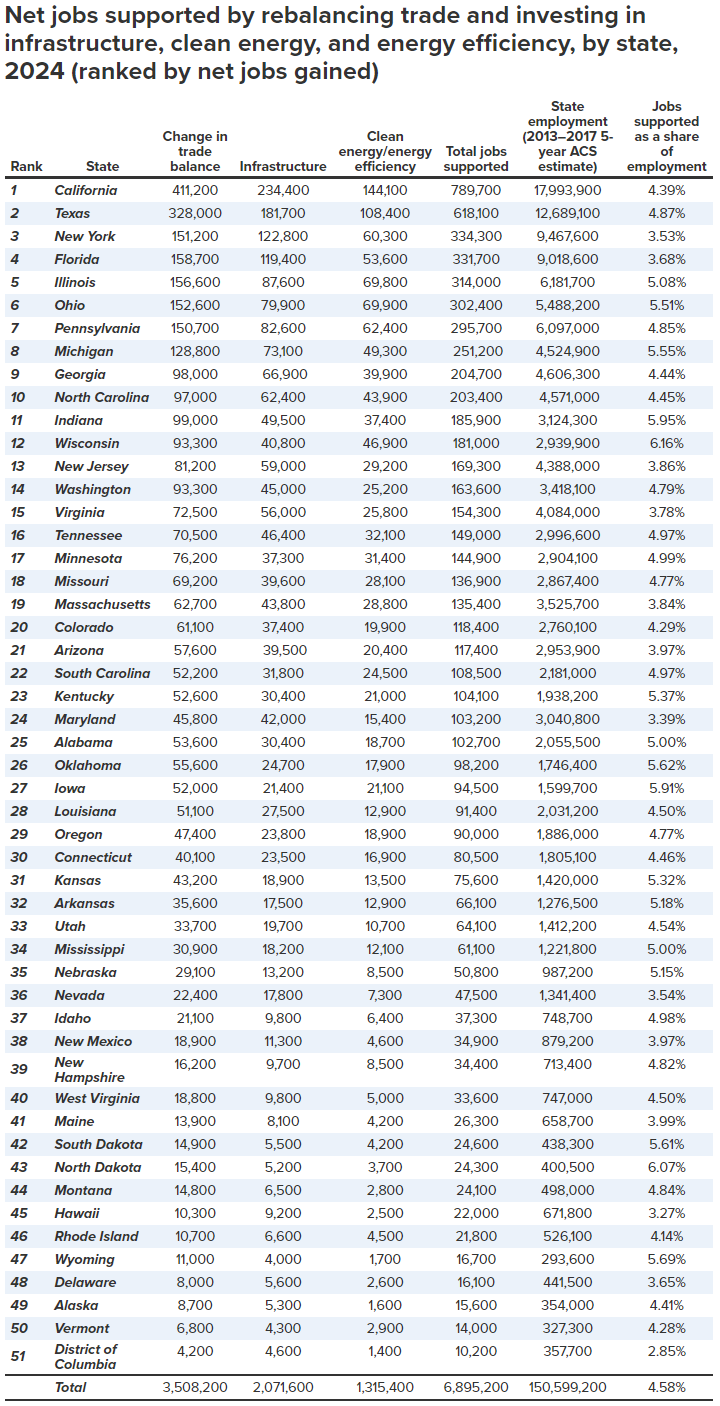
Every state and the District of Columbia would benefit from the investment stimulus, with Wisconsin, North Dakota, Indiana, Iowa and Wyoming getting the largest percentage job increases.
The $2 trillion, four-year investment matches a similar investment proposed by Democratic presidential nominee Joe Biden, who, in late July, released an updated plan for infrastructure and clean energy projects that committed to spending $2 trillion over four years.
At least one part of the EPI report is moving in the authors’ desired direction. The U.S. dollar’s role as the dominant global reserve currency has been weakening as dollar-denominated sovereign debt has lost some of its appeal as the dollar’s share of global foreign exchange reserves has declined from around 65% in the third quarter of 2016 to about 61% in the second quarter of this year. The overall effect is to lower the price of U.S. goods and services imported into other countries.
The $2 trillion investment the authors suggest is divided into four equal tranches of $500 billion and that amount is divided equally on infrastructure and renewable energy programs. Surface transportation (e.g., roads, bridges) snags nearly $106 billion of the $500 billion allocated for annual infrastructure improvements while wind and solar projects would receive $84.4 billion each.
Schools and broadband internet access would receive annual funding of $36.5 billion and $33.7 billion, respectively.
The full EPI report is available on the organization’s website and includes details on methodology and analytical tools. The following table from the report shows the effect on job creation of rebalancing U.S. trade and investing in clean energy/energy efficiency in each state and the District of Columbia.
[recirclink id=802167][wallst_email_signup]










 Top Gaining Stocks
 Top Losing Stocks