


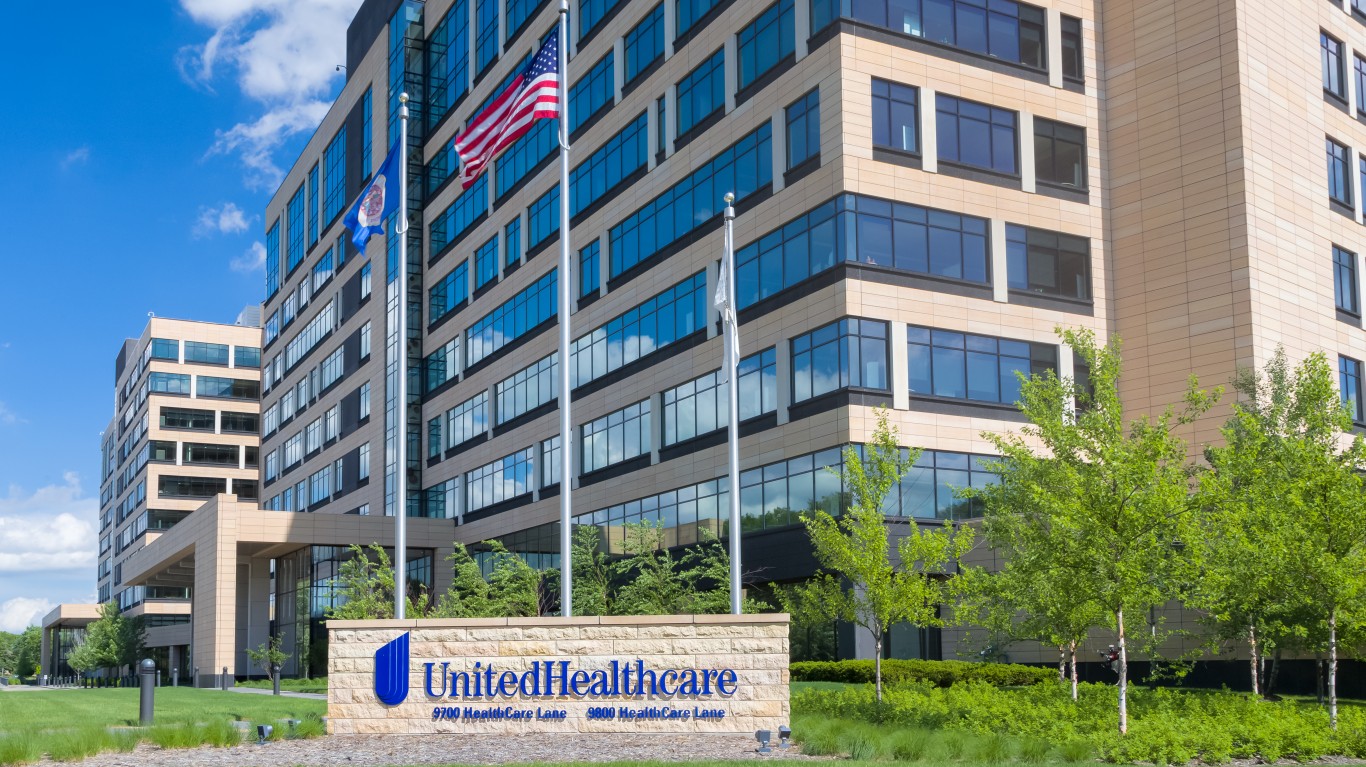
UnitedHealth (UNH) is an easy company to hate, after all they are the largest public health insurer. Their ex-CEO William McGuire took a ridiculous $1.6 Billion in exercisable options at the end of 2005, and that was perhaps the largest case of corporate greed and alleged options backdating and larceny from a non-founder that one could imagine. The company can’t even signal an exact EPS number because of the ongoing options review. Yes I know this all sounds negative, but the internal metrics are improving in the company. Since we are supposed to only be here for Wall Street views to pass down to main Street, the focus has to be on the financial aspects.
The revenues and net earnings were generally in-line with estimates, but the underlying aspects of how insurers look at themselves are looking better. The company posted earnings of $1.2 Billion ($1.18 Billion was a quasi-consensus). Based on a 1.4 billion share count you would derive roughly $0.86 EPS, just above an $0.85 consensus. Revenues were $18.1 Billion, and estimates were $18.2 Billion.
The company posted operating margins of 11.0% in the quarter, higher then the total margin average for 2006 of 9.7%. Outside of merger activities, its revenues were for the full year showed a 21% gain. That high revenue growth rate won’t likely be the case in 2007, but the street already assumes this and current estimates are looking for just under 10% revenue growth in 2007. The options issue is carrying over into 2007 as far as adding on to operating costs; and while this isn’t good it actually should be somewhat factored in by now for such a large comapny. They will have to pay, but the street is learning to deal with this ongoing options issue from company to company.
The key ratio is usually called the medical loss ratio (called medical care ratio by UNH) and theirs was 79.9% for the quarter, down 120 basis points from the 81.1% in Q3. The full year was higher at 81.2%, but part of that is from the PacifiCare acquisition and conversion to Medicare D. Medical costs were up 13% year over year on a raw basis and days payable were 53 days.
It reaffirmed the net income range of $4.7 to $4.75 Billion for the year and $980 million to $1 Billion in the first quarter. The company has not provided an estimated time frame for a resolution to its option issues. I can see both sides of the coin here for the reaction today, but as far as how insurance companies measure their internal goals the company is looking better on a retroactive basis. That means the execution is there.
UNH shares are down 2.5% at $54.23 after the mid-point of the day, and that is still in the middle of the $41.44 to $62.10 trading range over the last 52-weeks. UNH has grown so large from acquisitions that it may face trouble making acquisitions of companies now on a state to state basis since insurers are regulated in each state they operate in. Wall Street is taking "a glass half empty" stance, but the insurers would be looking at today with a "glass half full" stance.
Jon C. Ogg
January 18, 2007







 Top Gaining Stocks
 Top Losing Stocks