Fewer Americans Can Afford the Basics

Photo of Douglas A. McIntyre
By Douglas A. McIntyre Updated Published
This post may contain links from our sponsors and affiliates, and Flywheel Publishing may receive compensation for actions taken through them.

Among the large numbers of issues that are said to prove that the recession never ended is whether Americans can afford the “basics” that have been part of what the middle class has been able to expect for decades. Fewer and fewer Americans can. This means that a lack of demand for some services, like medical treatment, will undermine the ability of some services to exist at all — at least at current levels. Medicine, like any other economically based system, needs some base amount of demand to provide the financial scale that allows R&D and a delivery infrastructure to exist.

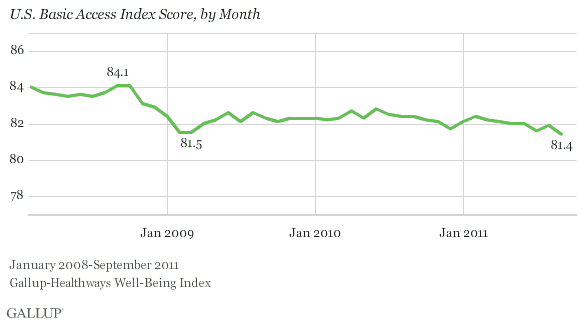
A new Gallup poll reports that “Fewer Americans had access to basic life necessities in September. The nation’s Basic Access Index score fell to 81.4 last month — on par with the 81.5 measured in February and March 2009 amid the recession.” This is a testament to the high unemployment levels of the past four years. The fact that the economy does not bleed jobs at the rate of 500,000 a month as it was in early 2009 does not help those who have lost jobs and not regained them. Some would say the joblessness trouble in the U.S. is not getting worse. That only means that the recession, which is still a horrible fact of the lives of most Americans, had not improved at all.

The two largest drops in “basics” are the number of people with a personal doctor, down 4.2% to 78.3% in September compared to September 2008. The number of Americans with health insurance coverage has dropped by 3.6% to 83.3% over the same period. At some point, the ability of hospitals and doctors to operate in current numbers falters. The same is probably true with expensive medical  R&D. The government will only fund so much of it, particularly in an age of austerity. Private donations low because even the well-to-do have cut back charity.

The current recession does not feel like one. It is worse than that

Methodology: Results are based on telephone interviews conducted as part of the Gallup-Healthways Well-Being Index survey Sept. 1 – 30, 2011, with a random sample of 29,313 adults, aged 18 and older, living in all 50 U.S. states and the District of Columbia, selected using random-digit-dial sampling.

Douglas A. McIntyre

Photo of Douglas A. McIntyre
About the Author Douglas A. McIntyre →

Douglas A. McIntyre is the co-founder, chief executive officer and editor in chief of 24/7 Wall St. and 24/7 Tempo. He has held these jobs since 2006.

McIntyre has written thousands of articles for 24/7 Wall St. He is an expert on corporate finance, the automotive industry, media companies and international finance. He has edited articles on national demographics, sports, personal income and travel.

His work has been quoted or mentioned in The New York Times, The Wall Street Journal, Los Angeles Times, The Washington Post, NBC News, Time, The New Yorker, HuffPost USA Today, Business Insider, Yahoo, AOL, MarketWatch, The Atlantic, Bloomberg, New York Post, Chicago Tribune, Forbes, The Guardian and many other major publications. McIntyre has been a guest on CNBC, the BBC and television and radio stations across the country.

A magna cum laude graduate of Harvard College, McIntyre also was president of The Harvard Advocate. Founded in 1866, the Advocate is the oldest college publication in the United States.

TheStreet.com, Comps.com and Edgar Online are some of the public companies for which McIntyre served on the board of directors. He was a Vicinity Corporation board member when the company was sold to Microsoft in 2002. He served on the audit committees of some of these companies.

McIntyre has been the CEO of FutureSource, a provider of trading terminals and news to commodities and futures traders. He was president of Switchboard, the online phone directory company. He served as chairman and CEO of On2 Technologies, the video compression company that provided video compression software for Adobe’s Flash. Google bought On2 in 2009.

Continue Reading

Top Gaining Stocks

CBOE Vol: 1,568,143
PSKY Vol: 12,285,993
STX Vol: 7,378,346
ORCL Vol: 26,317,675
DDOG Vol: 6,247,779

Top Losing Stocks

LKQ
LKQ Vol: 4,367,433
CLX Vol: 13,260,523
SYK Vol: 4,519,455
MHK Vol: 1,859,865
AMGN Vol: 3,818,618