Americans Donate Insanely Low Sum to Cut National Debt

Photo of Douglas A. McIntyre
By Douglas A. McIntyre Published
This post may contain links from our sponsors and affiliates, and Flywheel Publishing may receive compensation for actions taken through them.

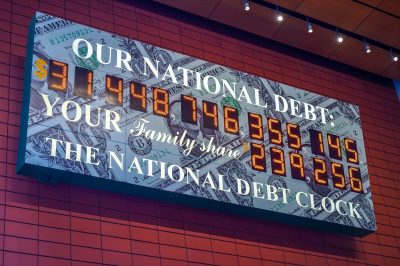
The Bureau of the Public Debt reported that Americans made total contributions of $7.7 million in 2012 to the U.S. government to reduce debt held by the public. The same organization put the amount of public debt at $11.4 trillion. Intergovenment debt holdings are $4.8 trillion, which brings the entire total to $16.2 trillion. For some inexplicable reason, the Bureau of the Public Debt is impressed that contributions rose from $3.3 million in 2011, which shows how crazy the Treasury can be.

The Treasury would be better off to hide the data, or not report it at all, if possible. The fact that donations are in the low millions and that debt is well into the trillions demonstrates how little sacrifice Americans are willing to make by any direct contribution to a problem often described as the worst the United States has.

Although there is no direct correlation between what taxes people are willing to accept and contributions to the Bureau of the Public Debt, there is one stretch in logic worth taking. Americans mostly have protested a rise in taxes that would be created by the elimination of the Bush tax cuts. If Americans ever did have a period during which sacrifice of the national benefit existed, it is long gone.

One of the reasons Americans are not willing to be generous in their own personal bailouts of the nation is that their real wages have not risen in a decade. Is that partially the fault of the government? Perhaps, but private enterprises’ drive to productivity has contributed as well, as have state and local cuts in services that are essential to earnings power — education the first among them.

Another reason Americans resist participation in debt reduction and resist high tax rates is their view that large companies have robbed the government of revenue though tricky tax dodges, though completely legal ones, and the movement of money and profits offshore. Multinationals have cut exposure. Why should individuals be left to pick up the slack?

Furthermore, the generosity of Americans probably has been dented by their views that the federal government has become less generous. Conservatives may not see the situation that way, but many others do. Many of the government programs cut in recent years have been those that give direct assistance to Americans, often those who are in difficult positions, particularly financially. A government that does not invest in its own citizens is not worth an investment by its citizens in that government.

The Bureau of the Public Debt reported a drop in the bucket at the same time that the bucket is getting larger, and Americas have opted out of directly changing the situation.

Douglas A. McIntyre

Photo of Douglas A. McIntyre
About the Author Douglas A. McIntyre →

Douglas A. McIntyre is the co-founder, chief executive officer and editor in chief of 24/7 Wall St. and 24/7 Tempo. He has held these jobs since 2006.

McIntyre has written thousands of articles for 24/7 Wall St. He is an expert on corporate finance, the automotive industry, media companies and international finance. He has edited articles on national demographics, sports, personal income and travel.

His work has been quoted or mentioned in The New York Times, The Wall Street Journal, Los Angeles Times, The Washington Post, NBC News, Time, The New Yorker, HuffPost USA Today, Business Insider, Yahoo, AOL, MarketWatch, The Atlantic, Bloomberg, New York Post, Chicago Tribune, Forbes, The Guardian and many other major publications. McIntyre has been a guest on CNBC, the BBC and television and radio stations across the country.

A magna cum laude graduate of Harvard College, McIntyre also was president of The Harvard Advocate. Founded in 1866, the Advocate is the oldest college publication in the United States.

TheStreet.com, Comps.com and Edgar Online are some of the public companies for which McIntyre served on the board of directors. He was a Vicinity Corporation board member when the company was sold to Microsoft in 2002. He served on the audit committees of some of these companies.

McIntyre has been the CEO of FutureSource, a provider of trading terminals and news to commodities and futures traders. He was president of Switchboard, the online phone directory company. He served as chairman and CEO of On2 Technologies, the video compression company that provided video compression software for Adobe’s Flash. Google bought On2 in 2009.

Featured Reads

Our top personal finance-related articles today. Your wallet will thank you later.

Continue Reading

Top Gaining Stocks

CBOE Vol: 1,568,143
PSKY Vol: 12,285,993
STX Vol: 7,378,346
ORCL Vol: 26,317,675
DDOG Vol: 6,247,779

Top Losing Stocks

LKQ
LKQ Vol: 4,367,433
CLX Vol: 13,260,523
SYK Vol: 4,519,455
MHK Vol: 1,859,865
AMGN Vol: 3,818,618