


The First Trust Indxx Aerospace & Defense ETF (NASDAQ:MISL) exists to solve a concentration problem: anyone betting on the defense and aerospace cycle through a single name takes on F-35 program risk, 737 certification risk, or one CEO’s execution risk. MISL spreads that bet across the prime contractors and engine makers driving the cycle. First Trust has not published current expense ratio, AUM, or holdings data through standard feeds, so this analysis leans on the index’s known constituents as proxies.
The fund closed at $44.21 on April 30, up 3% year to date and 40% over the past year. Recent action has cooled, with a 1% pullback over the past month, mirroring the divergence inside the index: Lockheed Martin fell 14% in April after its Q1 miss, while Boeing rallied 15% and General Dynamics climbed 8% on the week.
The Macro Signal: Defense Appropriations and Munitions Demand
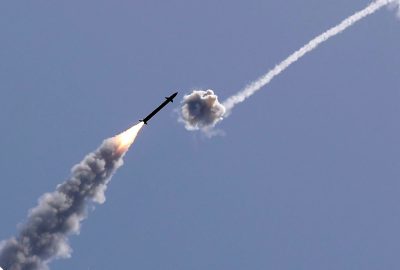
The single biggest macro driver for MISL over the next twelve months is the U.S. defense appropriations cycle and the geopolitical demand pulling munitions and missile-defense orders forward. The evidence is already in the Q1 prints. Lockheed signed multi-year framework agreements with the U.S. government for Patriot, THAAD, and PrSM that the company expects to lift production rates 3 to 4 times current levels. RTX’s Raytheon segment posted 25% adjusted operating profit growth on Patriot and naval munitions demand, and Boeing’s Defense, Space & Security revenue grew 21% with operating earnings up 50%.
What to watch: the FY27 defense appropriations bill and any continuing resolution that delays new program starts. A clean appropriations passage with elevated munitions line items extends the framework-agreement tailwind through 2027. A drawn-out CR caps procurement at prior-year levels and stalls the production ramp the index is pricing in. Bookmark the House and Senate Armed Services Committee markup releases and the DoD budget rollout each spring. The 2022 Ukraine surge offers a reasonable analog: munitions primes outperformed the broader industrials complex for roughly eighteen months as supplemental funding cleared.
The Micro Signal: Commercial vs Pure-Defense Mix
MISL blends pure primes (Lockheed, General Dynamics) with commercial-aerospace beneficiaries (GE Aerospace, Boeing, RTX’s Pratt & Whitney and Collins units). That mix is the most important micro factor because the two sub-sectors are now moving on different fundamentals.
The commercial side is firing. GE Aerospace booked $23.0 billion in orders, up 87%, with a $170 billion commercial services backlog, while RTX raised FY26 guidance to $6.70 to $6.90 adjusted EPS on a $271 billion backlog. The pure-defense side is mixed: Lockheed took $125 million in unfavorable F-16 adjustments and saw operating cash flow drop to $220 million from $1.41 billion, while General Dynamics swung to $2.155 billion in operating cash flow on a 2-to-1 book-to-bill.
What to monitor: the First Trust fact sheet and holdings file for MISL after each Indxx Aerospace & Defense Index reconstitution. If the index trims commercial weights toward pure-defense names, the fund’s correlation to oil prices (about $100 per barrel, in the top 4% of the trailing year) and global departures growth shrinks, and it becomes more sensitive to appropriations risk. The mechanic matters more than the headline yield because two funds with similar names can deliver very different drawdown profiles depending on which side of the cycle dominates the weights.
The Bottom Line
If FY27 defense appropriations clear without a long continuing resolution, MISL’s munitions-heavy constituents should keep compounding the framework-agreement tailwind into 2027; watch the next Indxx index reconstitution for any tilt away from GE Aerospace and Boeing, since a heavier pure-defense weight would reduce the fund’s commercial-cycle exposure just as GE’s $170 billion services backlog is converting to cash.











 Top Gaining Stocks
 Top Losing Stocks