


24/7 Wall St. Key Points:
Watch the Video
Transcript:
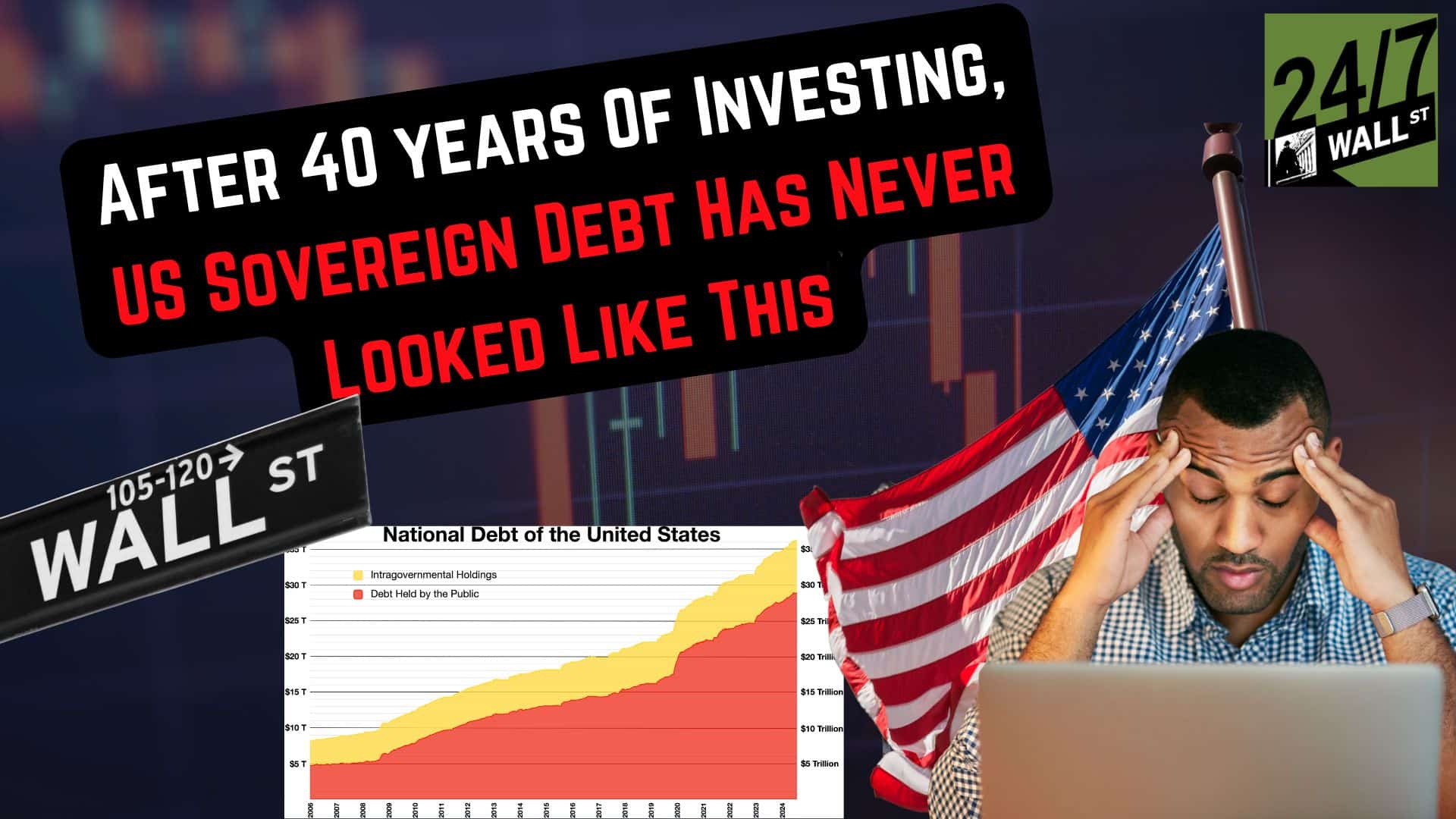
[00:00:04] Doug McIntyre: I saw something I thought I would never say, and that is, is that people are worried about whether or not US sovereign debt is actually have any risk to it at all. And about two weeks ago when the market started to fall apart, you actually saw trading in government securities that was based on risk.
[00:00:30] Doug McIntyre: and what happened is that yields started to go up and as everybody knows, if the yields go up, eventually that spills over into car loans, mortgage, just everything spills over into everything. I mean, what do you think? You really, have people who think that there is some risk in owning US government debt.
[00:00:56] Lee Jackson: Well, the thing that I, thought was the most astonishing is when the early tariff selloff started in, a month or so, six weeks ago, there was the proverbial flight to Safe haven flight and the yield on the 10 year dropped to like a 3.89. And after being 4.75 in late January, I had never seen such a, but, and for our viewers, if that yield drops.
[00:01:26] Lee Jackson: That means people are buying the bonds because yields move inversely to the movement of the stock. Stock if a stock, and same with dividend stocks, if the stock or bond goes up. the coupon on it, stays the same, so the yield goes down and, then all of a sudden people were like, uh-oh, the dollar’s getting kind of weak here.
[00:01:48] Lee Jackson: We can’t own these. And yields have gone back up into the, for the 10 year, into the 4.45 to 4.55 range. So, I mean, they went up 70 basis points in a month and a half.
[00:02:02] Doug McIntyre: Yeah. Well, one. Some of the people who watch who are older, let’s just say people over 60, it is not a bad idea to own, government paper at all.
[00:02:14] Doug McIntyre: No. And it becomes even more attractive compared to the stock market when you get these kinds of yields. I mean, if I can get a four, 4.5, 4.6 yield on, on US sovereign debt, I know if I think the stock market is dicey, that’s not a bad place to put money in. I mean as you can go to a discount broker and you can trade this stuff under BIL,
[00:02:44] Lee Jackson: Yeah, BIL one of our big favorites.
[00:02:47] Doug McIntyre: Yeah.
[00:02:48] Lee Jackson: Listen, you can, it doesn’t cost you dime. No. Any place with those no commission stuff, you can The BIL just so our viewers are aware, we’ve talked about this in the past. it is a closed end or a, a closed end fund that holds only one to three month. treasury bills. Yeah. and so they’re constantly rotating them ’cause they constantly come due.
[00:03:11] Lee Jackson: But the yields on the short end have stayed much higher than the mid maturities or the longer maturities. So the BIL yields of 4.74, 80 paid monthly. And the one thing we wanna tell viewers and people that would be interested in buying it, is remember it since it pays the dividend every month.
[00:03:34] Lee Jackson: Which is, I think 39 cents or whatever it is, the, fund will drop by that amount every month, but it always comes right back up because they’re constantly rebuying those one, two, and three month treasury bills. So yeah, that’s a great way to do it. And again, since, all the treasury debt under a year and under, they’re accrual, like a savings bond, so you’re not gonna get.
[00:04:01] Lee Jackson: A twice a year dividend payment, like a two to five, to 10 to 30 year bond. But you will get a monthly dividend on this ETF ’cause they have it laddered and set up to pay every month.
[00:04:12] Doug McIntyre: Well, the thing I like about it is, is, it’s, talk about liquidity. I mean, you can move in and outta that stuff, in a billionth of a second.
[00:04:23] Doug McIntyre: And it’s not gonna affect, I mean, the, price is not being affected by the number. By earnings or something like none. if you think yields are gonna go up, BIL is not a bad way to play
[00:04:35] Lee Jackson: it. It’s the perfect way to play it. And then if you see a, 10 year yield at a 4.75 to a five, buy it.
[00:04:43] Lee Jackson: Buy it, because then you can hold that bond and paying that kind of yield, four and a half, 4.75 to a five for backed by the full faith and credit of the, US government. That’s, certainly a buy on, that kind of maturity at that level. So remember 10 year, if you see it. Then you can go to your discount guy and say, buy me.
[00:05:05] Lee Jackson: You owe $10,000 worth of the tenure.
[00:05:08] Doug McIntyre: Yeah. And look with the debt where it is, it would not be surprising that if you had a little bit of slowness in terms of, Japan buys a little less China buys. You could see some of these rates creep
[00:05:26] Lee Jackson: up a little. Oh, absolutely. You can. And what if China gets a little more pissed off at us and decides to liquidate?
[00:05:37] Lee Jackson: Some of their US treasury holdings that could, skyrocket the yields. But still, they’re still those yields, regardless of what they are, they’re still, covered by the government.
[00:05:51] Doug McIntyre: They’re covered by the government. And by the way, if you think that the fight between economic fight between China and the United States is gonna get worse, it’s not a bad bet to say that, as you’re saying that.
[00:06:05] Doug McIntyre: That even if the Chinese make a threat, as something doesn’t have to happen in the market. If people have a sliver of a belief that something’s gonna happen in the market, things often trade on that. So keep an eye on this. You could. I think you’re right. Newspaper. Trump could say something, whatever it is, you could see that the yields on that stuff shoot up very fast.
[00:06:30] Doug McIntyre: Yep, yep. Doesn’t mean it’s gonna stay there, but you could see it shoot up.
[00:06:33] Lee Jackson: Oh, and we’re a hard buy on a, 10 year bond, on a five yield. I’m personally, the guy I work with and I have talked about this, ad nauseam, that if we ever see a five yield on a 10. We are a buyer.








 Top Gaining Stocks
 Top Losing Stocks