


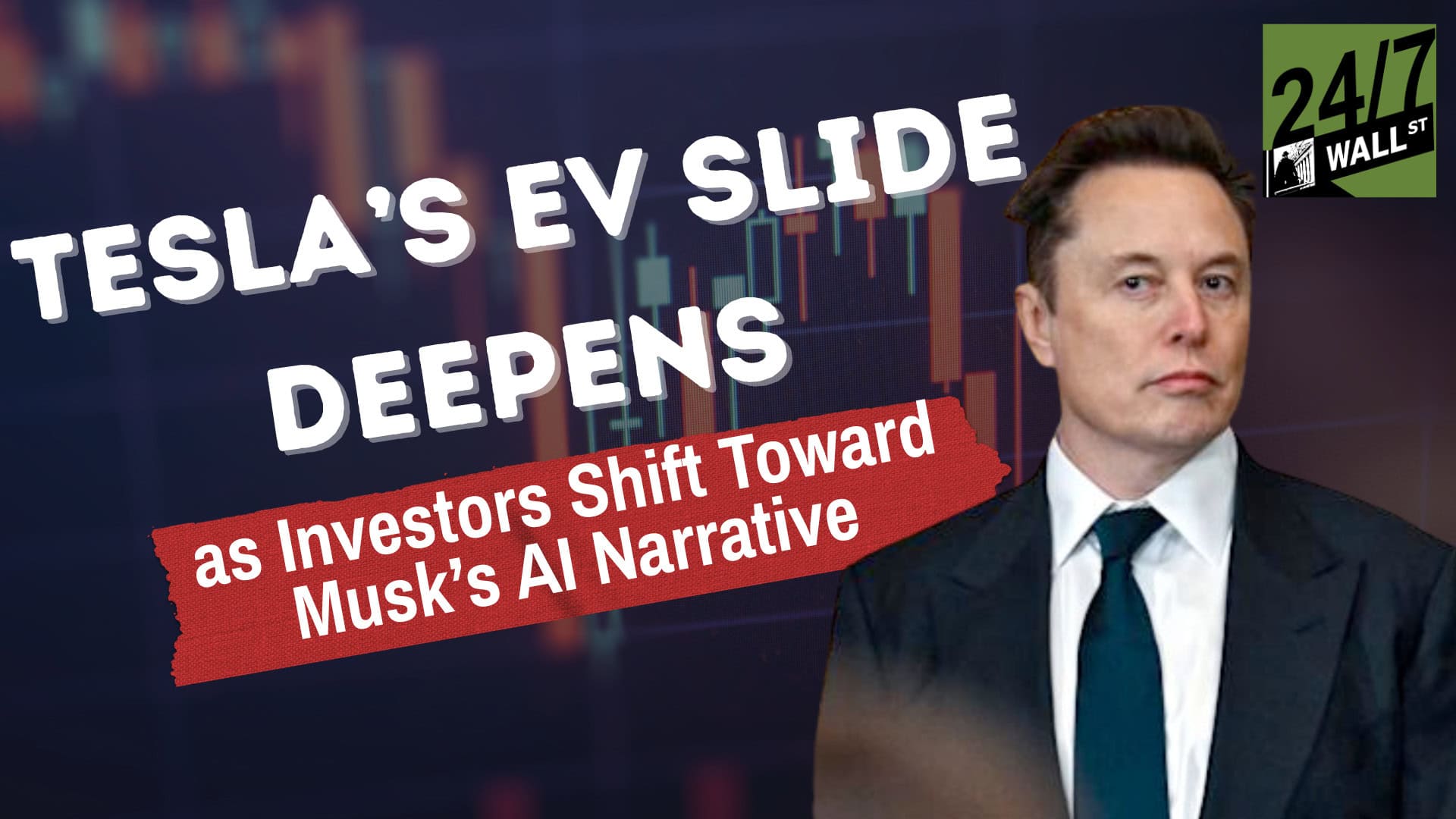
Watch the Video
Weakness Across Global Markets
The AI Pivot and the xAI Question
The Conglomerate Comparison
Lee and I touched on the idea of combining Tesla, SpaceX, xAI, the former Twitter platform and Starlink into a single publicly traded entity. The comparison reminded us of GE during the conglomerate era, when a collection of unrelated businesses traded at a discount because investors struggled to value the whole. Simplification usually creates value. Conglomerates rarely do.
Transcript:
[00:00:04] Lee Jackson: You know, Doug, I saw some new information and news coming out of Tesla (NASDAQ: TSLA) | TSLA Price Prediction, which I think you’ve heard of. Can you fill us in on that?
[00:00:13] Doug Mcintyre: Tesla’s Chinese sales dropped to a three year loan. Uh oh. It now has single digit market share in China, which, as you know, is the largest EV market in the world by right.
[00:00:25] Doug Mcintyre: Significant multiple. So let’s take a look at this for a second. He’s being smothered in China by BYD and other companies. There are apparently a hundred EV companies in China. A lot of ’em are gonna go bankrupt, but it’s still, you know, it’s a feeding frenzy, which makes it harder right now. I want to put a condition on this, the cars he made in China and exported, that was a good number. His sales in China were horrible. As you know, if you look at the EU numbers in a lot of countries over there, his, his drops year over year are well into the double digits.
[00:01:03] Lee Jackson: Yeah.
[00:01:03] Doug Mcintyre: In the United States, his, his EV market share in the United States peaked at 80%.
[00:01:10] Doug Mcintyre: It was 42% in the third quarter in the US you’ve got the expiration of the $7,500 tax credit. Yep. Boom. Please, please don’t tell me that that’s gonna help EV sales in the United States. It’s not. They’re gonna go through through the floor, which is gonna hurt. I don’t think so. Okay. So Tesla’s car business is completely in the tank.
[00:01:31] Doug Mcintyre: It’s shattered. And that means that investors, ’cause the stock is doing very well, it is and bought into, uh, the Musk point of view, view of Tesla, right? Which is Tesla will be an AI, robotics, Robo Taxii company within the next year or two. Now, the thing I like about this is there’s no evidence of it.
[00:01:57] Doug Mcintyre: No. Okay. It’s like, okay. I, I sort of believe you, but can you show me. He does not have any robots. I mean, he has demo. I, you know, of course he’s got some robots.
[00:02:07] Lee Jackson: Yeah, he’s got prototype, but that’s about it.
[00:02:10] Doug Mcintyre: Yeah. He’s not manufacturing robots. He’s not manufacturing robot taxis. Okay. They’re running in a few places.
[00:02:16] Doug Mcintyre: As a matter of fact, today, Waymo just announced that they will be running their cars on the open highways outside cities. I,
[00:02:23] Lee Jackson: I saw that.
[00:02:24] Doug Mcintyre: Well, okay. Every time somebody announces that, it’s bad for Musk. Okay. Yeah. Any, anytime somebody advances the self-driving car, Robo Taxii, that. You know, that falls apart.
[00:02:35] Doug Mcintyre: He’s not an AI company. Alright? I understand this self-drive. Now they’re talking about Tesla investing in X ai, which is right, his AI company, right? But quite frankly, I don’t get it. I mean, you put it on your balance sheet. If it goes up, it helps your balance sheet, but unless you also have a strategic contract with them.
[00:02:58] Doug Mcintyre: Yeah, yeah. About how you’re gonna be using the, the AI products that come from xai. Th th there’s no, dare there. I don’t, it’s, we’ll take some of Tesla’s cash and we’ll move over. XI, I could use it, but there’s nothing in it for Tesla shareholders. Okay.
[00:03:15] Lee Jackson: Unless, doesn’t seem to be, I mean, they’d be better off if he was up to rolling SpaceX in there, you know?
[00:03:21] Lee Jackson: Yeah. As a matter of fact, let’s merge ’em all. Let’s just take,
[00:03:24] Doug Mcintyre: I want a SpaceX XAI, Tesla, publicly traded company. Al I wanna be in the rock. I’ll be rockets.
[00:03:32] Lee Jackson: Kind of a GE, kind of a GE move in a, in a,
[00:03:35] Doug Mcintyre: I want the former Twitter, so I wanna be social. I’m social media. Throw that in there. AI and rockets. Okay.
[00:03:42] Doug Mcintyre: Yeah.
[00:03:43] Lee Jackson: and also, um. You can get to your, uh, internet, satellite Internet as, as well. Okay.
[00:03:49] Doug Mcintyre: I’m sorry. I’m sorry. I missed one. Right. Okay.
[00:03:52] Lee Jackson: You, you’ve got to throw that in there too. Alright, well, okay. Alright. I’ve
[00:03:55] Doug Mcintyre: got, uh, it’s like GE used to be under Welsh. We have five, that’s what I just said, like GE five, five divisions.
[00:04:01] Doug Mcintyre: Okay. Got the internet division, the space division, the social media division, the AI division, and the car division. And the car division. Right. And as it was true with GE, none of them are related to the things like GE. They have no, not, not
[00:04:14] Lee Jackson: to the original story. No. And, and like we, like we’ve told everybody every time that happens and they all GEs just the minute they kicked it out of the Dow and they, you know, spun off all the other stuff, they all immediately went higher.
[00:04:28] Lee Jackson: So, yes. Yeah, we’ll see. It’s conglomerate.
[00:04:30] Doug Mcintyre: Conglomerates in general are bad,
[00:04:32] Lee Jackson: right?








 Top Gaining Stocks
 Top Losing Stocks