



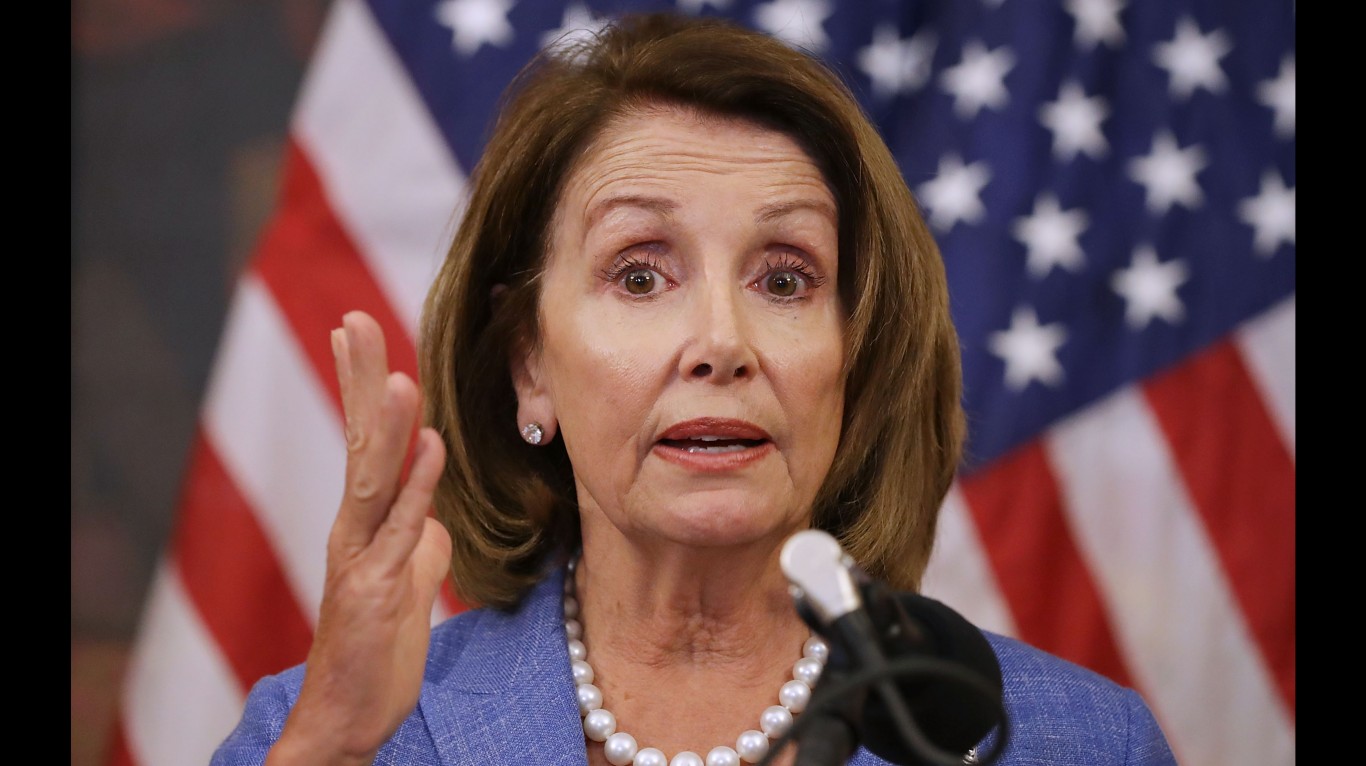
Former House Speaker Nancy Pelosi announced earlier this month that she will not seek re-election after nearly four decades in Congress. One of the most influential figures in American politics, Pelosi will complete her current term, serving until January 2027. That gives her more than a year to continue shaping legislation — and, for investors watching closely, to add to her extraordinary stock market track record.
Over the past decade, a simulated portfolio mirroring the disclosed trades of her husband, Paul Pelosi, has delivered approximately 827% cumulative returns, roughly three times the S&P 500‘s gain over the same period. Since the 2012 STOCK Act made congressional trades more transparent starting around 2014, trackers show she has achieved a compound annual growth rate (CAGR) of between 21% to 25% — a figure that edges out even Warren Buffett’s long-term Berkshire Hathaway (NYSE:BRK-A | BRK-A Price Prediction)(NYSE:BRK-B) performance.
The New York Post says her record during her entire time in Congress beginning in 1987 is even better: 16,930% cumulative returns compared to 2,300% by the index. If you want to build eye-watering wealth like one of Washington’s sharpest investors, here is exactly how she did it.
From FAANG Foundations to AI Dominance
Paul Pelosi’s strategy has remained remarkably consistent: concentrate on high-growth technology, use leveraged call options to amplify gains, and hold through major sector booms. Early wins in the 2010s and early 2020s centered on FAANG giants during the mobile and cloud computing era. Heavy bets on Apple (NASDAQ:AAPL), Microsoft (NASDAQ:MSFT), Alphabet (NASDAQ:GOOG)(NASDAQ:GOOGL), and Tesla (NASDAQ:TSLA) delivered millions of dollars as those companies dominated consumer tech and electric vehicles.
Between 2021 to 2022, the portfolio shifted toward semiconductors and artificial intelligence (AI) infrastructure. Repeated exercises of deep in-the-money calls on Nvidia (NASDAQ:NVDA) built a foundation that exploded when the AI boom hit in 2023. The same playbook — buying options just before major catalysts — was repeated with stunning results.
The 2023–2025 AI Supercycle
The past two years produced some of Pelosi’s largest absolute gains, driven by perfect positioning in the AI arms race.
- Nvidia remains the crown jewel. A November 2023 purchase of 50 call options (strike $120, later 500 post-split) was exercised profitably in late 2024 for millions. Additional 2025 buys, including 50 more calls in January, are already deep in the money amid continued AI demand. Nvidia positions often represent 20% to 22% of the total portfolio.
- Broadcom (NASDAQ:AVGO) delivered another blockbuster. In June 2024, Pelosi bought 20 calls (pre-split $800 strike) weeks before a 10-for-1 split and AI-fueled rally. He exercised them in June 2025 for 20,000 shares at roughly 71% below market price — locking in gains estimated at $10 million or more.
- Tempus AI (NASDAQ:TEM), a smaller-cap healthcare AI play, became 2025’s standout. January 2025 call options (50 contracts, $20 strike) rode a post-disclosure surge and major partnerships, with the stock rising 150% to 200% in months.
Other strong 2025 performers include calls on Vistra (NYSE:VST), an AI data-center power provider. The pattern is clear: early, leveraged exposure to AI-related infrastructure and applications, timed impeccably to sector momentum.
Key Takeaway
Critics point to suspiciously precise timing as evidence of potential informational edges from Pelosi’s oversight of tech regulation and massive government contracts. Examples include heavy Nvidia exposure just before the CHIPS Act boosted domestic semiconductors, and the Broadcom options purchased shortly ahead of explosive AI networking demand.
Pelosi and her office insist the trades are solely her husband’s, a successful venture capitalist operating independently with no improper information.
Regardless, the results speak for themselves. Trackers like Quiver Quantitative and Unusual Whales make every disclosure public in real time. Investors can even follow broader congressional patterns through two exchange-traded funds (ETFs) from Unusual Whales: the Subversive Democratic Trading ETF (CBOE:NANC) and Subversive Republican Trading ETF (CBOE:GOP).
With Pelosi set to leave Congress in January 2027, the window to ride shotgun with what many call the greatest living retail investor is closing fast. After that, one of Wall Street’s most profitable public playbooks may go dark.









 Top Gaining Stocks
 Top Losing Stocks