


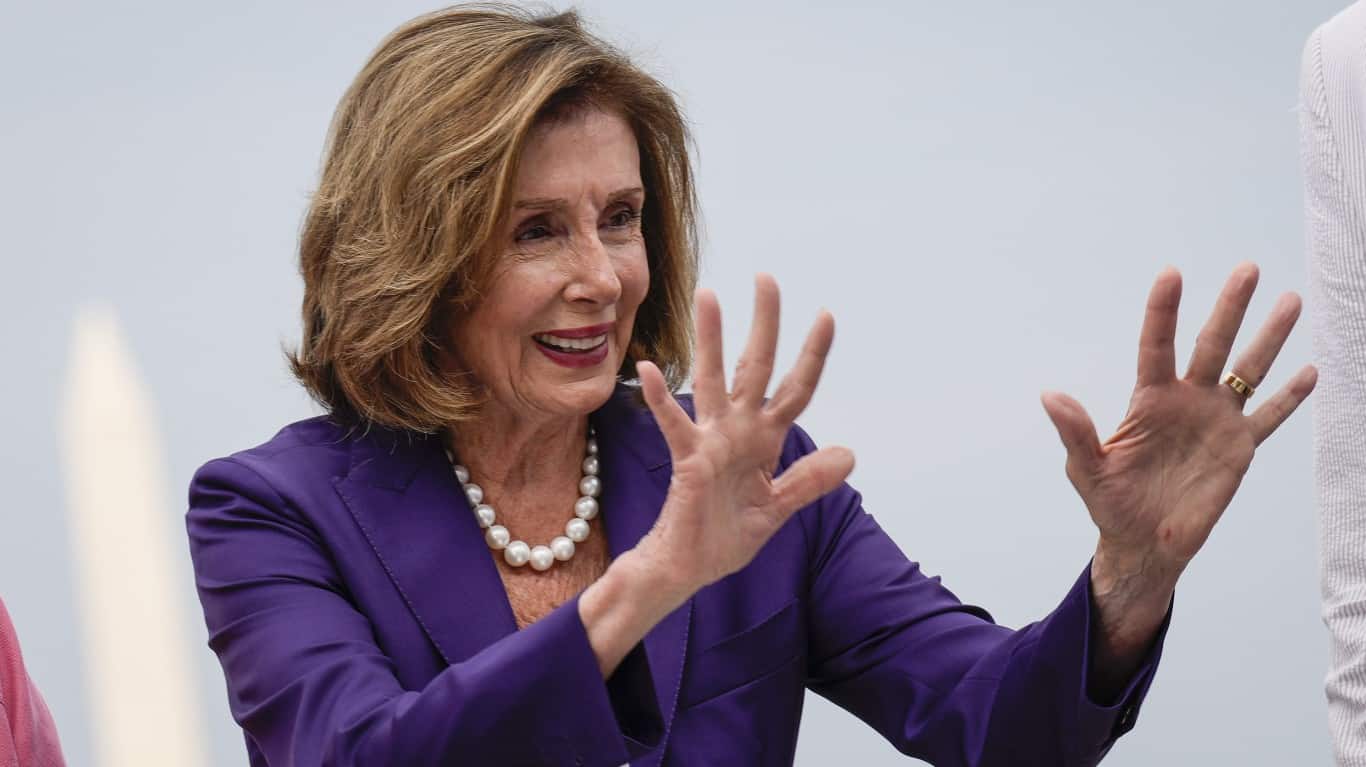
Nancy Pelosi is often portrayed as the most successful stock trader in Congress, having built a substantial fortune largely through well-timed investments in technology stocks. Her trading record has drawn intense scrutiny over the years, with critics alleging that she and other lawmakers may benefit from insights tied to their official oversight roles. Many of the trades occurred just prior to significant events benefiting the company and its stock. While no wrongdoing has been proven, every new trade tends to attract outsized attention from investors.
That attention spiked again last week when Pelosi’s latest stock trade report was released. The report showed that she continues to increase her exposure to artificial intelligence (AI), pairing large sales of long-held stocks with fresh option exercises and purchases tied to AI-driven companies. In total, the filing reflected roughly $69 million in transaction value, with the trades executed by her husband, Paul Pelosi.
Major Sales Trim Tech Exposure
In the Jan. 23 filing, Pelosi reported sizable sales in several familiar names. The most significant was Apple (NASDAQ:AAPL | AAPL Price Prediction), which accounted for a large portion of the total dollar value disclosed. She also sold smaller but still meaningful stakes in Nvidia (NASDAQ:NVDA) and Walt Disney (NYSE:DIS). Together, these moves reduced direct exposure to some of the portfolio’s most established tech and media holdings.
Apple’s sale stood out as a classic profit-taking move, especially given the stock’s elevated valuation. Nvidia’s sale was more surprising, considering its central role in powering AI workloads. Meanwhile, exiting Disney suggests a broader shift away from traditional entertainment toward faster-growing technology-driven opportunities.
Option Exercises Reload on Megacaps
Those sales were balanced by option exercises and purchases in several mega-cap technology companies. Pelosi exercised 50 Amazon (NASDAQ:AMZN) call options, originally purchased on January 14, 2025, at a $150 strike price, resulting in a transaction valued between $500,001 and $1,000,000. A nearly identical move was made in Alphabet (NASDAQ:GOOG), also exercising 50 calls at a $150 strike within the same value range.
Nvidia appeared again on the buy side, with the exercise of 50 call options purchased in January 2025 at an $80 strike, valued between $250,001 and $500,000. These exercises converted previously held options into shares, preserving exposure to the companies most closely tied to cloud computing and AI infrastructure.
Notably, Nvidia illustrates a recurring pattern: selling shares while simultaneously using options to regain exposure. This strategy allows investors to lock in gains or reduce risk on existing holdings, while still positioning the portfolio for gains through options. Because options offer leveraged exposure with defined risk, this approach can help manage portfolio concentration while maintaining a bullish outlook.
Bold AI Bets on Energy and Health
Beyond megacap tech, the filing highlighted targeted bets on AI-adjacent industries. Pelosi exercised options in Vistra (NYSE:VST), an energy company increasingly tied to AI data center demand. Vistra supplies nuclear and natural gas power to energy-hungry AI facilities and has struck major deals, including agreements with Meta Platforms (NASDAQ:META) covering more than 2,600 megawatts. Its recent $4 billion acquisition of gas plants further positions it to benefit from AI-driven electricity demand.
She also exercised 50 call options in Tempus AI (NASDAQ: TEM) — valued between $50,001 and $100,000 — from options purchased in January 2025 at a $20 strike. That initial purchase rocketed Tempus to the forefront of investor consciousness and caused its stock to soar. Tempus applies AI to precision medicine, using large datasets to improve diagnostics and treatment decisions in fields like oncology, cardiology, and radiology.
Key Takeaway
Taken together, these trades reflect continued confidence in AI’s long-term growth. By trimming mature tech positions and redeploying capital into AI leaders and enablers such as Nvidia, Amazon, Alphabet, Vistra, and Tempus, the portfolio tilts toward areas likely to see sustained demand from AI adoption.
The focus on energy infrastructure and AI-driven healthcare also suggests that the next phase of AI growth may extend well beyond software, reaching into the physical and practical systems that make AI possible.










 Top Gaining Stocks
 Top Losing Stocks