



If you are depending on Social Security for your retirement income, you might want to add reinforcements. While Social Security is tweaked annually in an attempt to keep up with the pace of inflation, its buying power has been dwindling in recent decades while the core inflation rate of 3% continues to hover above the Federal Reserve’s elusive 2% target. One strategic way to bolster your retirement income is to add a mix of income ETFs that are the most likely to offset any deficiencies left by Social Security.
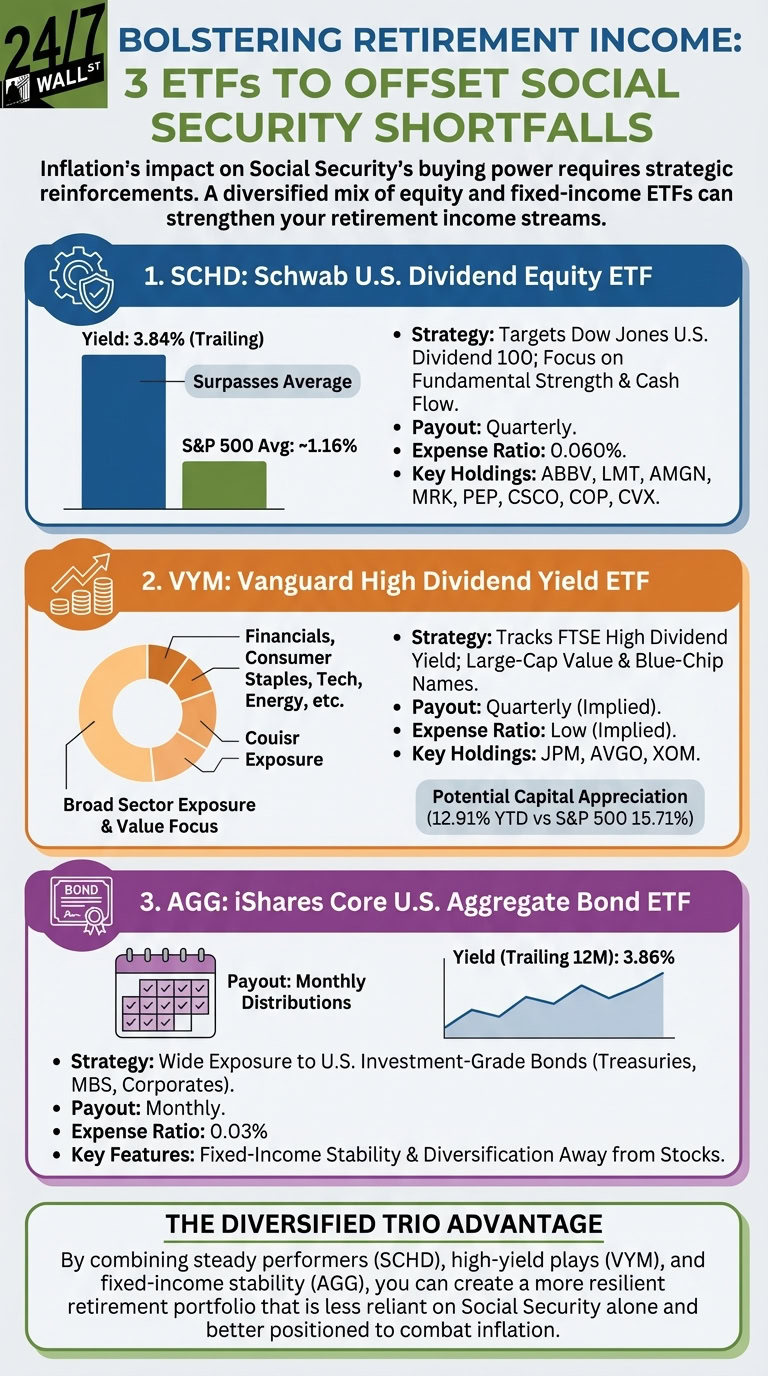
Rather than relying on a single stock or even asset class, we’ve uncovered a trio of income ETFs, including both equity and fixed-income flavors, that are dependable bets to offset any Social Security shortfall. These funds include the Schwab U.S. Dividend Equity ETF (NYSE Arca: SCHD | SCHD Price Prediction), Vanguard High Dividend Yield ETF (NYSE Arca: VYM) and the iShares Core U.S. Aggregate Bond ETF (NYSE: Arca: AGG), delivering a diversified mix of steady performers, high-yield plays and fixed-income stability. Given the uncertainty around the Social Security System, I would turn to these three income ETFs to strengthen my income streams in retirement.
1.) Schwab U.S. Dividend Equity ETF (SCHD)
The Schwab U.S. Dividend Equity ETF (NYSEArca: SCHD) is one to consider in the current market climate. Targeting the returns of the Dow Jones U.S. Dividend 100 Index, SCHD has a high standard for fundamental strength, including cash flow, among members, providing potential capital appreciation to a diversified portfolio in addition to the cash flow stream that dividends generate. With just over 100 stock holdings, SCHD has a trailing dividend yield of 3.84%, surpassing that of the average dividend stock in the S&P 500 at 1.16%.
With a total expense ratio of 0.060%, SCHD is attractive for its above-3% dividend yield, for a current quarterly payout of $0.2782 per share. By investing in SCHD, you’re gaining exposure to leading stocks such as AbbVie (NYSE: ABBV), defense giant Lockheed Martin (NYSE: LMT), biotechnology stock Amgen (Nasdaq: AMGN) as well as pharmaceutical giant Merck (NYSE: MRK), consumer staple stock PepsiCo (NYSE: PEP), Big Tech company Cisco Systems (Nasdaq: CSCO), energy holdings ConocoPhillips (NYSE: COP) and Chevron (NYSE: CVX), among many others.
Dividends are paid quarterly, giving investors an opportunity to plan and budget for cash flow as needed in retirement or decide to reinvest the dividends for a rainy day. Investors can replace the dependability of a steady paycheck with that of dividend income from stocks that have set the standard as steady payers for years, with some, like PepsiCo, achieving status as a Dividend Aristocrat for paying consistent dividends for at least 25 years.
2.) Vanguard High Dividend Yield ETF (VYM)
Next consider the Vanguard High Dividend Yield ETF (VYM) if your risk/reward profile allows for some high-yield drama. The higher the dividend yield, the greater the chance that these payouts could become unsustainable in the future. VYM tracks the FTSE High Dividend Yield Index, pursuing domestic large-cap names, falling on the moderate-to-aggressive side of the risk spectrum. Stocks include JPMorgan (NYSE: JPM), Broadcom (Nasdaq: AVGO), Exxon Mobil (NYSE: XOM), among hundreds of other names.
This ETF provides investors with grand sector exposure, ranging from financials to consumer staples to tech to energy and beyond, a strategy that that favors established cash generators over passing trends, spreads risk across sectors, and delivers a steadier yield profile than many other options. Distributions can ebb and flow with markets, but VYM’s wider emphasis on value and blue-chip names make it a credible core income path to help supplement Social Security, especially when combined with a cash or short-term bond instrument to buffer any potential rough patches.
In addition to dividends, VYM has a proven performance history on the capital appreciation side, generating returns of 12.91% year-to-date, just shy of the 15.71% in the S&P 500 index. There are always trade-offs; value-focused funds can lag when growth stocks lead, and dividend stocks have a tendency to favor financials and energy. Overall, VYM can add steady cash flow and capital appreciation to offset part of Social Security.
3.) iShares Core U.S. Aggregate Bond ETF (AGG)
For some fixed income exposure, consider the iShares Core U.S. Aggregate Bond ETF (NYSEArca: AGG). This fund strategy targets wide exposure to U.S. investment-grade bonds, ensuring that your portfolio is filled with credit-worthy instruments. The growth of a hypothetical $10,000 investment into this ETF would surpass $20,000 over the past two decades. With a dividend yield of 3.86% on a trailing 12 month basis, AGG makes distributions monthly, helping you to cover those bills in retirement without having to depend on Social Security.
AGG tracks the Bloomberg U.S. Aggregate Bond Index, holding a wide mix of Treasuries, agency mortgage-backed securities (MBS) and investment-grade corporate bonds. With a low expense ratio of 0.03%, this ETF is somewhat sensitive to interest rates; prices can dip when yields rise and rise when rates fall. AS a result, AGG offers both diversification away from stocks as well as steady monthly income for predictable cash flow when you need it the most.













 Top Gaining Stocks
 Top Losing Stocks