


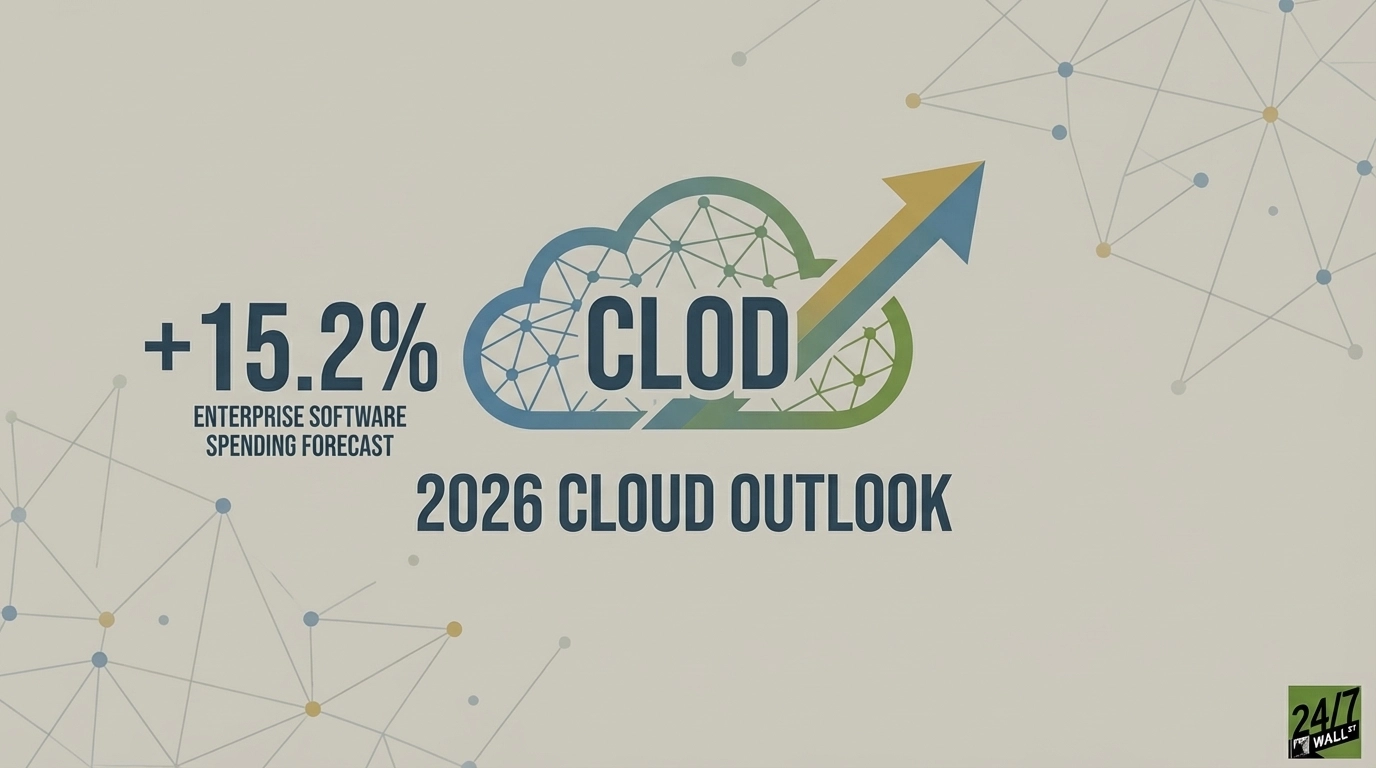
While investors chased artificial intelligence stocks through 2025, cloud computing quietly slipped into the background. The Themes Cloud Computing ETF (NYSEARCA:CLOD) gained just 7% in 2025, trailing the Nasdaq-100’s 21% return by more than 12 percentage points. This underperformance might set up cloud computing for a strong 2026.
CLOD launched in December 2023 with 73% information technology exposure concentrated in cloud infrastructure and software companies. The fund holds $1.3 million in assets with a 0.35% expense ratio. Top positions include Alphabet (NASDAQ:GOOGL | GOOGL Price Prediction) at 6.2%, AppLovin (NYSE:APP) at 5.6%, and Salesforce (NYSE:CRM) at 5.3%, alongside emerging cloud infrastructure names like CoreWeave and Nebius Group.
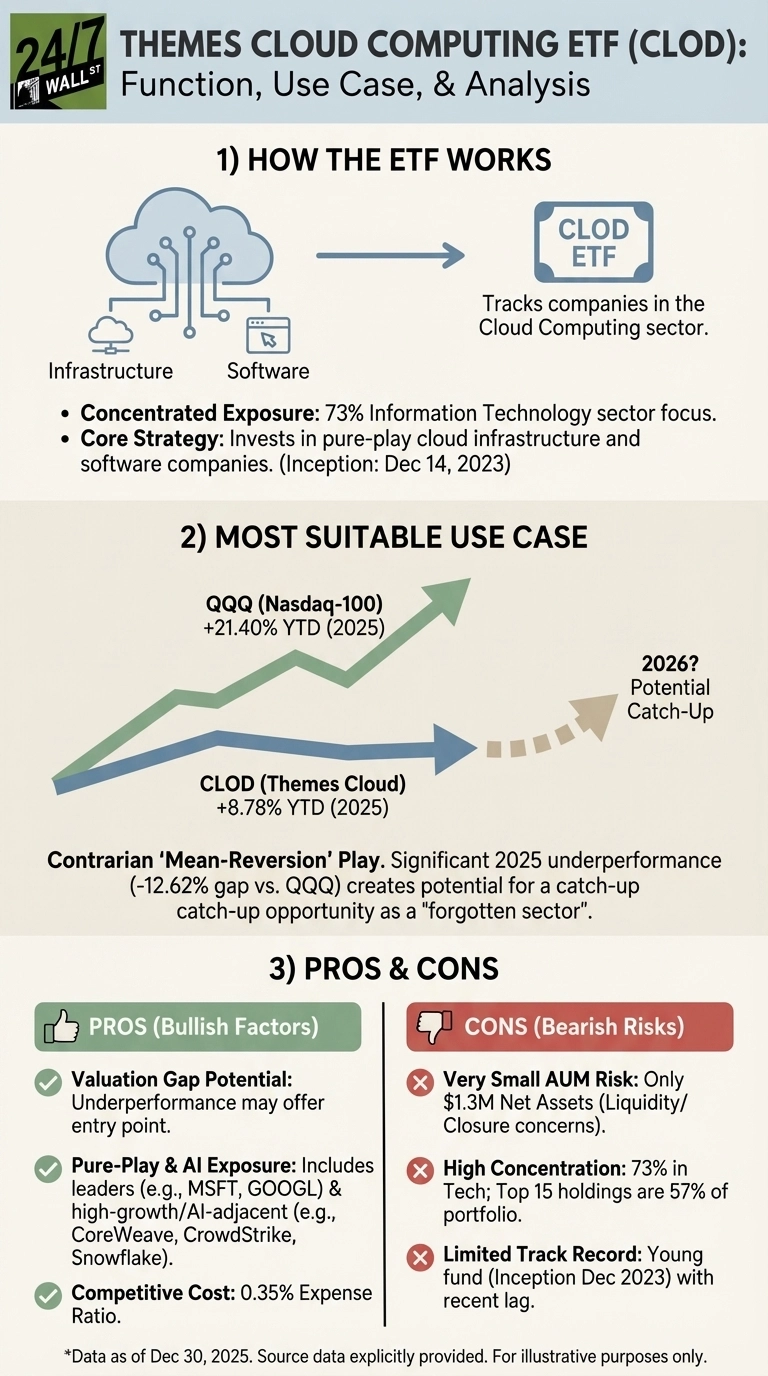
The divergence within CLOD’s portfolio tells the story. Salesforce, the ETF’s third-largest holding, dropped nearly 20% in 2025 despite beating earnings estimates in four consecutive quarters, including a 13.6% surprise in December. Meanwhile, Snowflake (NYSE:SNOW) surged 44.6% and CrowdStrike (NASDAQ:CRWD) gained 39.4%. These aren’t broken businesses experiencing coordinated failure. They’re quality assets caught in a sentiment-driven rotation that created a valuation disconnect.
Enterprise Software Spending Accelerates Into 2026
Gartner (NYSE:IT) forecasts enterprise software spending will grow 15.2% in 2026 to $1.43 trillion, making it the fastest-growing segment of the $6 trillion IT market. Cloud infrastructure spending reached $90.9 billion in Q1 2025 alone, up 21% year-over-year, with the global cloud market approaching $1 trillion. Enterprises abandoned custom AI builds after high failure rates in 2024 proof-of-concept projects. Now they’re buying commercial cloud solutions instead of building internally.
This shift directly benefits CLOD’s holdings. Microsoft (NASDAQ:MSFT), representing 4.5% of the portfolio, reported 18.4% revenue growth with a 48.9% operating margin, driven largely by Azure cloud services. The fund’s exposure to both mega-cap cloud leaders and high-growth SaaS companies positions it to capture spending across the entire cloud stack as AI workloads drive infrastructure demand.
Watch quarterly cloud revenue growth from major hyperscalers, particularly Azure, AWS, and Google Cloud Platform. These figures appear in earnings reports and signal whether enterprise cloud adoption is accelerating or decelerating.
The Portfolio Concentration Question
CLOD’s risk centers on its small asset base and concentrated positions. With just $1.3 million in net assets, liquidity could become problematic during market stress. The fund’s top 15 holdings represent 57% of the portfolio, creating meaningful single-stock risk.
However, this concentration means CLOD moves quickly when cloud sentiment shifts. The fund includes pure-play cloud names like Cloudflare (NYSE:NET) (2.3%), Datadog (NASDAQ:DDOG) (1.6%), and MongoDB (NASDAQ:MDB) (1.2%) that larger tech ETFs often underweight. Check CLOD’s monthly fact sheet to monitor whether holdings concentration increases or whether the fund adds assets that could improve trading liquidity.
Consider WCLD as an Alternative
The WisdomTree Cloud Computing Fund (NASDAQ:WCLD) offers a more established alternative with $290.6 million in assets and a 0.45% expense ratio. WCLD holds 92.3% in information technology with an equal-weight approach that spreads risk more evenly. The fund launched in September 2019, providing a longer track record. While WCLD charges 10 basis points more annually, its deeper liquidity and broader diversification across 60+ holdings could matter during volatile periods.
The Setup
Watch enterprise cloud infrastructure spending growth and CLOD’s asset accumulation over the next 12 months. If Gartner’s 15.2% software spending forecast proves accurate and cloud sentiment rotates back toward fundamentals, CLOD’s concentrated bet on quality cloud companies trading at sentiment-driven discounts could deliver outsized returns.













 Top Gaining Stocks
 Top Losing Stocks