



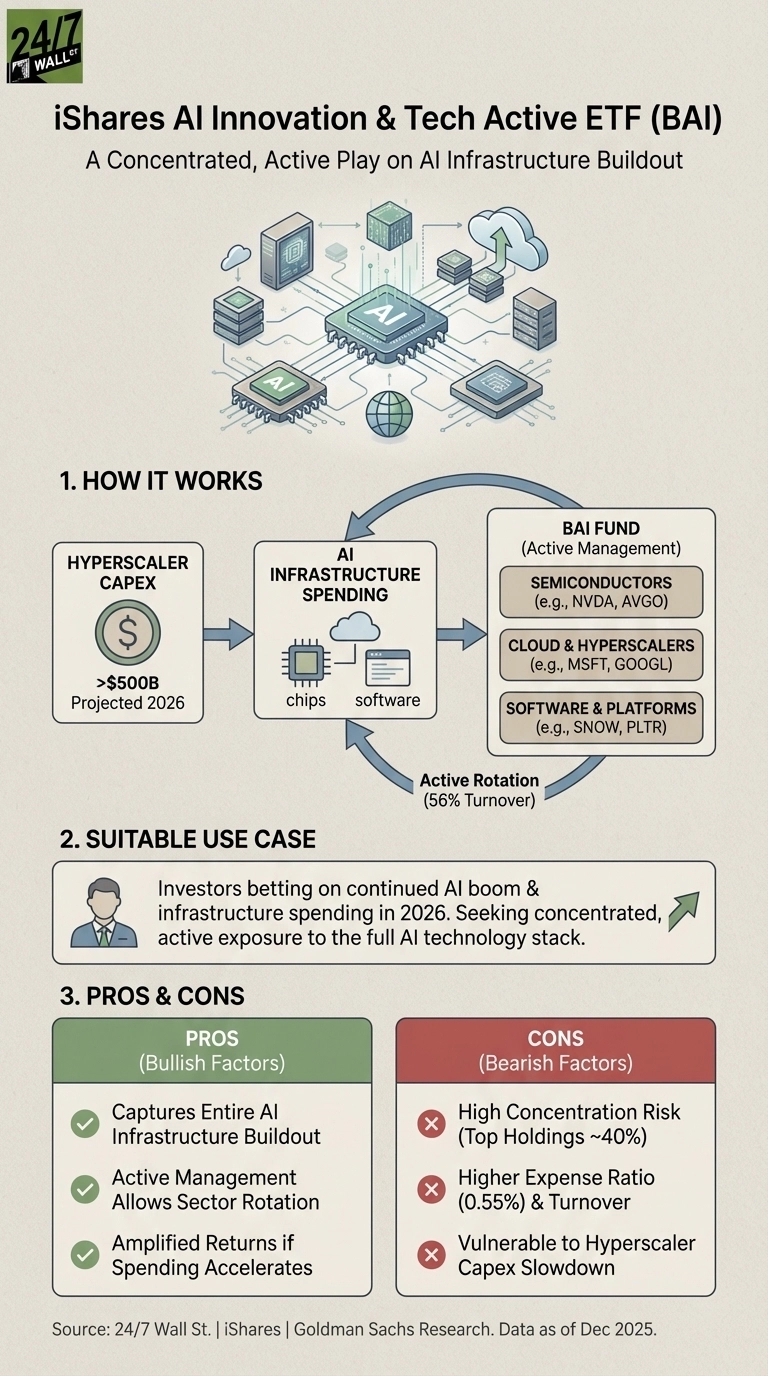
The iShares AI Innovation and Tech Active ETF (NYSEARCA:BAI) launched in October 2024 to capture the entire AI infrastructure buildout in one actively managed package. With $8 billion in assets and a 0.55% expense ratio, the fund takes a concentrated approach to AI exposure across the technology stack.
With $8 billion in assets and a 0.55% expense ratio, BAI takes a full-stack approach to AI exposure. Nearly 60% sits in information technology, led by NVIDIA (NASDAQ:NVDA | NVDA Price Prediction) at 9.5% and Broadcom (NASDAQ:AVGO) at 8.8%. The next tier includes hyperscalers Microsoft (NASDAQ:MSFT), Alphabet (NASDAQ:GOOGL), and Meta (NASDAQ:META), plus software plays like Snowflake (NYSE:SNOW) and Palantir (NYSE:PLTR). It’s a who’s-who of AI infrastructure, from chips to cloud to enterprise software.
What Drives This Trade in 2026
The single macro factor that matters most: hyperscaler capital expenditure. Goldman Sachs (NYSE:GS) Research projects AI companies will spend over $500 billion on infrastructure in 2026, up from roughly $400 billion in 2025. That spending flows directly to BAI’s top holdings. Microsoft, Google, Meta, and Amazon (NASDAQ:AMZN) are building data centers, buying NVIDIA GPUs, and deploying custom silicon at unprecedented scale. When Azure grows 40% year-over-year or Google Cloud expands 34%, that revenue translates into orders for semiconductors, networking gear, and software platforms.
Watch quarterly earnings from the hyperscalers, particularly their capex guidance. Microsoft, Alphabet, and Meta report fiscal results in January, April, July, and October. Any upward revision to infrastructure spending signals sustained demand for BAI’s semiconductor and hardware holdings. If capex growth slows below 25%, the valuation premium on AI infrastructure stocks compresses quickly.
Portfolio Mechanics and Concentration Risk
BAI’s active management means turnover runs at 56%, well above passive index funds. That flexibility allows managers to rotate between chip makers, cloud platforms, and emerging software plays as the AI landscape evolves. Check the fund’s monthly fact sheet on iShares’ website to track changes in sector allocation and top 10 concentration.
The fund’s concentration is both strength and vulnerability. NVIDIA and Broadcom alone represent 18% of assets. Add the hyperscalers and you’re approaching 40% in just seven names. This amplifies returns when AI infrastructure spending accelerates, but any stumble in semiconductor demand or cloud growth hits hard. The 56% turnover suggests active rebalancing, but investors should monitor whether the fund maintains its chip-heavy tilt or rotates toward software as enterprise AI adoption matures.
Consider the Broader Play
For comparison, the iShares Robotics and Artificial Intelligence Multisector ETF (NYSEARCA:IRBO) offers similar AI exposure with a 0.47% expense ratio and longer track record since 2018. IRBO spreads risk across 92 holdings versus BAI’s more concentrated approach, making it a steadier option for investors prioritizing diversification over maximum AI infrastructure exposure.
For 2026, hyperscaler capex guidance and BAI’s quarterly rebalancing will be key indicators. Goldman Sachs Research projects infrastructure spending above $500 billion, which would support continued demand for the fund’s semiconductor and cloud holdings.










 Top Gaining Stocks
 Top Losing Stocks