



The iShares Core Dividend Growth ETF (NYSEARCA:DGRO | DGRO Price Prediction) and Vanguard High Dividend Yield Index Fund ETF (NYSEARCA:VYM) are two highly popular dividend ETFs that income investors have a hard time choosing between. It’s a good idea to put both to the test and see which one has done better and has the best prospects in the coming years.
No ETF is inherently better, and both obviously come with their own risk-reward trade-offs. However, it is almost always a smart option to do a “background check” of sorts on your holdings to see which ETFs have the best history and whether or not they are well-positioned to keep performing in the future.
Let’s take a look at DGRO first.
iShares Core Dividend Growth ETF (DGRO)
This ETF focuses on stocks that have a record of consistently growing their dividends, hence “DGRO”. The thesis is that by investing in growing dividends, your investments can snowball in the long run. This is a proven strategy for those investors who aren’t shaken off by market crashes and simply want an income vehicle they can hold and reinvest into.
DGRO is up 55.6% over the past 5 years, but it yields 2.04% in dividends with a 0.08% expense ratio. Dividends have grown at 7.11% annually over the past 5 years. Thus, the dividend yield is nearly twice as big as the S&P 500, with a dividend growth rate just 2% higher. While that may look like pocket change today, those small numbers can add up over time and make DGRO a strong contender.
Looking at holdings, financials constitute the plurality of its holdings at 21.13%, followed by healthcare at 17.71%. The expense ratio is just 0.08%. Now, let’s see what VYM offers.
Vanguard High Dividend Yield Index Fund ETF (VYM)
This dividend ETF tracks the FTSE High Dividend Yield Index. It measures the investment return of stocks that come with a higher dividend yield, so it prioritizes current yield instead of dividend growth, along with long-term equity appreciation.
VYM is up 54.9% over the past five years, and it yields 2.38% in dividends. The record looks similar, but the underlying holdings are a little different.
The biggest sector is also financials, with 21.15% exposure. The single-largest holding is Broadcom (NASDAQ:AVGO) at 8.69%, followed by JPMorgan (NYSE:JPM) at 4.06%. VYM is practically as top-heavy as DGRO, with the top 10 holdings comprising 25-30% of the fund.
DGRO vs VYM, a head-to-head comparison
Here’s where it gets fun. Once you take reinvesting into account since DGRO’s inception, here’s what we get.
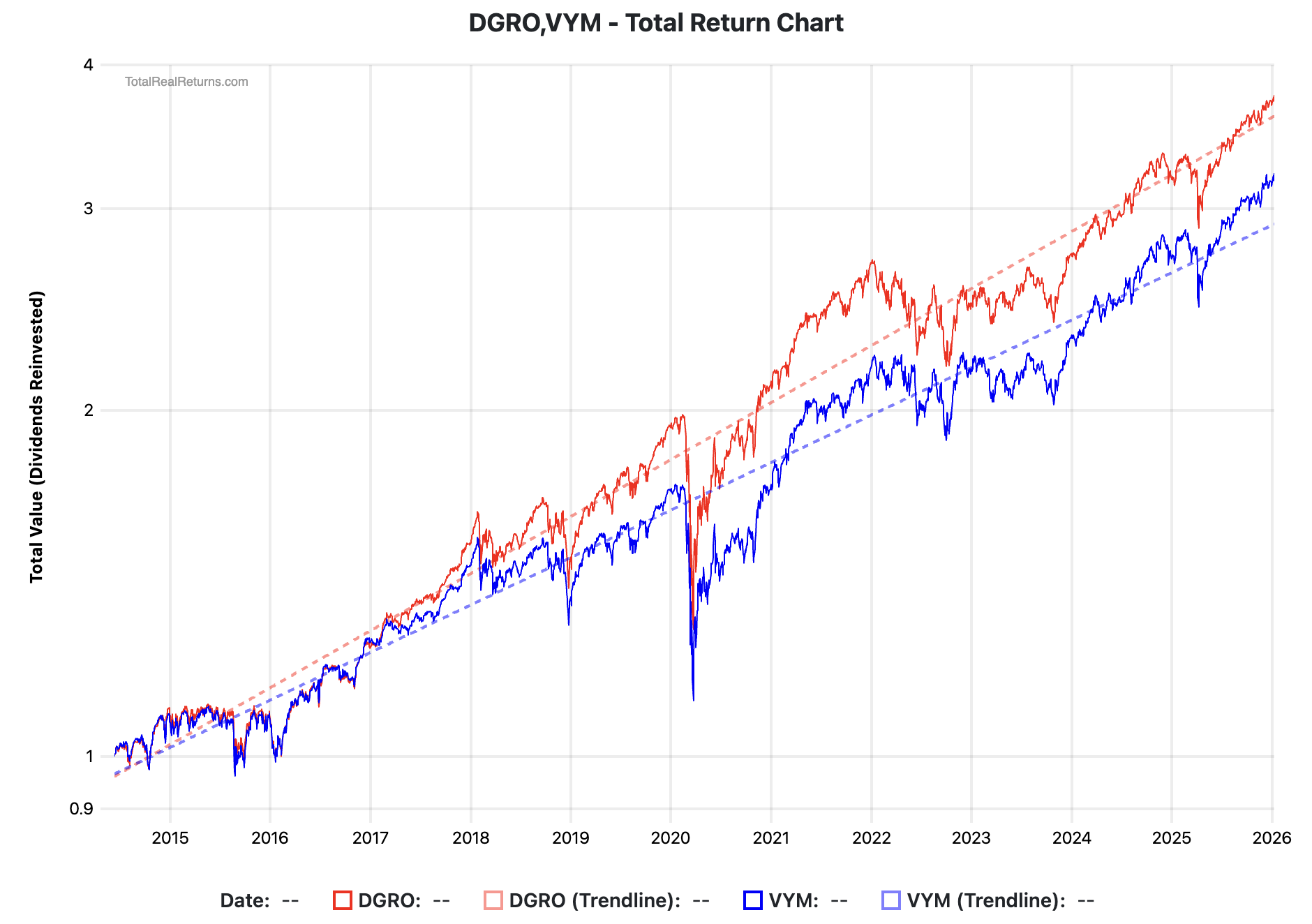
Both ETFs were essentially neck-and-neck before they started diverging in 2018. If you look at a smaller timescale, let’s say since 2020, the gap does get narrower. Since the start of 2020, DGRO gained 94.6%, vs. VYM’s 88.64%. However, VYM is still behind.
One place where VYM does better than DGRO is dealing with drawdowns. DGRO typically has worse downturns than VYM. For example, in 2022, DGRO lost 7.91% of its value, whereas VYM lost just 0.45%. It still kept the lead.
Which one should you buy?
I would go ahead and buy DGRO instead of VYM. Both are remarkably similar ETFs, but DGRO gives you a better, more diversified slate that has also performed better over time. DGRO’s top holding is JPM with just 2.99% weighting, and it has managed to perform better with this “impediment”, even though VYM has more tech exposure through AVGO stock.
You get a slightly lower dividend yield here, but that’s more than worth it when taking into account the long-term outperformance. VYM’s dividends have grown at just 3.79% annually over the past 5 years, so it is possible DGRO closes this gap quickly, too.











 Top Gaining Stocks
 Top Losing Stocks