



Everyone wants SpaceX exposure. Problem is, you can’t buy it. While retail investors fantasize about Starlink and Mars colonization, the real money is being made in unglamorous infrastructure powering the orbital economy: satellite internet for container ships, IoT connectivity from orbit, commercial moon deliveries, and small-payload launch services. Five publicly traded companies are capturing this buildout.
5. Globalstar: The Apple Validation Play
Globalstar (NASDAQ:GSAT) operates a low-Earth orbit satellite constellation providing IoT connectivity and emergency communications. The company generated $262M in trailing revenue with a 13.9% operating margin. Apple integrated Globalstar’s satellites into iPhone emergency SOS features, validating satellite-to-smartphone connectivity as a real market.
Globalstar trades at 30x revenue and 79x EBITDA, premium multiples that only make sense if investors expect material revenue acceleration beyond the current 2.1% growth rate. Analysts set a $65.67 target price, and the stock has surged 132% over the past year. The Apple partnership provides recurring revenue, but contract dependency creates risk. If Apple builds its own constellation or switches providers, Globalstar’s thesis evaporates.
4. Intuitive Machines: The Lunar Gamble
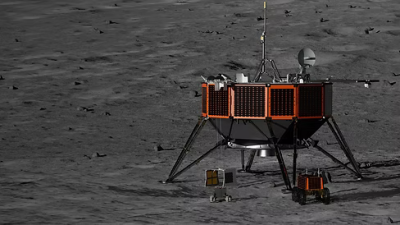
Intuitive Machines (NASDAQ:LUNR) is betting on commercial lunar missions becoming sustainable business. The company secured NASA contracts to deliver payloads to the moon’s surface, positioning itself as infrastructure for the Artemis program. Revenue hit $220M trailing, but the company burned cash with a negative 29.4% operating margin and $65M in negative EBITDA.
Earnings volatility is extreme. In Q2 2025, Intuitive Machines missed estimates by 2,300%, posting a $0.22 loss versus a $0.01 expected gain. By Q3 2025, losses narrowed to $0.06. Annual losses improved 85% from 2024 to 2025, dropping from $2.60 per share to $0.39. Eight of nine analysts rate it a buy, with a $17.67 target price. If NASA budgets shrink or lunar ambitions stall, Intuitive Machines has no fallback revenue stream.
3. EchoStar: The Spectrum Asset Play
EchoStar Corporation (NASDAQ:SATS | SATS Price Prediction) just completed a $42.6B spectrum sale, transforming from a satellite TV operator into a capital-rich holding company. The stock exploded 364% over the past year. Current financials are messy: $15.2B in trailing revenue but an 85% net loss margin due to transaction-related charges and restructuring costs.
The market cap sits at $34.5B with EBITDA of $1.31B, giving it a 20x EV/EBITDA multiple reflecting expectations of post-transaction value creation. The company’s 24.5% gross margin on $3.72B in gross profit shows the underlying satellite business can generate cash. The real question is capital allocation. The stock trades 125% above its 200-day moving average, suggesting the market has already priced in a best-case outcome.
2. Rocket Lab: The Small-Sat Launch Alternative
Rocket Lab USA (NASDAQ:RKLB) is carving out the small-payload launch market with its Electron rocket and developing reusability to compete with SpaceX’s Falcon 9. Revenue hit $554M trailing with explosive 48% year-over-year growth in Q3 2025, the strongest growth rate among all five companies. The stock surged 196% over the past year, reaching a $43B market cap.
The company still burns cash with a 38% negative operating margin and $192M in negative EBITDA, but trajectory matters more than current profitability. In Q3 2025, Rocket Lab beat earnings estimates by 56%, posting a $0.03 loss versus a $0.07 expected loss. Analysts set an $83.96 target price with nine of 14 rating it a buy. The company’s space systems division, which manufactures satellite components, provides diversification beyond launch services. The risk is execution: can Rocket Lab achieve reusability at scale and maintain pricing power as more small-sat launch providers enter the market?
1. Iridium Communications: The Profitable Incumbent
Iridium Communications (NASDAQ:IRDM) operates a 66-satellite constellation providing global voice and data connectivity where terrestrial networks don’t exist: maritime vessels, aircraft, military operations, and remote industrial sites. The company generated $872M in trailing revenue with a 30.9% operating margin and $445M in EBITDA, making it the only consistently profitable pure-play satellite operator on this list.
Earnings growth exploded 68% year-over-year while revenue grew 6.7%, demonstrating margin expansion and operational leverage. The company pays a $0.58 annualized dividend (2.6% yield) with consistent quarterly increases, most recently bumping to $0.15 per quarter in Q4 2025. On January 6, 2026, all 10 board members executed coordinated share purchases totaling 132,726 shares, a strong insider confidence signal.
The stock trades at 18x earnings with a $28.12 analyst target price, implying 58% upside. The PEG ratio of 0.95 suggests undervaluation relative to growth. The Starlink threat looms, but Iridium serves different customers at different price points. Ships and planes need certified, reliable connectivity with regulatory approvals Starlink doesn’t yet have. Government contracts provide 30% of revenue with long-term visibility. The business is boring, predictable, and profitable.
The Infrastructure Thesis
Space is sexy. These companies are not. They’re the pipes, wires, and trucks of the orbital economy. Iridium wins on profitability and dividend stability. Rocket Lab wins on growth and momentum. EchoStar wins on asset value if management executes. Globalstar wins if Apple dependency doesn’t become a liability. Intuitive Machines wins if the commercial moon economy materializes. The question isn’t which company reaches Mars first, it’s which one captures the unglamorous buildout happening right now.












 Top Gaining Stocks
 Top Losing Stocks