


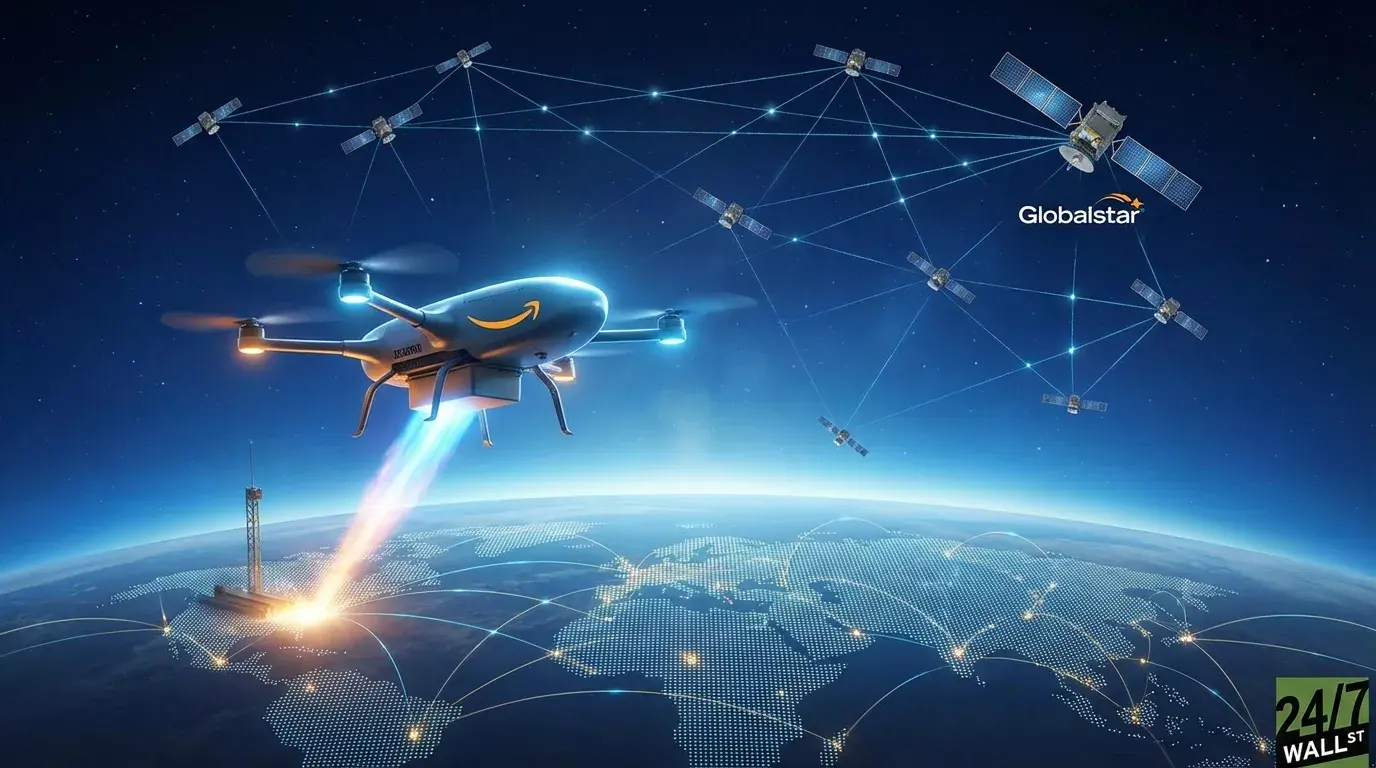
Amazon.com (NASDAQ:AMZN | AMZN Price Prediction) announced it is acquiring satellite company Globalstar (NASDAQ:GSAT) for $11.6 billion, and the market delivered an immediate verdict. Amazon shares rose 5% on the news, adding $125 billion in market cap in a single day. That kind of single-session move on a company already valued at $2.667 trillion tells you investors see this as far more than a satellite acquisition. They see a direct challenge to SpaceX’s grip on space-based internet.
What Globalstar Brings to the Table
Globalstar, founded in the late 1990s and headquartered in Louisiana, operates 24 satellites in orbit and owns valuable licensed wireless bandwidth. The company’s Band 53/n53 spectrum assets are globally harmonized, a rare and strategically significant attribute in satellite communications. Globalstar already has a foothold in the consumer market through Apple’s Emergency SOS satellite feature on iPhone 14 and newer models. That existing relationship with Apple (NASDAQ:AAPL) proves the infrastructure works at consumer scale, and it comes with an existing revenue stream.
The deal includes a simultaneous partnership with Apple to expand satellite connectivity beyond emergency texts. Amazon plans to upgrade the service by 2028 to support voice, data, and full messaging capabilities under the name Amazon LEO. Andy Jassy had already signaled this direction, noting in Amazon’s Q4 2025 earnings that the company would face approximately $1 billion higher year-over-year Amazon Leo costs in 2026 as the satellite program scales.
The SpaceX Competitive Dynamic
The competitive benchmark here is Starlink. SpaceX currently operates 10,000 satellites compared to Amazon’s fewer than 300. Starlink generates $10 billion in annual revenue with a 65% profit margin, more than double SpaceX’s rocket business revenue. That margin profile is exactly the opening Amazon needs. As the TBOY podcast hosts framed it: “Your margin is my opportunity.” Amazon’s logistics and infrastructure scale gives it the cost structure to undercut Starlink on pricing while still generating healthy returns.
What This Means for Legacy Telecom
The broader implication extends well beyond Amazon versus SpaceX. The 40-year era of traditional telecom dominated by Verizon, AT&T, and T-Mobile is ending as infrastructure shifts from physical towers to satellites in orbit. Globalstar’s XCOM RAN software-defined private wireless platform and its next-generation C-3 satellites reinforce that the company was already building toward this future. Amazon accelerates that timeline considerably.
Jassy committed to approximately $200 billion in capital expenditures across Amazon in 2026, with low earth orbit satellites named explicitly alongside AI, chips, and robotics as priority areas. The Globalstar deal converts that stated ambition into a real asset base with spectrum rights, operational satellites, and an existing enterprise customer in Apple. Investors watching the legacy carrier space should treat this announcement as a structural signal, not a one-day story.









 Top Gaining Stocks
 Top Losing Stocks