



Google DeepMind’s Genie 3 marks a shift in artificial intelligence (AI) toward always-on systems that generate and sustain interactive environments without pausing. This world model creates photorealistic worlds from text prompts, running continuously at 24 frames per second for minutes, predicting actions and maintaining consistency. It points to persistent simulations that evolve independently, aiding agent training and approaching AGI.
While the implications for this advancement span robotics and media, investors panicked on Friday over the threat it potentially represents to game engines. Unity Software (NYSE:U | U Price Prediction) stock plunged 24% to $29.10 per share — and had sunk as low as $27.54, a 28% decline.
While other related stocks like Roblox (NYSE:RBLX) and AppLovin (NASDAQ:APP) also plunged by steep, double-digit percentages, this overreaction creates a buying opportunity for Unity Software.
Genie 3’s Core Advancements and Untapped Potential
Genie 3 builds on prior models like Genie 2, which generated 3D worlds but lacked real-time interaction. This new version enables users to input text like “glacial lake with paths” and navigate the resulting 720p environment instantly via keyboard controls, with responsive elements like splashing water. It predicts frames on the fly, holding coherence for several minutes before drift occurs. DeepMind highlights its 11-billion-parameter scale, trained on vast video data for physics intuition.
The potential lies in scalable, infinite worlds. Future iterations could run indefinitely, evolving autonomously even offline, with agents acting independently. This supports training AI for real-world tasks in diverse simulations, accelerating robotics and AGI progress.
In gaming, it hints at prompt-based creation of playable spaces, reducing manual design time. Project Genie — available to select subscribers — lets users remix worlds, showing its early collaborative uses.
Why Investors See Doom for Game Engines
Unity’s stock rout stems from fears that Genie 3 makes traditional game engines obsolete. It generates explorable worlds from prompts, skipping asset modeling and level building that Unity excels at. Unity serves over 3 million creators, powering 70% of top mobile games via subscriptions and tools. If AI handles environments on-demand, demand for Unity’s editor could drop, hitting revenue.
There are broader concerns as well. AI world models could automate content, eroding barriers for indie developers and flooding markets, pressuring established tools. The declines seen in the stocks of Roblox and AppLovin reflect worries over user-generated platforms and monetization. Some analysts view neural engines like Genie as replacements for rigid systems, potentially disrupting Unity’s dominance in mobile and real-time rendering.
Adaptation Over Extinction
While the bear case Genie 3 represents is certainly plausible, I’d argue it actually suggests it augments Unity’s position rather than eliminates it. Genie 3 is limited to short sessions of just a couple of minutes, lacks quests, multiplayer, or precise physics — all of which are Unity’s core strengths.
Unity CEO Matt Bromberg calls world model AI a “powerful accelerator,” not a threat to its business. Because players require consistent, repeatable experiences, such models are actually unsuitable on their own for games. Instead, Unity says they are feeders for its ecosystem, handling runtime, distribution, and operations. The company integrates AI through tools like Muse for asset generation and Vector for ads, converting video into editable assets.
Bromberg emphasized AI frees developers for innovation, not replacement. With engines like Unity and Unreal holding 80% market share, they will likely embed such models, expanding the industry. Faster creation means more games, boosting Unity’s user base and tools revenue.
Key Takeaways
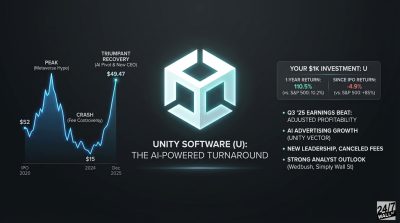
Unity is still recovering from a series of serious errors it made in the past, from feeding its algorithm “bad data” back in 2021 to overcoming the disastrous runtime fee debacle to charge developers for every game of theirs that was downloaded (it ultimately abandoned the idea).
The stock had been making strides over the past year and hit a 52-week high in December. While additional volatility may cause the stock to fall further as the market assesses what Genie 3 really means to its business, the plunge offers investors a unique buying opportunity
Unity remains the dominant player by far in game engines in the sheer volume of games produced with it. This plunge represents a chance to build a position, betting on Unity’s AI pivot and its market leadership.












 Top Gaining Stocks
 Top Losing Stocks