



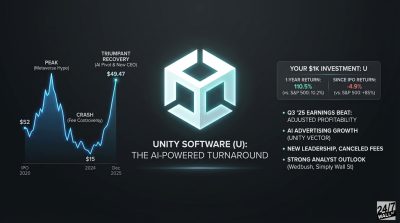
Wall Street loves a comeback story. Unity Software’s recent analyst upgrades tell one version: a company executing a turnaround with improving margins and AI-powered monetization. But the market’s version? A stock down 5% year-to-date while the S&P 500 climbs, trading at 88x forward earnings despite still burning cash. Twenty days before Q4 earnings, the gap between analyst enthusiasm and investor skepticism has never been wider.
The Turnaround Thesis: What Analysts See
The bull case rests on Q3 2025’s surprise beat. Unity Software (NYSE:U | U Price Prediction) posted $0.20 earnings per share against expectations of a $0.23 loss, a 187% beat marking the first profitable quarter in recent memory. Revenue hit $471 million with 5.4% growth, while adjusted EBITDA margins expanded 200 basis points to 23%.
CEO Matthew Bromberg called it an inflection point: “The second quarter of 2025 would ultimately be seen as an inflection point in Unity’s trajectory, the moment where it became clear that the company was poised to deliver sustainable long-term growth.”
The catalyst is Vector, Unity’s AI-powered advertising platform. The Grow segment posted 11% sequential growth in Q3, with management claiming “broad-based improvement across all customer sets, small and big geography, genre.” BTIG upgraded to Buy with a $60 target, citing Vector’s momentum and an Epic Games partnership extending Unity’s monetization tools to Unreal Engine developers.
Four analysts rate Unity a Strong Buy, 12 say Buy, with a consensus target of $47.60 suggesting 14% upside from current levels around $42.
The Skeptic’s Case: What Insiders Know
While analysts upgraded, insiders sold. Between October and January, executives dumped 1.7 million shares with zero offsetting purchases. Director David Helgason sold 708,000 shares at $49 to $51 in December. CEO Bromberg, CFO Yahes, and COO Blum had sales of 130,000 shares on November 25 alone.
This was not bottom-feeding. Insiders sold as the stock recovered from $37 to $52, the exact window when analyst upgrades accelerated. Director Tomer Bar-Zeev liquidated 675,000 shares across that range. If the turnaround were real, why would so many C-suite executive be heading for the exits? Part of planned sales is the usual explanation, but even so, this is a lot of selling!
The valuation tells a similar story. Unity trades at 10x sales despite a $435 million net loss over the trailing twelve months. Operating margins remain negative 27%. The company burns cash funding AI infrastructure while still unprofitable on a GAAP basis. GuruFocus estimates the stock trades at 1.97x intrinsic value with 33% downside potential.
The Developer Trust Problem
Reddit sentiment collapsed from neutral scores of 38-42 in early January to bearish 22-28 by mid-month. The developer community Unity alienated with its disastrous 2023 runtime fee pricing hasn’t forgiven. Discussion volume dropped 50% while negativity intensified, suggesting disengagement rather than reconciliation.
February 11: The Verdict
Q4 earnings will reveal whether Q3 was inflection or anomaly. Management guides for $480-490 million revenue with mid-single-digit Grow segment growth, a deceleration from Q3’s 11% sequential jump. If Vector momentum was real, why the slowdown?
The turnaround has substance: Vector is generating revenue, margins are expanding, and free cash flow turned positive at $151 million in Q3. But insiders selling into analyst upgrades, a skeptical developer community, and valuation multiples pricing perfection suggest Wall Street may be writing checks Unity’s execution can’t cash. The market’s 5% year-to-date decline while analysts pound the table tells you which narrative has more evidence.










 Top Gaining Stocks
 Top Losing Stocks