



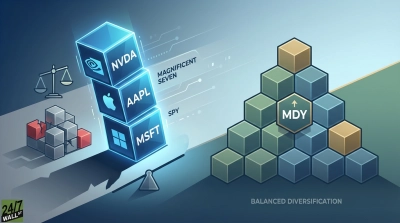
The Nasdaq-100 is dominated by a handful of massive companies, with the top three accounting for more than 20% of the index. That concentration creates a problem: when those few stocks stumble, the entire index feels it. QQEW exists to solve that problem by giving every company equal weight, spreading risk across the full portfolio rather than betting on a few giants.
The fund recently underwent a significant restructuring. As of late December 2025, QQEW shifted from holding all 101 Nasdaq-100 constituents to selecting just 50 companies based on quality and growth scores. This change represents a meaningful evolution from pure equal-weighting to a more selective approach that still maintains equal exposure across chosen holdings.
Equal Weight as a Diversification Tool
QQEW’s return engine is straightforward: it removes the concentration risk inherent in market-cap weighting. Traditional Nasdaq-100 indexing creates a top-heavy portfolio where a handful of mega-caps drive most returns. Equal-weighting changes that dynamic by capping each position at roughly 1.4%, ensuring that smaller innovators like Micron Technology (NASDAQ:MU | MU Price Prediction) and Intuitive Surgical (NASDAQ:ISRG) have the same portfolio influence as Apple (NASDAQ:AAPL) or Microsoft (NASDAQ:MSFT). This approach transforms the index from a bet on a few giants into a diversified play on Nasdaq-100 innovation.
QQEW’s recent performance illustrates the tradeoff inherent in equal-weighting. The fund’s 12.4% gain over the past year lagged the traditional index because 2025 was a year of concentrated mega-cap dominance. When a handful of tech giants drive most market returns, equal-weighting means missing that concentrated rally. The strategy shines when market leadership rotates beyond the largest names. The long-term picture shows a different dynamic, with QQEW delivering strong absolute returns over the past decade and demonstrating the strategy’s ability to capture Nasdaq-100 growth while providing more stability during market rotations.
What You Give Up
The first tradeoff is obvious: you miss the full upside when mega-cap tech dominates. The second is cost, and it’s meaningful. QQEW’s 0.55% annual expense ratio is three times higher than QQQ’s 0.18% fee, a gap that compounds significantly over decades of ownership. The fund also offers minimal income, with a 0.27% dividend yield that provides little cash flow for income-focused investors. These costs are the price of diversification.
QQEW works best for investors who believe Nasdaq-100 returns will come from broader participation rather than continued mega-cap dominance, but expect to pay more in fees and accept lower returns during periods of concentrated tech strength.











 Top Gaining Stocks
 Top Losing Stocks