


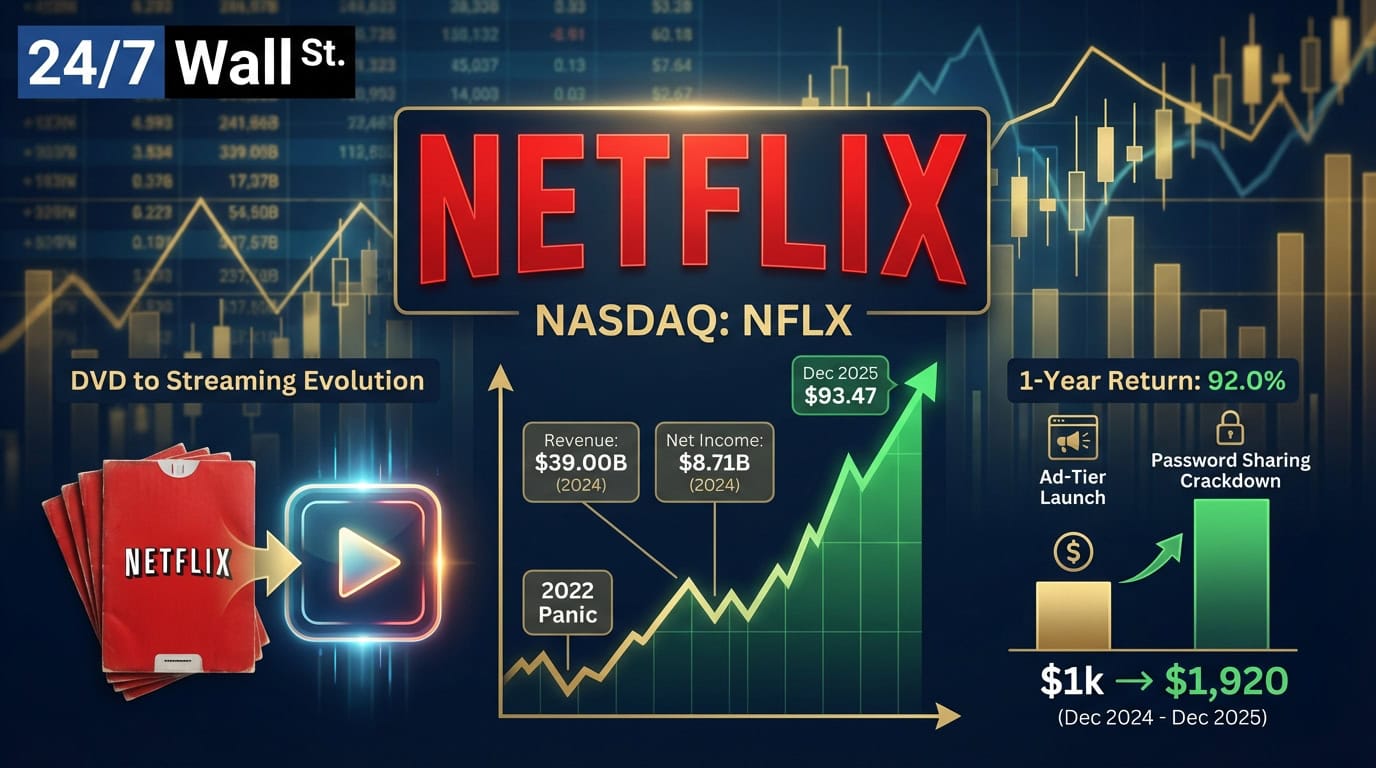
Netflix (NASDAQ:NFLX | NFLX Price Prediction) closed the week at $76.87, down 6.48% from February 6. That’s five times worse than the broader market’s 1.29% decline and leaves the streaming giant down 18% year to date. The stock trades near its 52-week low of $79, a sharp reversal from 2024’s momentum. Three storylines explain what’s happening.
Analysts Maintain Buy Ratings Despite Price Decline
Wall Street maintains positive ratings on Netflix despite the recent plunge. The consensus rating sits at “Moderate Buy” with 30 buy or strong buy ratings against 14 holds or sells. The average analyst target of $111.43 implies 45% upside.
The technical setup supports a contrarian case. The RSI hit 26.8, deep into oversold territory, while the Schaeffer’s Volatility Index sits in the 8th percentile, suggesting excessive bearishness. Options traders are building put positions at the $80 strike, but max pain sits at $90, indicating potential upside if sentiment stabilizes.
The fundamentals remain intact. Revenue grew 17.6% year over year in Q4 2025, operating margins hit 29.5% for full year 2025, and the company generated $2.66 billion in free cash flow last quarter. Renaissance Technologies loaded up on shares recently, signaling institutional confidence.
Warner Bros Acquisition Battle Creates Uncertainty
Netflix’s $82.7 billion all-cash offer for Warner Bros Discovery (NASDAQ:WBD) faces serious headwinds. Activist investor Ancora Holdings, holding a $200 million stake, is pushing Warner’s board to reject Netflix in favor of Paramount Global (NASDAQ:PARA) Skydance’s competing bid.
Paramount sweetened its offer on February 10, adding a “ticking fee” of 25 cents per share per quarter if the deal doesn’t close by year end and pledging to cover Warner’s $2.8 billion breakup fee to Netflix. The tender deadline was extended to March 2.
Investors worry about leverage. Netflix has historically operated with minimal debt and industry-leading margins. Acquiring Warner would fundamentally change that profile, adding significant debt while integrating HBO, HBO Max, and legacy franchises like Game of Thrones and Harry Potter. Regulatory scrutiny from the DOJ and Senate Judiciary Committee adds another layer of risk. A shareholder vote is expected in March 2026.
AI Disruption Fears Hit Media Stocks
Monday.com (NASDAQ:MNDY) dropped 25% this week after withdrawing its 2027 guidance, citing concerns that AI advancements could disrupt its project management business. That spooked investors across software and media sectors.
Another event that’s dropped like a bomb on media stocks is the release of Seedance 2.0 model from Bytedance. The model creates extraordinary videos and is from China, which raises additional fears about models gaining popularity that won’t comply with U.S. infringement laws.
Netflix isn’t immune to AI anxiety, but it does have weapons many other rivals lack. The company is deploying GenAI tools internally and has 85% of devices on its new TV UI, which leverages machine learning for personalization.
The real question is whether AI-generated content or new distribution models threaten Netflix’s moat. So far, the company’s scale and content library provide insulation, but the Monday.com selloff shows how quickly sentiment can shift.
Netflix faces a critical stretch. The Warner acquisition decision, analyst conviction at depressed prices, and broader AI fears in media will define whether this week’s decline is a buying opportunity or the start of a deeper revaluation.












 Top Gaining Stocks
 Top Losing Stocks