


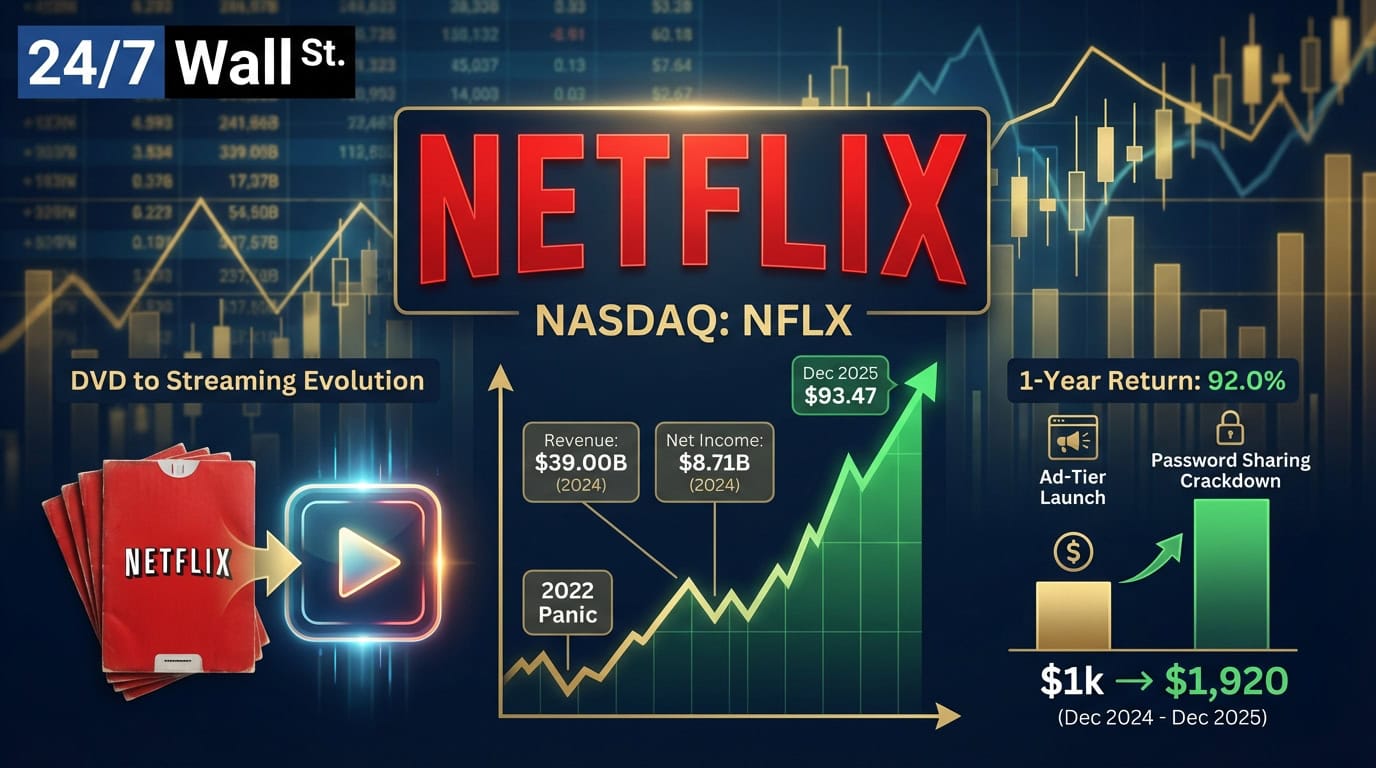
Netflix (NASDAQ:NFLX | NFLX Price Prediction) currently trades around $98.97, while analysts have a consensus price target of about $113.43, implying roughly 14.6% upside from current levels. The stock is down around 26% from its 52-week high in June.
Netflix operates the world’s largest subscription streaming platform, serving over 325 million paid memberships across more than 190 countries. The company is layering advertising revenue, live sports, gaming, and a pending studio acquisition onto its core subscription engine.
Netflix Walks Away From Warner Bros. Deal. Here’s What That Means
Netflix’s stock fell sharply earlier this year, dropping to a low near $77 in February 2026, due to concerns around its now-abandoned Warner Bros. Discovery deal.
The proposed acquisition would have been transformative and risky. Netflix agreed to pay $27.75 per share in an all-cash deal that implied roughly $42.2 billion in financing needs, alongside a total enterprise value near $82.7 billion for the assets. To fund the transaction, the company would have needed a large bridge financing facility. Investors quickly repriced the stock to reflect a more leveraged balance sheet and significant integration risk.
That overhang has now been removed. In late February, Netflix declined to raise its bid after Paramount Skydance increased its offer to $31 per share, valuing the full Warner Bros. Discovery business at around $110 billion. Netflix walked away from the deal and received a $2.8 billion breakup fee. Management has since reinforced that it is unlikely to pursue another major studio acquisition, with co-CEO Ted Sarandos emphasizing that Netflix is focused on building rather than buying.
With the deal now off the table, the investment narrative resets. Going forward, investors are likely to refocus on subscriber growth, pricing power, and margin expansion without the distraction of a large, debt-funded transaction.
Why 51 Analysts Still See a Path Back Above $113
The bull case rests on a simple observation: the operating business never stopped improving. Q4 2025 revenue of $12.05 billion beat estimates and grew 17.6% year over year. Full-year 2025 free cash flow hit $9.46 billion, up 36.68%. Ad revenue more than doubled to over $1.5 billion in 2025 and is expected to roughly double again in 2026. Goldman Sachs upgraded the stock to Buy with a $120 price target, citing “attractive valuation, expected revenue acceleration from price hikes and advertising, and potential capital returns.” The near-term catalyst is Q1 2026 earnings, due April 16, where prediction markets currently assign an 88.5% probability of a beat against the company’s guidance of $0.76 diluted EPS.
Of the 51 analysts covering the stock, 37 rate it a Buy or Strong Buy, 13 rate it a Hold, and 1 rate it a Sell, indicating a 73% bullish consensus versus 2% bearish. Zacks holds a Rank #2 (Buy) on the stock, driven by positive earnings estimate revisions.
The Numbers Tell a Story of Recovery With an Asterisk
Netflix trades at $98.97 against a consensus analyst price target of $113.43, representing roughly 14.6% implied upside. The stock has recovered meaningfully from its February low of $77.00, and is up 5.4% year to date. That compares favorably to the S&P 500, which is down roughly 1.1% on the year through the same period.
Netflix trades at a trailing P/E of 39x and a forward P/E of 31x, reasonable given the company’s earnings growth trajectory. Full-year 2025 net income grew 26.05% to $10.98 billion. Return on equity sits strong near 42.8%, reflecting the capital-efficient streaming model before the acquisition reshapes the balance sheet.
What the Deal Outcome Could Mean for Netflix’s Recovery
The path back to $113 (and higher) is fairly straightforward.
A Q1 earnings beat, continued strength in the ad-supported tier, and a return to share buybacks would all help rebuild investor confidence. U.S. TV time share already hit a record 9.0% in December, and 2026 free cash flow guidance of roughly $11 billion suggests the core business is still accelerating.
The bear case comes down to execution and sentiment. If growth in ads or engagement slows, the recovery could stall. Investors are also watching roughly $141 million in insider selling over the past 90 days, suggesting limited urgency for insiders to step in at current levels. On top of that, an Italian court ruling tied to pricing for 5.4 million users adds a modest legal overhang.
Stepping back, the gap between the current price and the consensus target reflects a market that is still cautious, even as the underlying business improves. The fundamentals look strong, analysts remain broadly bullish, and the stock appears to have absorbed much of the recent volatility. The April 16 earnings report will be the first real test of whether the rebound can hold.












 Top Gaining Stocks
 Top Losing Stocks