


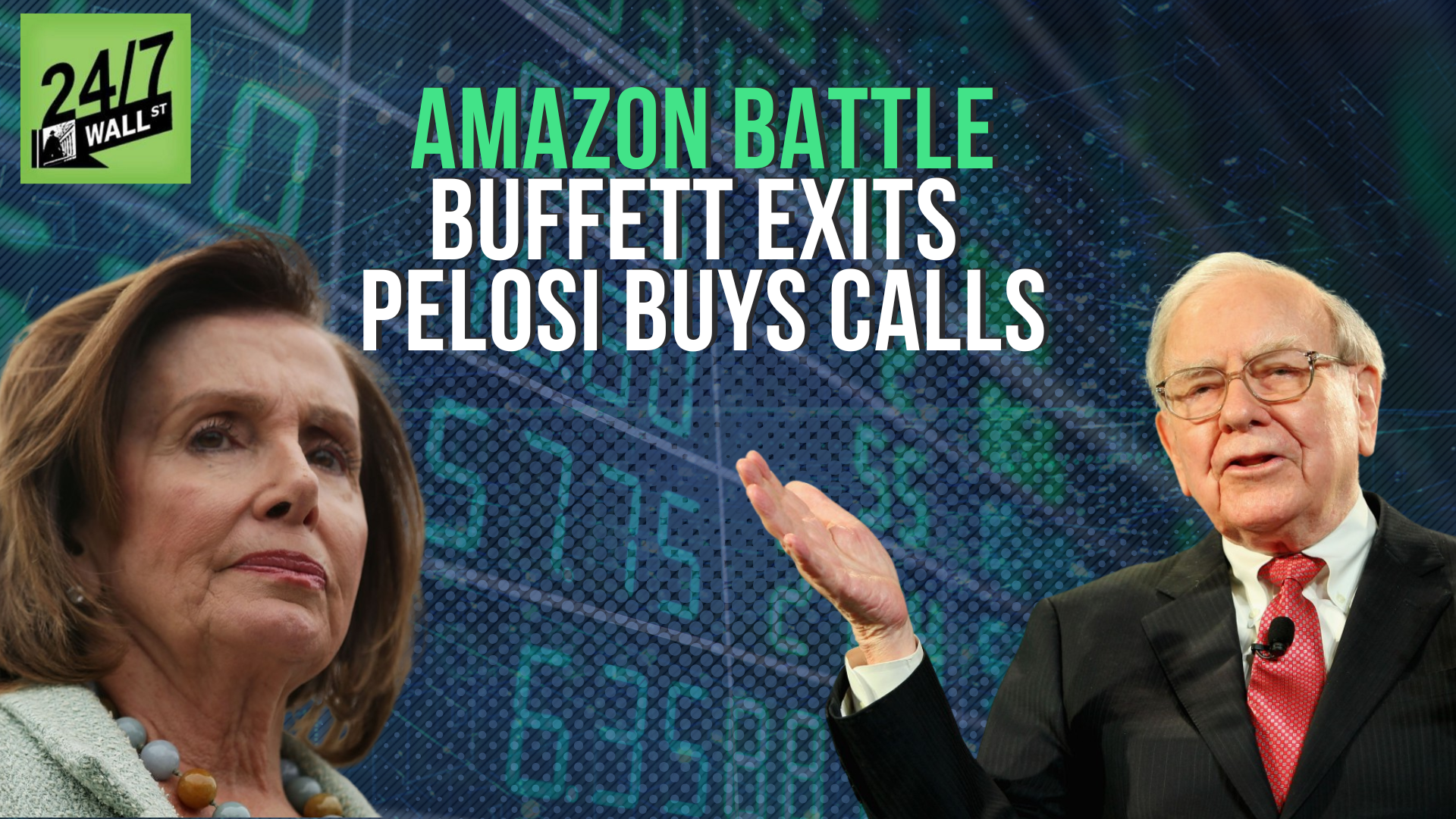
Two of the most scrutinized investors in America just made opposite bets on Amazon.com (NASDAQ:AMZN | AMZN Price Prediction). Warren Buffett’s Berkshire Hathaway dumped 77% of its Amazon stake in the most recent 13F filing, while Nancy Pelosi added Amazon call options in her latest congressional disclosure.
With Amazon down 15.9% over the past month and trading at $201.15, this is one of the most fascinating bull-versus-bear debates in markets right now. Let’s look at the moves from both Pelosi and Buffett to see what they might say about the debate around Amazon today.
The Two Trades
Berkshire slashed its Amazon position by 77%, continuing a pattern of reducing big tech exposure. This follows Berkshire’s well-documented Apple trimming and reflects Buffett’s broader cash-raising mode as the company transitions to Greg Abel’s leadership. Buffett has never been comfortable with businesses he doesn’t fully understand, and Amazon’s sprawling empire of AWS, advertising, and retail may be too complex for his taste.
Pelosi, meanwhile, has been actively trading Amazon. After her family’s account sold 20,000 shares on December 24th, it added 20 call options on the company on December 30th. On January 16th, she exercised calls on Amazon, adding 5,000 shares.
So it appears that after reducing Amazon before Christmas, Pelosi is now once again adding to her holdings in the company, including calls at a $120 strike price that expire next January. However, while Pelosi’s trades have generally led to outstanding returns in recent years, this may not be the bullish signal for Amazon a headline around her ‘purchasing calls on the company’ would lead you to believe, as Pelosi had that large sale right before Christmas.
It’s important to note that Pelosi’s trades are often executed by her husband, who was previously a Venture Capitalist.
The Bear Case: Why Buffett Is Selling
Amazon has entered bear market territory and is currently down 12.9% year to date.
Despite AWS revenue hitting $35.6 billion in Q4 2025 with 24% year-over-year growth – the fastest in thirteen quarters – investors remain nervous about massive AI spending. Amazon plans to deploy $200 billion in capital expenditures in 2026, predominantly in AWS infrastructure.
That spending is compressing margins. While AWS posted a 35% operating margin, CEO Andy Jassy acknowledged headwinds from AI depreciation. Free cash flow remains under pressure as Amazon races to build data center capacity. For Buffett, who prefers simple businesses generating cash today, this may be too much reinvestment for too uncertain a payoff.
Prediction markets reflect this skepticism. On Polymarket, there’s only a 55.5% probability Amazon stays above $200 by month’s end, and just a 3.9% chance it reaches $220.
The Bull Case
The bull case centers on AWS dominance and AI infrastructure leadership. On the February 5, 2026 earnings call, Jassy noted AWS is now a $142 billion annualized run rate business, with 1.4 million Trainium 2 chips already deployed.
Amazon added major enterprise wins, including OpenAI, Visa, BlackRock, and Salesforce. With 66 of 70 analysts rating Amazon a buy and a consensus price target of $281.46, Wall Street sees roughly 40% upside from current levels.
My call: Amazon looks very attractive here. If Andy Jassy had spoken more clearly on the company’s conference call about AWS growth rates staying elevated (for example, growth rates in the high-20s in the back half of 2026), shares would likely be trading for 15% to 20% above where they are today.
Investors are underestimating how well Amazon’s business sets up for the age of AI, where its logistics advantages and early adoption of robotics should give the company powerful margin catalysts.









 Top Gaining Stocks
 Top Losing Stocks