



Amazon is dominating financial headlines right now, and sure, AWS grew 24% in Q4 and the AI story is real. But here’s what you should actually be watching.
I’ve seen this movie before. A company announces a jaw-dropping capex plan, the Street cheers the vision, and retirement accounts quietly absorb the risk. Andy Jassy just told the world Amazon plans to “invest about $200 billion in capital expenditures across Amazon in 2026.” That’s not a growth story. That’s a bet. And energy prices are the variable nobody’s pricing in.
WTI crude is sitting at $71.13 per barrel after surging 10.3% in the past month alone. If oil reaches $100, Amazon’s $200 billion buildout of data centers, fulfillment networks, and satellites becomes dramatically more expensive. Walmart doesn’t. Here’s why.
Point One: Amazon’s Capex Is an Energy Sponge
Amazon added 3.8 gigawatts of power capacity in the past 12 months. Data centers eat electricity. Fulfillment centers run fleets. Satellites require launch infrastructure. Every dollar of that $200 billion capex plan has an energy cost embedded in it that goes up when oil goes up.
The financial signal is already flashing. Amazon’s free cash flow collapsed 65.95% year-over-year in FY2025 even as operating cash flow grew 20.4%. The capex surge is consuming cash faster than the business generates it. Add an oil shock on top of that, and the margin cushion gets thin fast. Amazon explicitly listed energy prices as a risk factor in its forward outlook. They know.
Point Two: Walmart’s Infrastructure Is Already Built
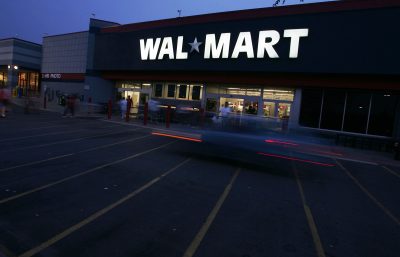
Walmart isn’t in a build phase. The stores exist. The supply chain is established. Store-fulfilled delivery now reaches 95% of U.S. households in under three hours, using physical locations that were already paid for. That’s a toll bridge that doesn’t need new construction when energy gets expensive.
Walmart’s capex discipline tells the whole story: FY26 capital expenditures came in at $26.64 billion, roughly 3.5% of net sales. Amazon is planning to spend $200 billion in a single year. The incremental energy exposure Walmart faces is manageable. Amazon’s is structural.
Point Three: Grocery Anchors Walmart Against a Consumer Pullback
Consumer sentiment is sitting at 56.4 on the University of Michigan index, which is recessionary territory. When oil hits $100, that number goes lower. People stop buying discretionary goods. They don’t stop buying groceries.
Walmart’s grocery-anchored model is designed for exactly this environment. The company reported consistent U.S. comp sales of approximately 4.5% to 4.6% every single quarter of FY26. Not a spike. Not a fluke. Consistent execution. And critically, Walmart is gaining share across all income tiers, led by upper-income households who are trading down as costs rise. That’s the exact customer flow you want when energy inflation bites.
Meanwhile, Walmart’s free cash flow grew 17.88% year-over-year to $14.92 billion in FY26, and the company just authorized a new $30 billion share repurchase program with an annual dividend raised to $0.99 per share for FY27. That’s a company returning cash, not burning it.
Amazon is a great business. But you’re not buying the business at this price, with this capex plan, in this energy environment. You’re buying the hype. Walmart is up 11.12% year-to-date while Amazon is down 7.63%, and the gap will widen if oil keeps climbing. If you’re building a retirement portfolio and oil is moving toward $100, stop chasing the headline and buy the retailer that was built for exactly this moment.











 Top Gaining Stocks
 Top Losing Stocks