



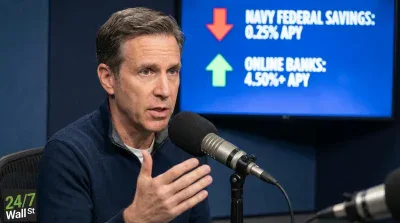
A caller named Javon from North Carolina posed a question on an August 27 episode of The Dave Ramsey Show that a growing number of Americans are wrestling with: should he use a credit union like Navy Federal or an online bank like Ally for day-to-day banking? Ramsey’s answer contained real wisdom but left out a key financial mechanic that changes the math depending on what Javon actually does with his money.
Ramsey is right that credit unions offer genuine advantages, but framing this as a binary choice costs the average saver real money every year. The financially optimal move for most people is to use both institutions for different jobs.
The Rate Gap Is the Story
The core concept here is yield differential: the gap between what two accounts pay on the same deposited dollar. With the federal funds rate sitting at 3.75%, there is meaningful yield available to consumers who seek it out. The problem is that not all financial institutions pass that yield along equally.
Navy Federal’s basic savings account pays well below 1% APY, in line with traditional savings accounts, which has remained well below 1% APY throughout the current rate cycle. Online banks like Ally have consistently offered rates in the range of 3% to 4% APY during the current rate environment, though those rates have declined as the Fed eased from its peak.
Most savers never think about what their savings account actually earns — and that inattention has a real cost. On a typical emergency fund, the gap between a credit union’s standard savings rate and a competitive online account can mean hundreds of dollars in lost interest each year, simply because the money was never moved. That is not a rounding error; it is a recurring annual cost of financial inertia.
The Fed has cut rates from 4.50% in September 2025 to 3.75% today, and online savings rates have followed that trend downward. But the spread between online banks and traditional institutions has remained wide throughout the easing cycle, so the yield advantage of online banking has not evaporated.
Where Credit Unions Actually Win
The case for Navy Federal is strongest on the borrowing side, and this is where Ramsey’s instincts are sound. Credit unions are member-owned, meaning profits flow back to members through lower loan rates and fewer fees rather than to shareholders. For someone financing a car, taking out a personal loan, or buying a home, the difference in loan rates between a credit union and a commercial bank can be substantial over the life of the debt.
Navy Federal serves military-affiliated members and has a track record of competitive rates on mortgages and auto loans. The relationship banking benefits are real: physical branches, personalized service, and lending products a purely digital institution cannot match.
Ally has no physical branches. If you need to deposit cash regularly, resolve a complex issue in person, or want a loan officer who knows your history, an online-only bank creates real friction. These are actual limitations that matter depending on how you bank.
Two Profiles, Two Different Answers
Consider two people who both have $15,000 in savings deciding where to park it.
The first is a 32-year-old active-duty service member who banks primarily through Navy Federal, plans to buy a car within the year, and values having a physical branch near base. Keeping a checking account at Navy Federal makes sense for the relationship and lending benefits. But parking the full $15,000 in a roughly 0.3% APY savings account while competitive online accounts sit above 3% is a costly habit. Moving the bulk of that emergency fund to a high-yield account generates meaningfully more interest each year without sacrificing the credit union relationship.
The second is a 28-year-old remote worker with no near-term loan needs, no preference for in-person banking, and a primary goal of growing an emergency fund. For this person, Ally or a similar online bank is the clear choice. Higher yield, zero monthly fees, and strong mobile tools make it the better fit without meaningful downside.
The U.S. personal savings rate has declined from 6.2% in early 2024 to 3.6% in the fourth quarter of 2025. Americans are saving less, which makes the return on what they do save more consequential. Leaving yield on the table when savings rates are already compressed is a compounding problem.
The Dual-Institution Strategy
The smart approach is not to pick a winner between these two institution types. Use each for what it does well.
A practical setup looks like this:
- Keep a checking account and a small cash buffer at your credit union. This gives you access to competitive loan products, physical branch service, and the relationship benefits that matter when you need to borrow.
- Move your emergency fund and any savings you are not actively spending to a high-yield online savings account. The yield difference on even a modest balance adds up to hundreds of dollars annually that you are otherwise giving up.
- Revisit the setup annually. As the Fed continues its easing cycle, online savings rates will keep adjusting. The Fed has been on a gradual cutting path since September 2025, and rates will likely continue drifting lower. The yield gap may narrow, but the structural advantage of online banks on savings has persisted through multiple rate cycles.
One practical note on security: both credit union deposits and online bank deposits are federally insured up to $250,000 per depositor per institution through the NCUA and FDIC respectively. There is no safety trade-off in using an online bank for savings.
Use Navy Federal for borrowing and transactional banking. Use a high-yield online account to make your savings work harder. The only thing a loyalty-first approach to a single institution costs you is interest income you could have kept.












 Top Gaining Stocks
 Top Losing Stocks