


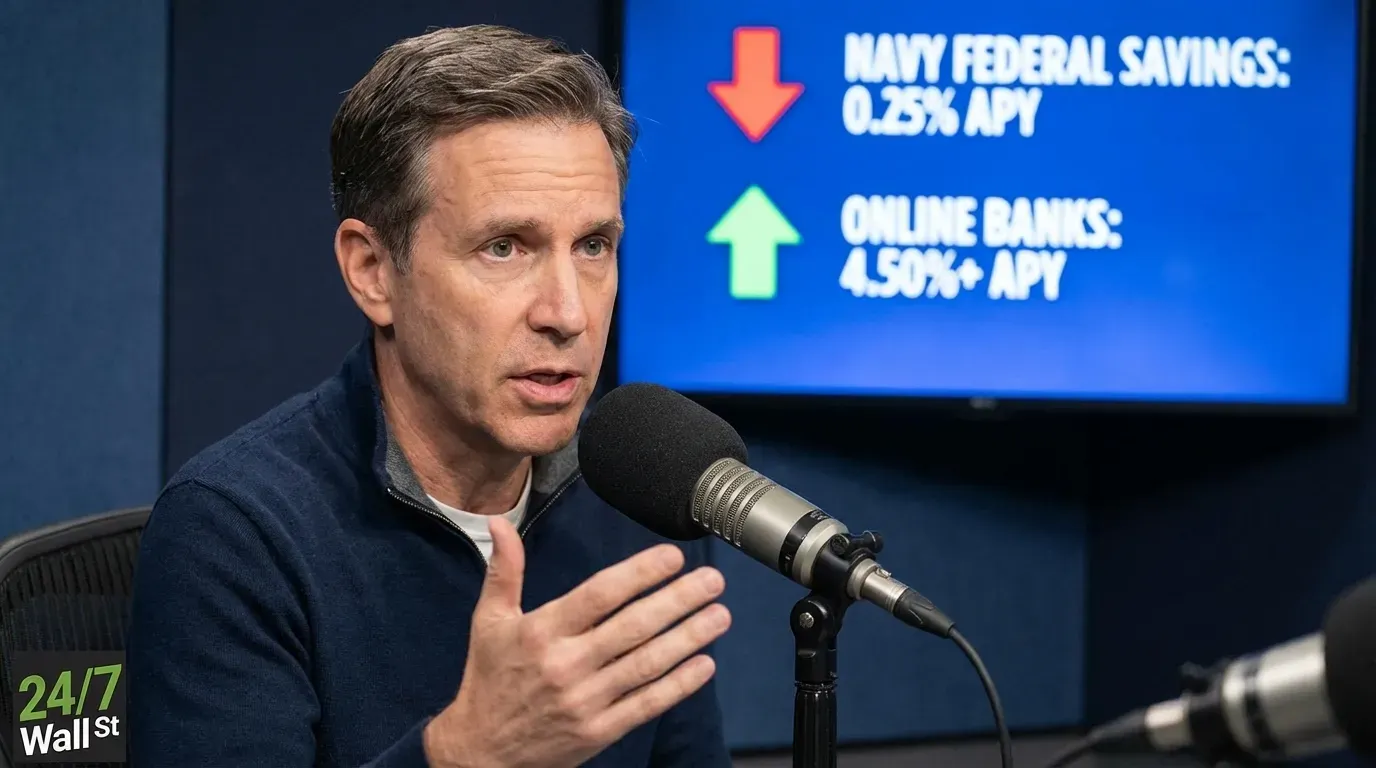
Doreen from North Carolina put the question plainly: she joined Navy Federal Credit Union because Clark Howard recommended it, and now she wants to know why the savings rates are no better than the big banks Howard regularly tells listeners to avoid. It is a fair challenge, and Howard’s answer is worth unpacking because it reveals a structural reality about credit unions that most members never think about until they check their savings balance.
Howard’s Verdict: Navy Federal Is Built for Borrowers, Not Savers
Howard did not dodge the question. “Credit unions, which Navy Federal is, USAA is a federal savings bank, but is there for the benefit of the members. They are both what’s known as borrower-friendly credit unions more than saver-friendly credit unions,” Howard explained. His advice was direct: “If you’re sitting with a pile of cash, you want that in a high-yield savings account with an online bank, or you want to place the money, if you’re doing CDs, through a discount broker like Schwab, Vanguard, or Fidelity.”
Howard is right, and the contrast is stark. Navy Federal’s standard savings account currently pays 0.25% APY. Meanwhile, online banks are offering rates that dwarf that figure, in some cases approaching or exceeding rates more than fifteen times higher as of mid-March 2026. For members sitting on meaningful cash reserves, the difference translates into hundreds or even thousands of dollars in foregone interest each year. That is not a rounding error; it is a structural disadvantage for savers who stay put.
Why the Rate Gap Exists and What It Means
Credit unions are member-owned nonprofits. Their surplus goes back to members, but the form that benefit takes depends on the institution’s focus. Navy Federal has built its competitive advantage on the lending side: Howard noted their “rates on loans, vehicle loans, mortgages, home equity lines of credit, interest rates on credit cards that are vastly better than you’re going to get from a typical bank.” A borrower who finances a car or a home through Navy Federal can save thousands in interest over the life of that loan. That is a real, tangible benefit. A saver parking emergency funds there is getting almost nothing in return.
The broader rate environment makes the comparison even more striking. The Federal Reserve’s benchmark rate currently sits at 3.75% Even after recent cuts, online banks are still passing meaningful yields on to depositors. The 10-year Treasury yield stands at 4.23%, which is why brokered CDs through platforms like Charles Schwab (NYSE:SCHW | SCHW Price Prediction), Vanguard, or Fidelity remain attractive, often matching or exceeding that yield with FDIC or NCUA insurance protection.
Inflation adds urgency to this. The Consumer Price Index reached 327.5 in February 2026, up from 319.8 a year earlier. Purchasing power erodes steadily when your savings account pays 0.25% while prices keep rising. Every year that money sits at a sub-1% rate is a year your real wealth declines.
Who Should Stay and Who Should Move Their Cash
If you are a Navy Federal member who carries a mortgage, auto loan, or credit card balance through the institution, the membership still makes sense. The lending rates justify the relationship. A member who financed a vehicle at a rate meaningfully below what a traditional bank offered is already ahead, even if their savings account pays next to nothing.
The problem is when members treat Navy Federal as a one-stop shop for all their financial needs. Military families and home-buyers are leaving real money on the table. A military family with a $30,000 emergency fund sitting in a Navy Federal savings account earns a fraction of what the same balance would generate in a high-yield savings account at current online bank rates. Over several years, the difference compounds to a meaningful sum in foregone interest, particularly for families managing a tight budget.
The second scenario is a member holding $80,000 in cash while waiting to deploy it toward a home purchase. Parking that sum in a brokered CD ladder through Schwab or Fidelity at current rates could generate substantially more interest over 12 months than leaving it in a Navy Federal savings account. The opportunity cost is hard to ignore when the tools to capture that yield are a free brokerage account away.
The personal savings rate has fallen from 6.2% in early 2024 to 4% by the end of 2025. Americans are saving less even as incomes rise, which makes squeezing every available basis point out of the money they do save more important, not less.
What to Actually Do With This Information
The practical move is straightforward: keep your Navy Federal membership for its lending products and use it as your primary transactional account if you value the service. Open a separate high-yield savings account at an online bank for your emergency fund and short-term cash reserves. For cash you will not need for six months or more, compare CD rates through a brokerage account at Schwab, Vanguard, or Fidelity, where you can often find rates competitive with or above current Treasury yields.
To compare CD options, visit the brokerage platforms directly and filter by maturity date and yield. For high-yield savings accounts, sites like Bankrate and NerdWallet publish updated rate comparisons weekly. The accounts are free to open, carry FDIC insurance up to $250,000, and require no ongoing relationship with a bank you do not otherwise use.
Howard’s endorsement of Navy Federal has always been about the borrowing side of the ledger. Doreen’s question was smart because it identified the part of the recommendation that does not apply to her situation. A credit union that excels at lending is worth belonging to. It just should not be where your savings live.












 Top Gaining Stocks
 Top Losing Stocks