


The right investment products can turn your financial dreams into a reality. Baby boomers are navigating an uncertain global market and looking for investments that can generate steady passive income. They’re looking for income-generating assets and capital preservation. But this doesn’t have to mean a high-risk investment that generates a minimal payout.
However, if you’re tired of the 2% or 3% yields, consider exchange-traded funds that have a high yield. They’ll carry a little risk but are established ETFs that have a history of generating passive income. I’ve identified 5 high-yield ETFs that pay up to 10%. Let’s dive deep into them.
Global X SuperDividend ETF
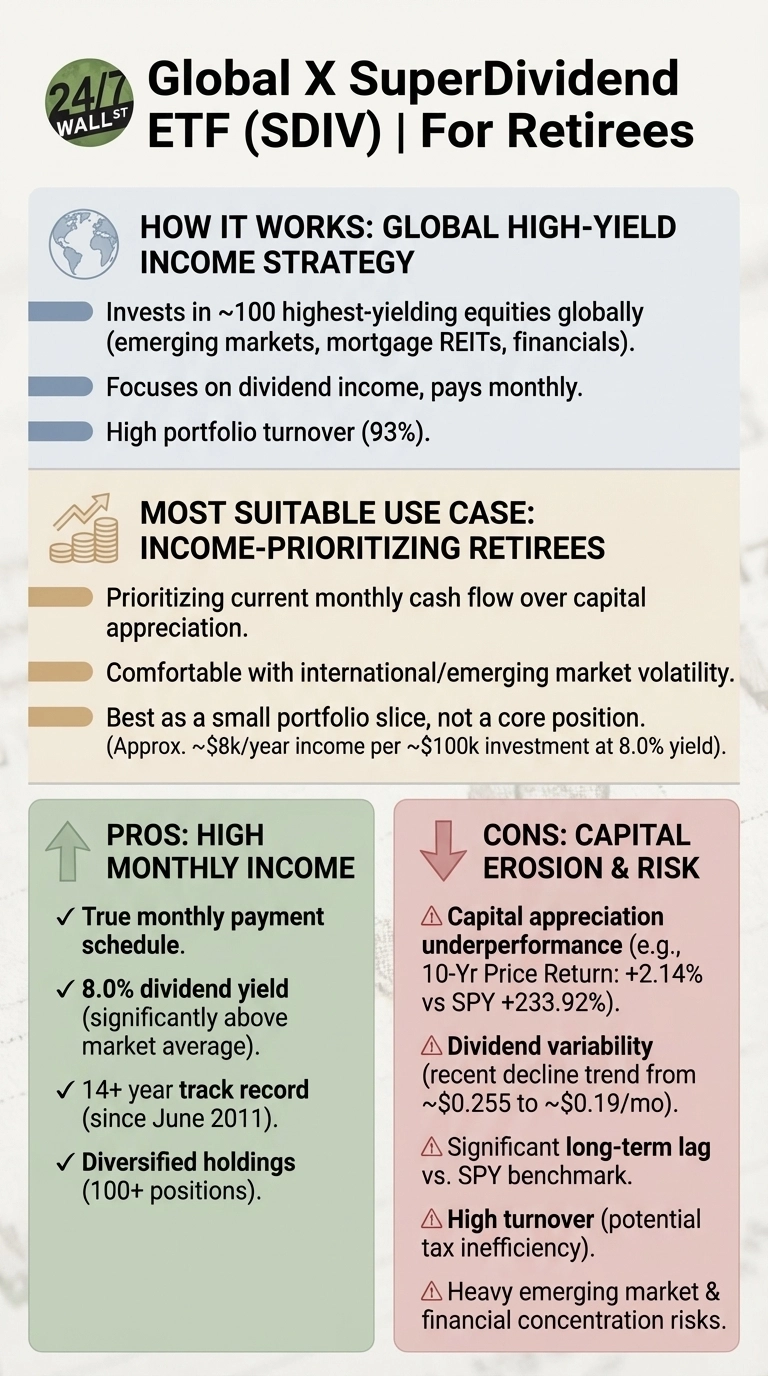
The Global X SuperDividend U.S. ETF (NYSEARCA:SDIV) offers an opportunity to own the best stocks globally. The fund invests in 100 of the highest dividend-paying stocks in the world to increase the fund’s yield. It invests in 106 stocks and has a distribution rate of 9.01%. SDIV has $1.33 billion in assets under management and an expense ratio of 0.58%.
SDIV has generated an average annualized 1-year return of 28.27% and a 3-year return of 11.43%. It has the highest allocation in the financial sector at 31.8%, followed by real estate at 20% and energy at 18%.
Country-wise, the fund invests 27.8% in the United States, 15% in Brazil, and 10.6% in Britain. While the holdings may be unfamiliar, they’re carefully picked by the fund managers to ensure a high yield. It paid an annual dividend of $2.30 per share in 2025.
SDIV has gained 5.25% so far this year and is exchanging hands for $25.47.
JPMorgan Nasdaq Equity Premium Income ETF
An excellent fund for passive income investors, the JPMorgan Nasdaq Equity Premium Income ETF (NYSEARCA:JEPQ) has a covered call strategy that has helped it maintain a yield of 11.38%. The fund invests in top-quality blue-chip stocks that have a history of steadily paying dividends. It then writes out-of-the-money call options to generate a monthly distributable income. This is an ETF that will give you a monthly paycheck.
It has an expense ratio of 0.35% and holds 108 stocks. About 40% of the portfolio is allocated towards technology, which is why the top 10 holdings include the Magnificent Seven. The tech-heavy portfolio has generated impressive returns as the industry booms.
JEPQ generated a cumulative 1-year return of 15.76% and a 3-year return of 87.18%. Since the fund maintains a high dividend yield, the capital appreciation is limited. The ETF has remained flat in 2026 and is exchanging hands for $57.62.
State Street SPDR S&P International Dividend ETF
The State Street SPDR S&P International Dividend ETF (DWX) is similar to SDIV and invests in global stocks that have a strong dividend history. It invests in 100 high-yielding stocks, and no country or sector has a weightage higher than 25%, and no stock has a weightage higher than 3%. You get to own the best dividend stocks outside the U.S.
The fund invests in 102 stocks and has a yield of 4.27%. Geographically, it has the highest allocation in Japan (24.75%), followed by France (12.28%) and the United Kingdom (9.89%). Sector-wise, it invests 16.4% in financials, 13% in consumer staples, and 12.9% in communication services. DWX has an expense ratio of 0.45%.
It has generated a 1-year return of 38.28% and a 3-year return of 18.03%. The fund has gained 4.5% in 2026 and is exchanging hands for $46.05. This high-yield ETF could power your portfolio higher.
JPMorgan Equity Premium Income ETF
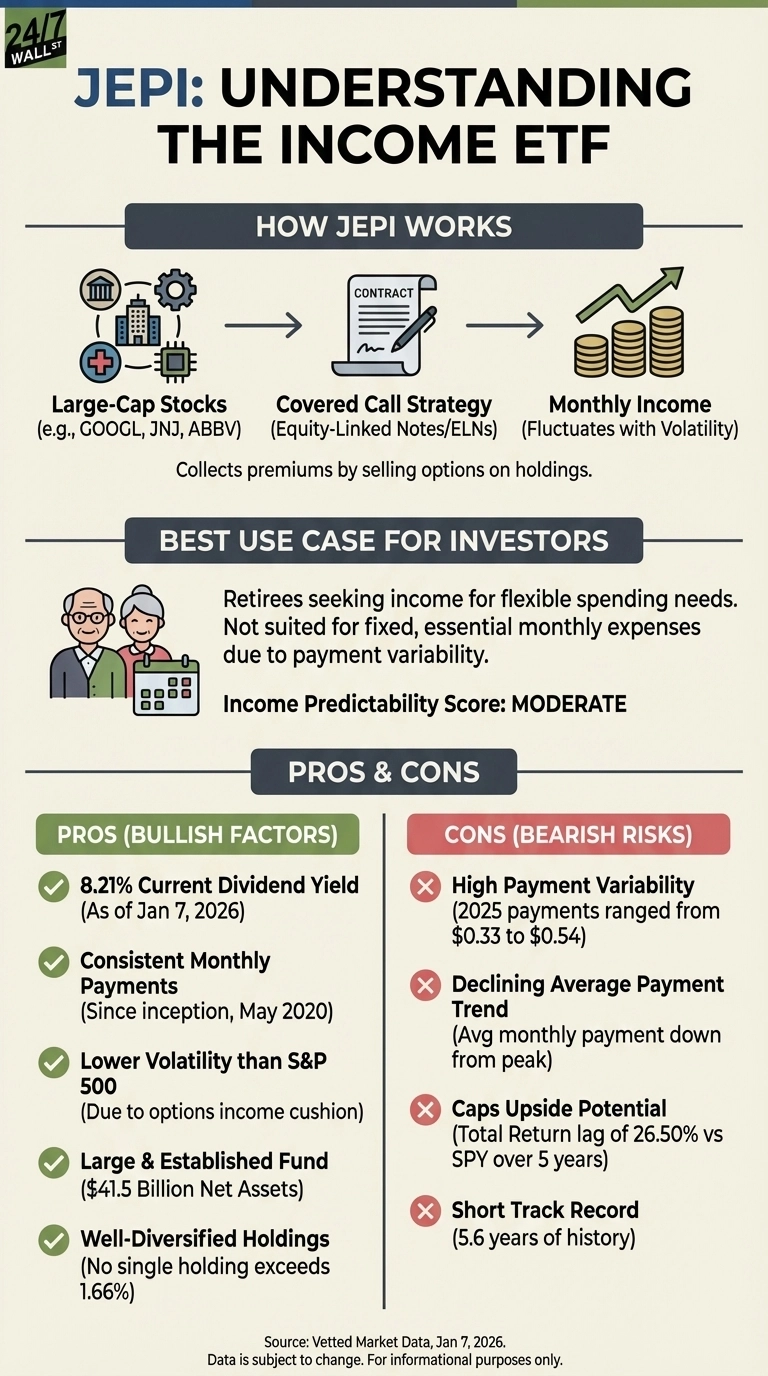
The JPMorgan Equity Premium Income ETF (NYSEARCA:JEPI) has remained a favorite of retirees and baby boomers for a reason. The fund generates monthly passive income and has a juicy yield of 8.13%. It is similar to JEPQ and has a covered call strategy that generates a premium. It has expert portfolio managers that identify the top blue-chip stocks and add them to the portfolio.
JEPI has generated a cumulative 1-year return of 9.55%, a 3-year return of 41.39%, and a 5-year return of 66.40%. It invests in 123 stocks with the highest allocation to the information technology sector at 15%, healthcare at 12.5%, and industrials at 12.3%. The top 10 holdings include dividend kings like Johnson & Johnson, PepsiCo, and NextEra Energy.
The fund has an expense ratio of 0.35% and is exchanging hands for $58.19. It offers a simple trade-off: steady passive income for limited capital appreciation. JEPI ensures low volatility, has a defensive portfolio, and offers downside protection during market uncertainty.
Invesco KBW Premium Yield Equity REIT ETF
With an attractive yield of 7.93%, the Invesco KBW Premium Yield Equity REIT ETF (KBWY) is another fund boomers are loading up on. The fund invests in small-cap and mid-cap equity real estate investment trusts (REITs) that have competitive dividend yields. It holds 30 stocks and has an expense ratio of 0.35%.
KBWY is 100% invested in one sector, and some of its top holdings include Alexandria Real Estate Equities Inc., Innovative Industrial Properties Inc., Gladstone Commercial Corp., and Global Net Lease Inc. The ETF is riskier than the others mentioned here, but since it invests in an REIT, the dividends remain consistent. An REIT is required to distribute 90% of the earnings to shareholders, thus ensuring steady payouts.
The fund pays monthly dividends and has recently announced a dividend of $0.12 per share. KBWY has gained 1.86% in 2026 and is exchanging hands for $15.86.














 Top Gaining Stocks
 Top Losing Stocks