



Nike (NYSE:NKE | NKE Price Prediction) shares are down 11% in early Wednesday trading, reacting to a quarterly earnings report that beat estimates on the surface but delivered a forward outlook that rattled investors. The stock closed Tuesday at $52.82, and today’s selloff pushes NKE stock toward levels not seen in years.
The headline numbers looked passable. Nike reported Q3 FY2026 revenue of $11.3 billion, slightly above estimates, with diluted EPS of $0.35 against a consensus of $0.28, a 24.25% beat. However, investors sold first and asked questions later, because what management said about the road ahead was far less encouraging than what it reported for the quarter just ended.
The stock is now down 17% year-to-date and 60% over five years. That five-year number is the one that keeps long-term shareholders up at night, and it frames the central question every investor is asking this morning: is Nike a generational buy at these levels, or has the brand structurally lost its edge?
Guidance Cut Sparks the Selloff
The market’s reaction is almost entirely about what comes next. Nike’s management guided for an anticipated revenue decline of 2% to 4% in the upcoming quarter, a signal that the recovery CEO Elliott Hill has been promising is still more promise than reality. That forward warning, layered on top of persistent margin pressure, is what drove the gap down.
Furthermore, Nike’s gross margin contracted 130 basis points year-over-year to 40.2%, pressured by tariff-driven cost increases in North America. Operating income declined 19.42% year-over-year to $635 million, and net income fell to $520 million, down 34.51% year-over-year. These numbers reflect a company still deep in its restructuring phase.
Greater China sales remain a stubborn issue. Nike’s China sales contracted 16% year-over-year, and there is no clear timeline for normalization. Additionally, Converse revenues collapsed 35% with EBIT turning negative, adding another layer of concern about Nike’s portfolio depth beyond its core brand.
Analysts Are Divided on What Comes Next
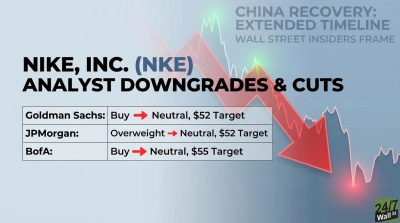
The analyst reaction has been sharp and split. JPMorgan Chase (NYSE:JPM) cut its Nike stock price target from $86 to $52, a dramatic reduction that now essentially matches yesterday’s closing price and implies the stock is fairly valued even after the drop. That’s a sobering signal from one of the Street’s most closely watched research desks.
On the other side, BofA Securities analyst Lorraine Hutchinson maintained a Buy rating with a $73 price target, pointing to North American progress and wholesale channel recovery as reasons to stay constructive. The broader analyst consensus sits at a $74.97 target price, with 23 buy ratings, 14 holds, and just 2 sells. The institutional community, on balance, still believes the stock is worth considerably more than where it trades today.
For more context on how Wall Street has framed Nike’s valuation, this analysis breaks down why the $76 target has looked increasingly difficult to defend.
Bull Case vs. Bear Case
The bull case rests on a few durable pillars. Nike remains the world’s largest athletic footwear and apparel brand, with a global distribution network and marketing infrastructure that no challenger has come close to replicating at scale.
For what it’s worth, Nike has raised its dividend for 24 consecutive years, paying $0.41 per share quarterly, a signal that management retains confidence in long-term cash generation even through the current downturn. Moreover, the upcoming FIFA 2026 World Cup represents a meaningful marketing catalyst that could reinvigorate Nike’s brand momentum globally.
The bear case has grown more concrete: On Running, Hoka, and New Balance have each gained measurable market share among younger consumers, a demographic Nike has historically owned. On the other hand, NIKE Direct revenues declined 4% and digital revenues declined 9%, two channels that were supposed to be the growth engine of Nike’s next chapter. Structural tariff headwinds show no sign of easing.
Reddit sentiment on NKE stock shifted sharply post-earnings, moving from bearish scores of 22 to 28 pre-earnings to bullish readings of 64 to 72 after the report. Retail investors appear to see dislocation. Whether that instinct proves correct depends almost entirely on whether Hill’s “Win Now” restructuring can deliver visible revenue growth before patience runs out.
Generational Buy or Value Trap?
You should consider the bull case if you believe Nike’s brand equity is temporarily impaired rather than permanently damaged, and that the World Cup cycle plus wholesale recovery can stabilize revenue by fiscal year-end. Yet, you should stay cautious if you believe the China recovery timeline and competitive erosion represent structural, not cyclical, problems.
The stock’s prior 52-week low was $50.95, and today’s move is pushing that floor lower. How well Nike stock holds the $45 level into the close will signal whether institutional buyers are stepping in or standing aside.










 Top Gaining Stocks
 Top Losing Stocks