


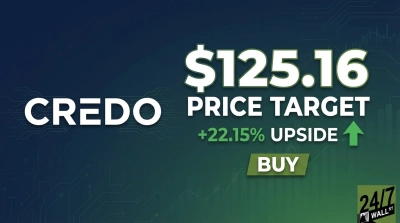
Credo Technology (NASDAQ:CRDO | CRDO Price Prediction) has risen 212% over the past year, climbing from $35.30 in April 2025 to $110.21 today. If you watched that move from the sidelines, the question is obvious: is there anything left, or did you miss it?
The entry here carries real risks that deserve a clear look before acting.
Valuation: Expensive, But the Forward Picture Is Different
At first glance, the valuation looks stretched. The trailing price-to-earnings ratio sits at 56x, and the stock trades at 18x trailing sales. Those numbers would give any retirement-focused investor pause.
The forward picture is more compelling. The forward P/E drops to 22x, reflecting the pace at which earnings are growing into the current price. Non-GAAP diluted EPS has moved from $0.25 in Q3 FY2025 to $1.07 in Q3 FY2026 in the span of four quarters. Revenue grew 201.5% year over year to $407.0 million, beating the consensus estimate of $387.6 million. When a company is growing earnings at this rate, a trailing multiple is a misleading lens.
Forward Catalyst: The Growth Engine Has Not Stalled
The reason to stay interested is that Credo’s growth is not a one-product story running out of runway. Active Electrical Cables remain the primary driver, but management announced three new market expansions in Q3: ZeroFlap optics, Active Line Cards, and OmniConnect memory solutions, each targeting what CEO Bill Brennan called “multi-billion dollar TAM expansions.”
Q4 FY2026 guidance calls for revenue of $425.0 million to $435.0 million, sequential growth from an already-record quarter. The company carries $1.22 billion in cash with $188.5 million in total liabilities, a balance sheet that supports continued investment without financial stress. Wall Street has taken notice: 15 of 16 analysts rate the stock a buy or strong buy, with a consensus price target of $199.38.
Risk and Entry: Where the Caution Lives
Three risks deserve direct attention. First, gross margin is compressing. Q4 guidance puts non-GAAP gross margin at 64.0% to 66.0%, down from 68.6% in Q3 as new product lines ramp. That compression is manageable if revenue continues growing, but it bears watching.
Second, insider selling has been persistent. The CEO and CTO both sold shares across January and March 2026, with the CTO selling as recently as March 31, 2026 at prices in the $88 to $93 range. There were zero insider purchases in the dataset. Insider selling at multiple price levels, including well below where the stock trades today, is a signal worth factoring in.
Third, the stock carries a beta of 2.72, meaning it moves roughly 2.7 times the market in either direction. The stock has already pulled back 33% from its September 2025 peak of $164.42. The bear case scenario puts the stock at $97.81 over the next 12 months. For a retiree with limited tolerance for drawdowns, that is a meaningful risk.
The Verdict
Credo’s fundamentals remain intact: record revenue, $1.22 billion in cash against $188.5 million in total liabilities, and a product roadmap that extends well beyond its current offerings. The stock is not cheap on trailing metrics, but the forward multiple of 22x is reasonable given the growth trajectory. The pullback from the peak has created a more rational entry point than existed six months ago.
The forward multiple of 22x, combined with a product roadmap extending beyond current offerings, gives investors a clearer picture than the trailing metrics suggest. With the next earnings report on June 1, 2026 serving as the first meaningful test of whether the Q4 guidance holds, that date is the key near-term signal to watch — particularly given the beta of 2.72 and the persistent insider selling.









 Top Gaining Stocks
 Top Losing Stocks