


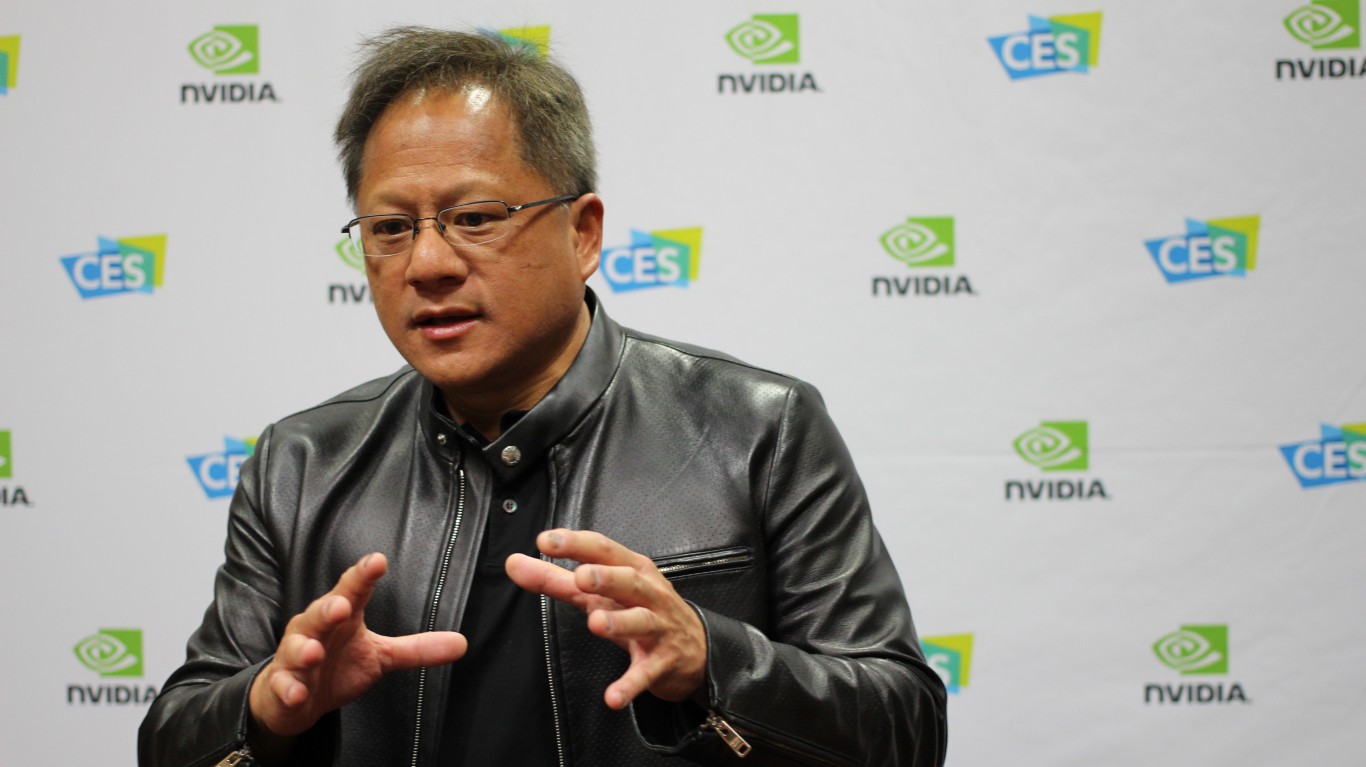
NVIDIA (NASDAQ:NVDA | NVDA Price Prediction) chief Jensen Huang treats Clayton Christensen’s The Innovator’s Dilemma as his personal operational doctrine. On a recent Motley Fool Money podcast episode, the hosts discussed how Huang has spent decades using the theory as a defense playbook, going as far as to hire Christensen as a consultant, and structuring the company around the threat of disruption from below. Author Steven Witt, whose book The Thinking Machine won the 2025 Financial Times and Schroders Business Book of the Year award, provided field research confirming it worked.
The Philosophy of Studying How Incumbents Die
Huang built his strategy around understanding how dominant companies lose and avoiding such a fate. Honda entered the U.S. with low-end dirt bikes in the 1960s, then moved upmarket into cars and minivans. Over time, Honda and Toyota took meaningful share from General Motors.
By the mid-2000s, Huang saw a similar threat forming. Instead of defending the high-margin market, he chose to invest in lower-margin products in smaller markets that most incumbents would ignore. He effectively treated Christensen’s framework as a playbook, operating on the belief that NVIDIA is always on the verge of disruption. Internally, that translated into a mindset that the company is “30 days from going out of business” at any given time.
Nvidia’s “Self-Disruption as Policy”
Huang ships expensive supercomputing software with every card the company sells, including the consumer GPUs at Best Buy, as a defensive moat. The strategy launches numerous initiatives simultaneously, knowing many will fail, on the theory that one winner makes the losses irrelevant. The journey was not smooth, with NVIDIA’s stock dropping 90% twice in the first 15 years.
The cadence continues today. Huang told investors in February that “Grace Blackwell with NVLink is the king of inference today, delivering an order-of-magnitude lower cost per token, and Vera Rubin will extend that leadership even further.” Each architecture cannibalizes the prior one before competitors can catch up.
Owning a Market Before It Exists
Speaking with Motley Fool Chief Investment Officer Andy Cross at a San Diego member event, author Steven Witt asked: “Who was building robotic inference chips in 2017 when there was no robotics industry trying to buy this stuff? It was Jensen, and it was NVIDIA.”
“I’ve talked to maybe 40 robotics manufacturers in the past 3 or 4 months. Every single one without exception runs on an NVIDIA Thor chip in its brain,” Witt said, referring to the Jetson Thor robotics platform.
Huang made self-disruption a core operating principle, even when it meant sacrificing near-term economics. NVIDIA consistently invested in markets that did not yet exist, and then scaled into them as demand arrived.











 Top Gaining Stocks
 Top Losing Stocks