


The “Dogs of the Dow” is a well-known strategy first published in 1991 by Michael O’Higgins. The plan aims to maximize investment returns by purchasing the 10 highest-yielding dividend stocks in the Dow Jones Industrial Average each year. The highest-yielding stocks are also the lowest-priced stocks in the venerable average, as the lower a stock (or bond) is priced, the higher the attached yield or coupon becomes.
Since the turn of the century, the Dogs of the Dow have outperformed the overall Dow and the Small Dogs of the Dow, which are the five highest-yielding stocks, even more so. The fact that investors are buying the highest-yielding companies in the venerable index improves the chances for total return gains. From 2000 through the early 2020s, the Dogs strategy posted strong average annual returns, generally beating the Dow by a few percentage points over the entire period. The plan is not foolproof; it struggled during the dot-com bust (early 2000s) and the tech-driven growth surge post-pandemic (2020-2021), when growth stocks soared, and value stocks lagged. The Dogs also lagged in 2025 as the AI-driven rally continued for the third straight year.
The Dogs often shine in tough markets (like 2008 or 2022), protecting investors’ capital much better than the broader market by holding stable, high-yielding blue-chip companies. This makes them an excellent choice for Baby Boomers searching for safety and passive income. While the AI/data center rally has pushed stocks and indices to all-time highs, it could still be a force the rest of 2026. The reality is that the stock market, as measured by the S&P 500, is expensive, trading at 28 times trailing earnings and 20.9 times forward earnings. With the midterm elections on the way this year, investors can expect heightened volatility, so the Small Dogs may be the perfect play for 2026 for growth and income investors wary of a major sell-off, which could be much larger than the recent quick correction.
Why do we cover the Dogs of the Dow?

Dividend stocks like the Small Dogs of the Dow offer investors a reliable source of passive income. Passive income generates revenue without requiring the earner’s continuous active effort, making it a desirable financial strategy for those seeking to diversify their income streams or achieve financial independence. We listed the current Small Dogs from highest yield to lowest. All of the Small Dogs are rated Buy at the top Wall Street firms we cover.
Verizon
Verizon Communications (NYSE: VZ | VZ Price Prediction) is an American multinational telecommunications company that continues to offer tremendous value. It trades at 9.13 times its estimated 2026 earnings and pays a 5.76% dividend. Verizon provides a range of communications, technology, information, and entertainment products and services to consumers, businesses, and government entities worldwide.
Verizon’s trailing 12-month interest coverage ratio is 4.6× to 5×, providing ample cushion for dividend payments. With a very predictable revenue stream from telecom services, the company has less exposure to commodity cycles. In addition, the large scale helps in financing and absorbing shocks.
It operates in two segments:
- Verizon Consumer Group
- Verizon Business Group
The Consumer segment provides wireless services across the United States through Verizon and TracFone networks, as well as through wholesale and other arrangements. It also provides fixed wireless access (FWA) broadband through its wireless networks and related equipment and devices, such as:
- Smartphones
- Tablets
- Smartwatches
- Other wireless-enabled connected devices
The segment also offers wireline services in the Mid-Atlantic and northeastern United States through its fiber-optic network, Verizon Fios product portfolio, and copper-based network.
The Business segment provides wireless and wireline communications services and products, including:
- FWA broadband
- Data
- Video and conferencing
- Corporate networking
- Security and managed network
- Local and long-distance voice
Network access services to deliver various IoT services and products to businesses, government customers, and wireless and wireline carriers in the United States and internationally.
Raymond James has an Outperform rating with a $56 target price.
Chevron
Chevron (NYSE: CVX) is an American multinational energy company primarily focused on oil and gas. It is a safer option for investors looking to position themselves in the energy sector, and it pays a substantial 3.56% dividend, which was raised by 5% earlier this year. Chevron operates integrated energy and chemicals businesses worldwide through its subsidiaries. Berkshire Hathaway bought a very well-timed 8 million additional shares in the fourth quarter and now owns 130.15 million shares, which equal 6.5% of the float and 8% of the portfolio.
The company operates in two segments. The Upstream segment is involved in the following:
- Exploration, development, production, and transportation of crude oil and natural gas
- Processing, liquefaction, transportation, and regasification associated with liquefied natural gas
- Transportation of crude oil through pipelines, and transportation, storage
- Marketing of natural gas, as well as operating a gas-to-liquids plant
The Downstream segment engages in:
- Refining crude oil into petroleum products
- Marketing crude oil, refined products, and lubricants
- Manufacturing and marketing renewable fuels
- Transporting crude oil and refined products by pipeline, marine vessel, motor equipment, and rail car
- Manufacturing and marketing of commodity petrochemicals, plastics for industrial uses, and fuel and lubricant additives
It also involves cash management, debt financing, insurance operations, real estate, and technology businesses.
Wells Fargo has an Overweight rating with a $222 target price.
Procter & Gamble
Procter & Gamble (NYSE: PG) was founded more than 185 years ago as a soap-and-candle company. It has paid dividends to shareholders since 1891, raised them for 70 straight years, and currently pays a 2.87% dividend. The company focuses on providing branded consumer packaged goods worldwide.
This is one of the most widely held Dividend Kings, with a portfolio of essential consumer brands that generate steady cash flow through all economic cycles. Procter & Gamble remains a favorite among retirees because its products are used in millions of households every single day. Even during economic downturns, consumers continue buying P&G products, which helps support reliable dividend payments.
The company’s segments include:
- Beauty
- Grooming
- Health Care
- Fabric & Home Care
- Baby
- Feminine & Family Care
The company’s products are sold in approximately 180 countries and territories primarily through mass merchandisers, e-commerce, including social commerce channels, grocery stores, membership club stores, drug stores, department stores, distributors, wholesalers, specialty beauty stores, including airport duty-free stores, high-frequency stores, pharmacies, electronics stores, and professional channels. It also sells directly to individual consumers. It has operations in approximately 70 countries.
Procter & Gamble offers products under such brands as:
- Head & Shoulders
- Herbal Essences
- Pantene
- Rejoice
- Olay
- Old Spice
- Safeguard
- Secret
- SK-II
- Braun
- Gillette
- Venus
- Crest
- Oral-B
- Ariel
- Downy
- Gain
- Tide
- Always
- Always Discreet
- Tampax
- Bounty
Jefferies has a Buy rating with a $175 price objective.
Merck
Merck (NYSE: MRK) develops and produces medicines, vaccines, biological therapies, and animal health products. It is not just a healthcare company but a global force in the industry, paying a solid 3% dividend after raising it for 15 consecutive years.
Merck operates through two segments. The Pharmaceutical segment offers human health pharmaceutical products in:
- Oncology
- Hospital acute care
- Immunology
- Neuroscience
- Virology
- Cardiovascular
- Diabetes
- Vaccine products, such as preventive pediatric, adolescent, and adult vaccines
The Animal Health segment discovers, develops, manufactures, and markets veterinary pharmaceuticals, vaccines, health management solutions and services, and digitally connected identification, traceability, and monitoring products.
Merck serves:
- Drug wholesalers
- Retailers
- Hospitals
- Government agencies
- Managed healthcare providers, such as health maintenance organizations
- Pharmacy benefit managers and other institutions
- Physicians
- Physician distributors
- Veterinarians
- Animal producers
Merck’s growth is a result of its efforts and strategic collaborations. The company works with AstraZeneca, Bayer, Eisai, Ridgeback Biotherapeutics, and Gilead Sciences to jointly develop and commercialize long-acting HIV treatments, demonstrating a commitment to innovation and growth.
UBS has a Buy rating with a $145 target price.
Coca-Cola
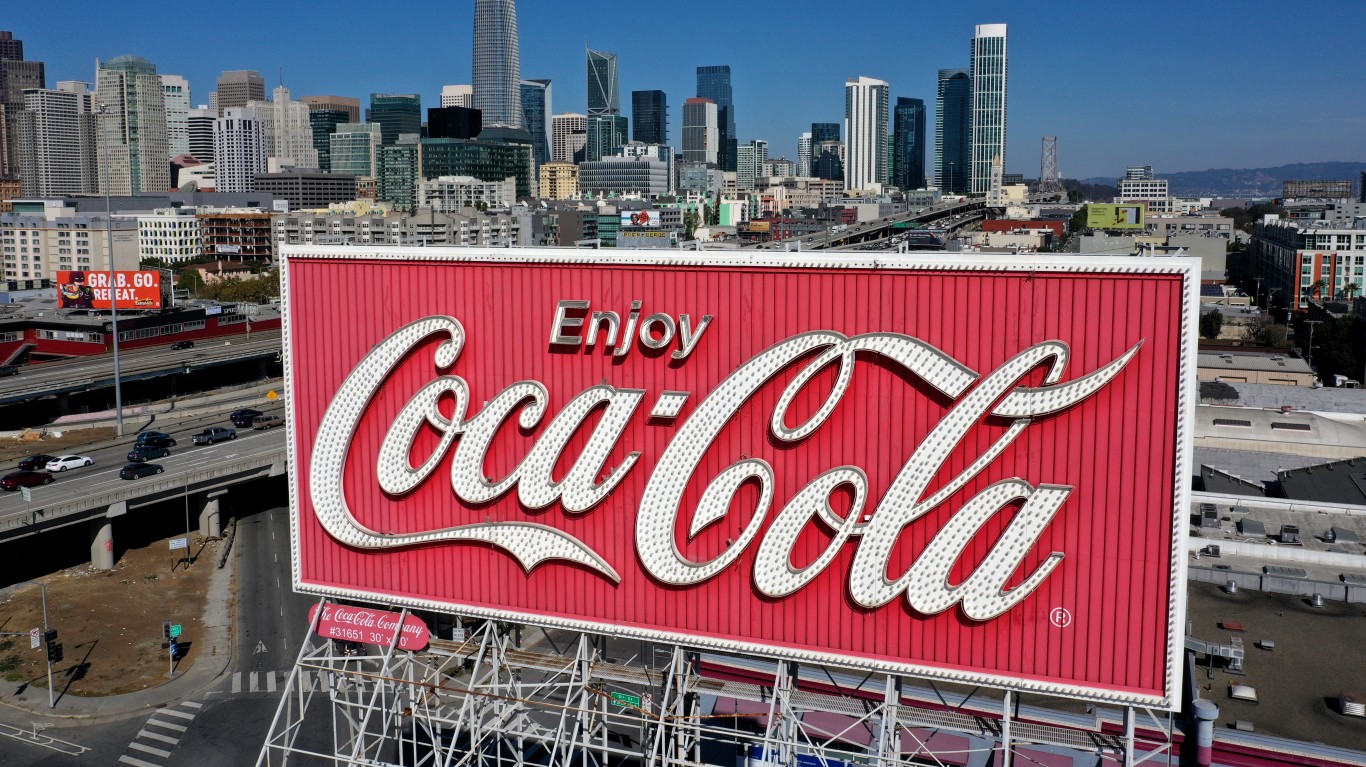
Coca-Cola (NYSE: KO) is an American multinational corporation founded in 1892. This company remains a top long-time holding of Warren Buffett, whose 400 million shares are 9.3% of the float and 9.9% of the portfolio. The stock pays a dependable 2.66% dividend.
Coca-Cola is the world’s largest beverage company, offering consumers more than 500 sparkling and still brands. Led by Coca-Cola, one of the world’s most valuable and recognizable brands, the company’s portfolio features 20 billion-dollar brands, including:
- Diet Coke
- Coca-Cola Light
- Coca-Cola Zero Sugar
- Caffeine-free Diet Coke
- Cherry Coke
- Fanta Orange
- Fanta Zero Orange
- Fanta Zero Sugar
- Fanta Apple
- Sprite
- Sprite Zero Sugar
- Simply Orange
- Simply Apple
- Simply Grapefruit
- Fresca
- Schweppes
- Dasani
- Fuze Tea
- Glacéau Smartwater
- Glacéau Vitaminwater
- Gold Peak
- Ice Dew
- Powerade
- Topo Chico
- Minute Maid
Globally, it is the top provider of sparkling beverages, ready-to-drink coffees, juices, and juice drinks. Through the world’s most extensive beverage distribution system, consumers in more than 200 countries enjoy the company’s beverages at a rate of over 1.9 billion servings per day. And remember that the company owns 19.5% of Monster Beverage (NASDAQ: MNST), which continues to deliver strong financial results.
UBS has a Buy rating with a $90 target price on the shares.








 Top Gaining Stocks
 Top Losing Stocks