



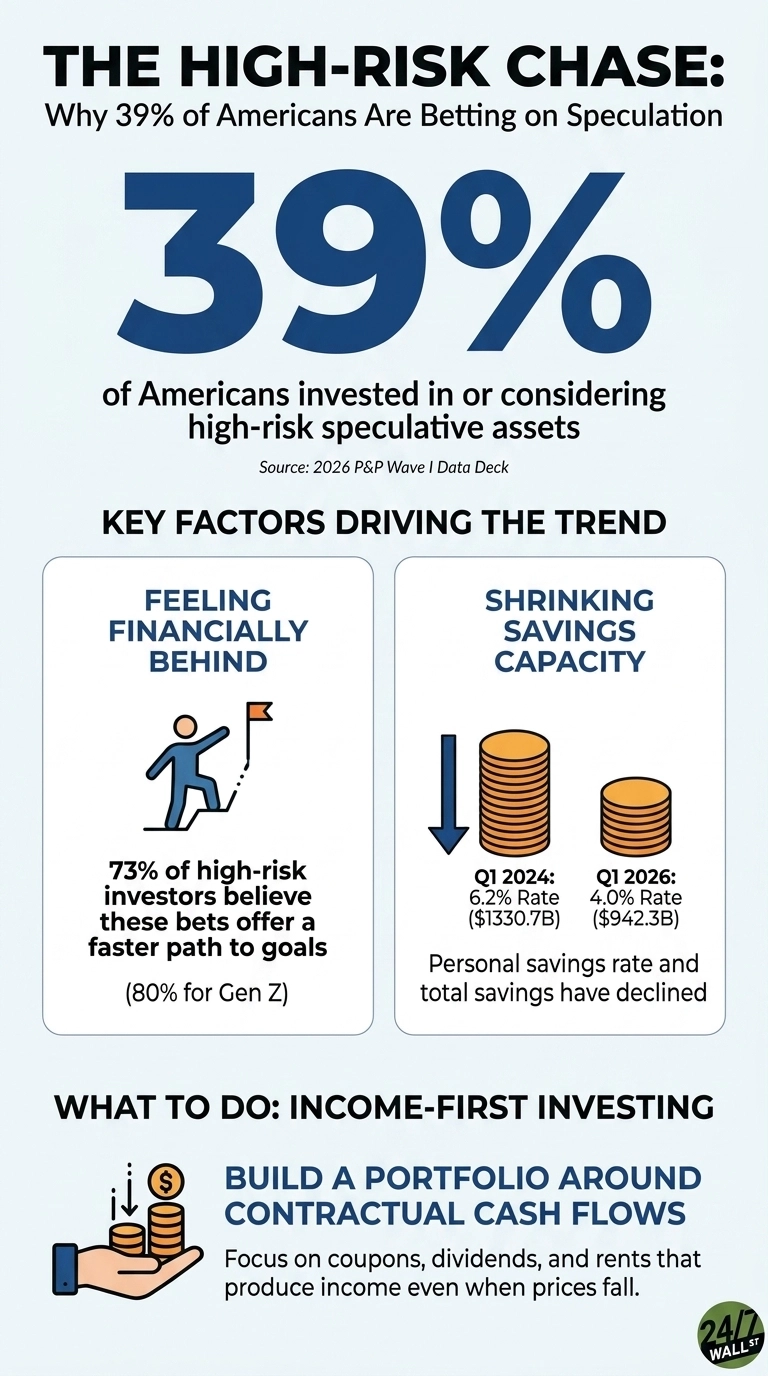
Something interesting is happening inside the Northwestern Mutual 2026 Planning & Progress Study data that does not resolve cleanly. More Americans feel financially secure today than at any point in recent years, with the share reporting confidence in their financial lives climbing meaningfully from the prior year. At the same time, roughly four in ten Americans are either invested in or actively considering high-risk speculative assets, including prediction markets, sports betting, and cryptocurrencies. Stated confidence is rising, and so is the willingness to pursue outcomes that carry no contractual claim to future cash flow.
The survey documents the motivation behind that apparent contradiction, and the explanation is worth sitting with. Among those pursuing speculative assets, nearly three-quarters say they are doing so because they feel financially behind and believe these bets offer a faster path to their goals than traditional methods. Among Gen Z, that figure climbs to eight in ten. Researchers have begun calling the pattern financial nihilism, the belief that conventional saving and investing simply cannot close the gap fast enough, which makes a low-probability, high-payoff swing feel less like gambling and more like the only logical play available.
Why the Math Feels Broken
The frustration behind that belief is not imaginary, and the report data helps explain where it comes from. Inflation ranks as the single biggest obstacle to financial security for more than four in ten Americans, well ahead of concerns such as lack of savings, personal debt, and healthcare costs. More than half of all Americans expect inflation to worsen in 2026, and nearly half report that their household income is already growing more slowly than prices. When the gap between what things cost and what people earn keeps widening despite working and saving, the logic of slow and steady starts to feel less convincing.
Consumer sentiment reflects the same squeeze. The share of Americans who expect the economy to weaken in 2026 outnumbers those who expect improvement, and that pessimism cuts across generations. Gen Z and Millennials are feeling it most acutely, which helps explain why those cohorts are the most likely to describe their speculative activity as a response to falling behind rather than a considered portfolio decision. When the baseline feels broken, the appeal of a faster solution grows regardless of the odds attached to it.
The Planning Gap Inside the Portfolio
The same survey identifies a structural blind spot beneath the speculative behavior and connects the two patterns in a way that matters. More than half of Americans acknowledge they place too much emphasis on building and growing assets without adequately protecting them or managing risk, with younger adults reporting that gap most frequently. A portfolio tilted entirely toward upside, with limited attention to drawdown, income generation, or long-term sequence risk, is the same orientation that makes speculative assets feel like a natural next step. Both reflect a growth-at-any-cost mindset that the data suggests is becoming more common even as financial confidence rises.
The discipline trend in the same report runs in the opposite direction and deserves equal weight. The share of Americans who describe themselves as disciplined financial planners has climbed to a majority in 2026, recovering from a record low two years earlier and continuing a two-year upward trend. Those households tend to pair contribution targets with protection layers, automate savings decisions, and maintain a plan for what to do when markets fall. The gap between that group and the speculative cohort is not primarily an income gap. It is a framework gap, and the report data suggests it is one of the more consequential differences in how American households are positioning themselves heading into the rest of 2026.
Why Income-First Holds Up Better
Income-first investing offers a fundamentally different structure for someone who genuinely feels behind, and the case for it does not require dismissing the frustration behind financial nihilism. Dividends, coupons, and rental income arrive on a schedule and can be reinvested at whatever rates the market offers, which is the engine of compounding that speculative assets cannot replicate. A portfolio built around contractual cash flows yields a measurable metric even when prices fall, and it gives the investor a denominator to track progress against, regardless of what the broader market is doing in any given month.
The real cost of a speculative bet gone wrong is not just the capital lost. It is the income that was never built in its place, the compounding that never started, and the years of contribution runway that cannot be recovered once they are gone. Gen Z sits on the longest investment horizon of any working generation, which makes the financial nihilism finding particularly costly in practical terms. The cohort most likely to describe its strategy as a catch-up trade is also the one that needs it least, because no other group has more time for a disciplined, income-focused approach to do the work that speculation is being asked to do instead.













 Top Gaining Stocks
 Top Losing Stocks