



The stock market keeps climbing, even as investors wrestle with sticky inflation, elevated interest rates, and slowing earnings growth. The S&P 500 has returned over 26% over the past 12 months, driven largely by artificial intelligence enthusiasm and a small group of mega-cap technology stocks. But beneath the rally sits a number that deserves attention — the Shiller P/E ratio, also called the cyclically adjusted price-to-earnings ratio, or CAPE, which currently stands at 40.90.
That is not merely expensive. It is historic. In fact, the market has only been more expensive one other time: November 1999, when the CAPE ratio reached an all-time high of 44.19 during the dot-com bubble.
That comparison alone should make investors pause.
What the Shiller P/E Ratio Actually Measures
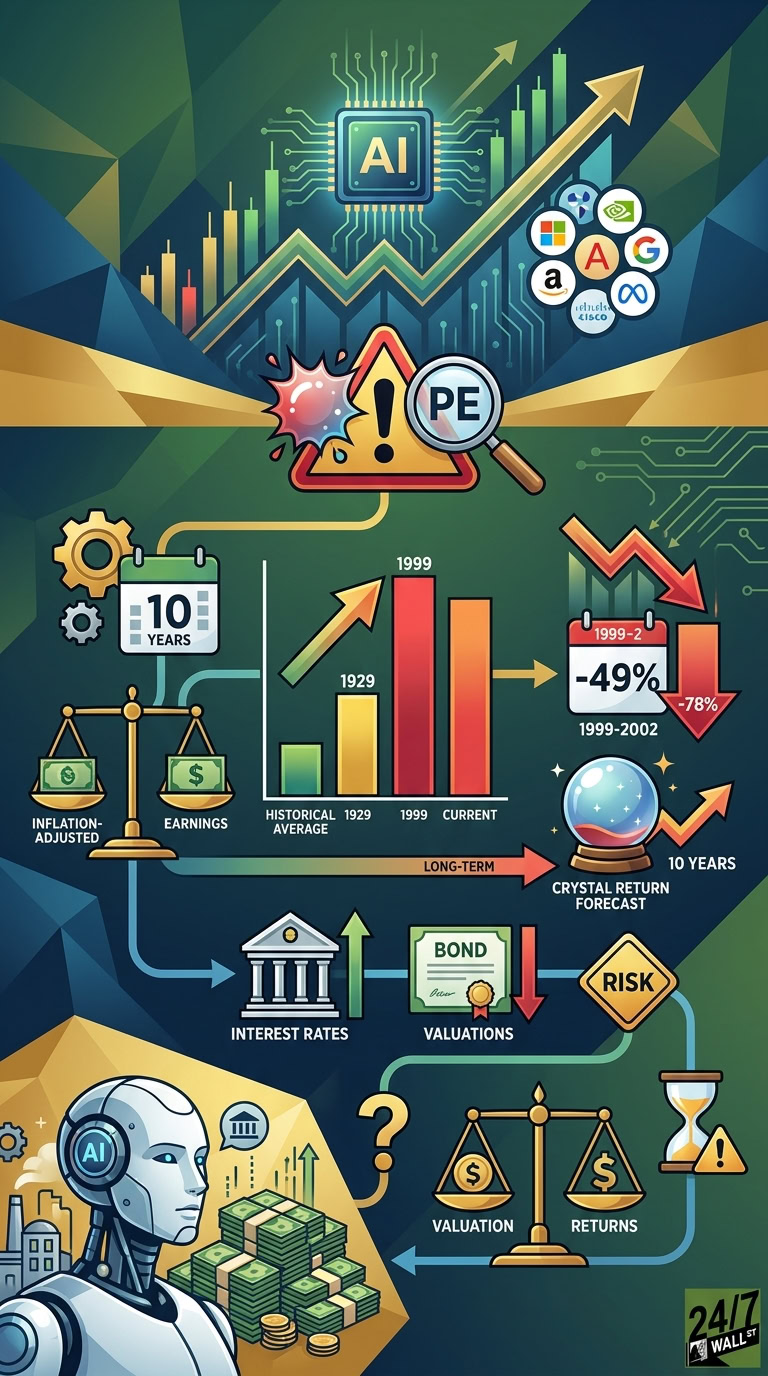
The Shiller P/E ratio was developed by Nobel Prize-winning economist Robert Shiller. Unlike the standard price-to-earnings ratio, which compares stock prices to one year of profits, the CAPE ratio uses 10 years of inflation-adjusted earnings to smooth out economic booms and recessions, and provide a clearer picture of how expensive stocks really are.
Historically, the average Shiller P/E ratio has hovered around 17.2. Here’s how today’s reading compares to other notable moments in market history:
| Period | Shiller P/E Ratio |
| Historical average | 17.2 |
| October 1929 | 32.6 |
| December 2021 | 38.6 |
| November 1999 peak | 44.19 |
| Current reading | 40.90 |
Here’s what the numbers tell us: investors are currently paying more than 40 times average inflation-adjusted earnings for the S&P 500. Regardless of how you look at it, that leaves little room for disappointment.
Granted, today’s market is different from 1999 in important ways. Companies like Microsoft (NASDAQ:MSFT | MSFT Price Prediction), Nvidia (NASDAQ:NVDA), and Alphabet (NASDAQ:GOOG)(NASDAQ:GOOGL) generate real profits and enormous free cash flow. During the dot-com bubble, many high-flying tech companies barely generated revenue, much less earnings.
That said, valuations still matter.
What Happened the Last Time Valuations Reached These Levels?
The uncomfortable part is not the CAPE ratio itself. It is what historically followed.
After the Shiller P/E ratio peaked in late 1999, the S&P 500 fell 49% during the dot-com crash. The Nasdaq Composite plunged 78% between March 2000 and October 2002, according to Nasdaq historical market data. Even more important, future returns suffered for years afterward.
Research published by Robert Shiller and data from Crestmont Research show that when investors buy stocks at elevated CAPE ratios above 35, subsequent 10-year annualized returns have historically averaged between 0% and 3%. By comparison, periods when the CAPE ratio traded below 15 often produced double-digit annualized returns over the next decade.
Surprisingly, this does not necessarily mean a crash is imminent. Valuations are terrible short-term timing tools. The market stayed expensive for years during the late 1990s before finally breaking.
But high valuations do tend to predict lower long-term returns. In any case, investors buying today should probably not expect the kind of gains the market delivered from 2010 through 2021, when ultra-low interest rates and expanding profit margins pushed stocks steadily higher.
Let’s also consider another difference between today and the late 1990s: interest rates.
The federal funds rate currently ranges between 3.5% and 3.75%, according to the Federal Reserve. In 2021, when stocks last approached these valuation levels, rates were near zero. Higher interest rates generally compress stock valuations because safer investments like Treasury bonds suddenly offer meaningful yields.
That’s a challenge the market still hasn’t fully worked through.
Why AI Optimism May Not Be Enough
Much of the market’s current optimism revolves around artificial intelligence. Nvidia’s revenue climbed 65% year over year in fiscal 2026, while Microsoft, Alphabet, Amazon (NASDAQ:AMZN), and Meta Platforms (NASDAQ:META) recently committed to spending $710 billion this year for AI infrastructure.
The excitement is understandable. AI could reshape productivity, software, healthcare, and manufacturing over the next decade. But investors should remember an important lesson from history: transformative technology does not guarantee attractive investment returns if the starting valuation is too high.
Cisco Systems (NASDAQ:CSCO) became one of the most important technology companies in the internet era. Yet investors who bought the stock near its 2000 peak waited more than 20 years for shares to revisit those highs. The business succeeded. The valuation did not.
That’s the risk facing investors today. Not necessarily economic collapse, but the possibility that future gains may struggle to justify today’s prices.
Key Takeaway
In short, the stock market is trading at a level investors have seen only once before. The Shiller P/E ratio of 40.90 sits just below the all-time record set during the dot-com bubble in 1999.
History does not say a crash must happen tomorrow. Markets can remain expensive longer than many investors expect. But history does suggest future returns from these levels tend to be muted, especially over the next decade.
Smart investors do not need to panic. They do need to adjust expectations. That may mean emphasizing quality companies with strong cash flow, keeping some dry powder available for volatility, and resisting the temptation to chase every AI-fueled rally. When all is said and done, valuation still matters — even in a market convinced this time is different.














 Top Gaining Stocks
 Top Losing Stocks