



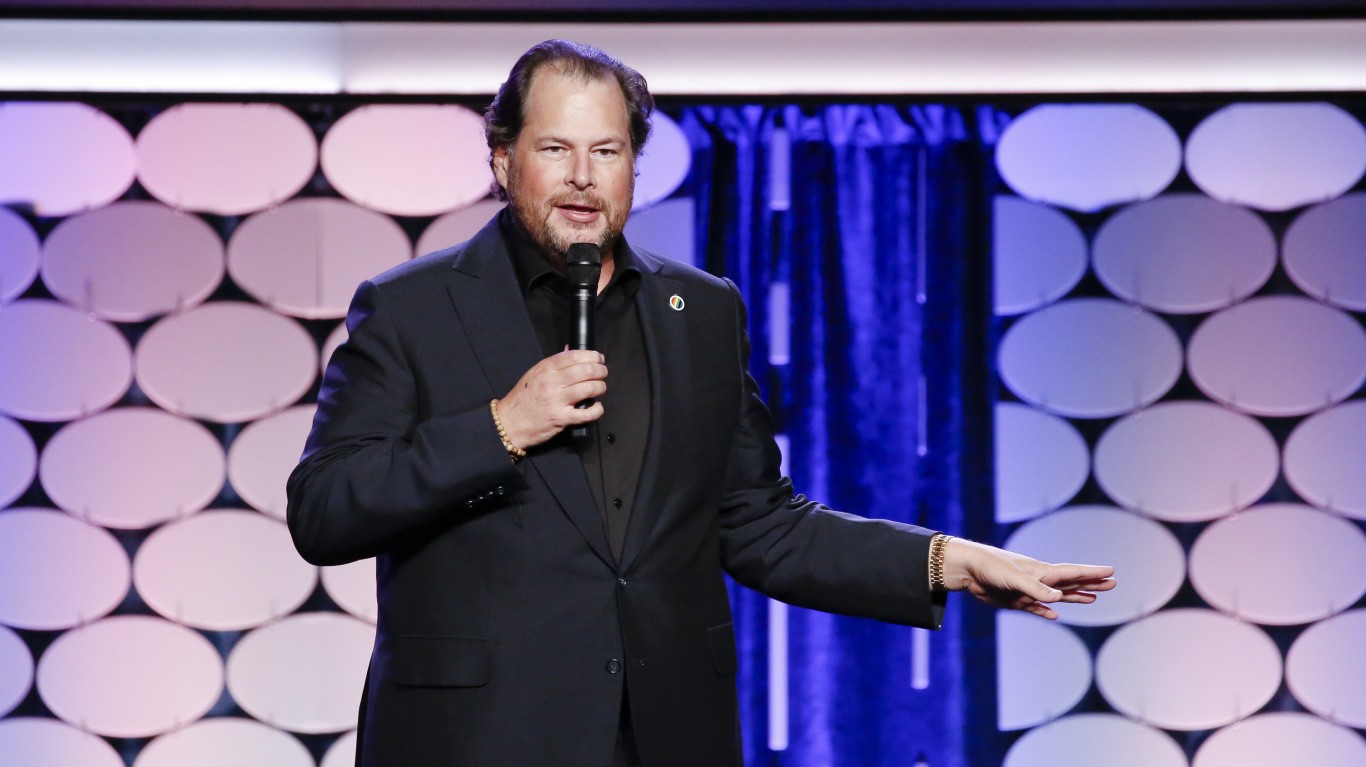
Marc Benioff has run Salesforce (NYSE: CRM | CRM Price Prediction) since 1999, and he has given no signal he intends to leave. Yet 26 years into his tenure as co-founder, board chair, and chief executive, the question of what happens without him is worth asking.
Why Benioff Matters More Than a Typical Software CEO
Benioff is a category-defining operator. He popularized the “No Software” cloud movement, built Dreamforce into the largest software conference in the world, and codified the 1-1-1 philanthropy model. His personal relationships extend deep into Fortune 100 IT departments. That is brand equity that no slide deck can replicate.
The Actual Succession Landscape
The bench is deeper than skeptics suggest. Robin Washington became president and chief operating officer in 2025, and on March 22, 2026, she received 47,059 RSUs and 58,352 performance options, a retention package that signals board intent. Co-founder Parker Harris remains the technology figurehead. The Bret Taylor co-CEO experiment ended in November 2022, and no formal successor has been named in public filings. Activist pressure from Elliott, Starboard, ValueAct, and Inclusive Capital in 2022 and 2023 already tightened governance discipline.
The Financial and Strategic Risk
Multiple compression has already occurred. The trailing price-to-earnings ratio (P/E) is near 23, the forward P/E near 14, and the stock down 31.6% year to date and 33.7% over one year. FY26 delivered revenue of $41.525 billion (up 9.6%), operating income of $8.331 billion, and free cash flow of $14.402 billion, with FY27 revenue guided to $45.8 billion to $46.2 billion. The real exposure is customer renewal behavior at the largest accounts, the tone of Dreamforce 2026 without Benioff on stage, and Agentforce go-to-market continuity.
The Bull Case for Life After Benioff
The model is durable. Subscription revenue is 95% of the mix, total RPO is $72 billion, up 14% year-over-year, and gross margin holds at 77.7%. Benioff said on the Q4 call, “Agentforce ARR reached $800 million, up 169% year-over-year, and we’ve closed 29,000 deals, up 50% quarter-over-quarter.” The company carries a $50 billion buyback authorization, a $0.44 quarterly dividend (up 5.8%), the Informatica acquisition that closed in November 2025, and a $63 billion FY30 revenue target. Analyst consensus remains constructive, with a $268.25 average target price.
Verdict: A Brand and Culture Test
A Benioff exit would be a brand and culture test. Watch three things: customer renewal behavior at the largest accounts, Dreamforce 2026 attendance and tone, and whether Robin Washington’s operating discipline can sustain the equity story independently.







 Top Gaining Stocks
 Top Losing Stocks