


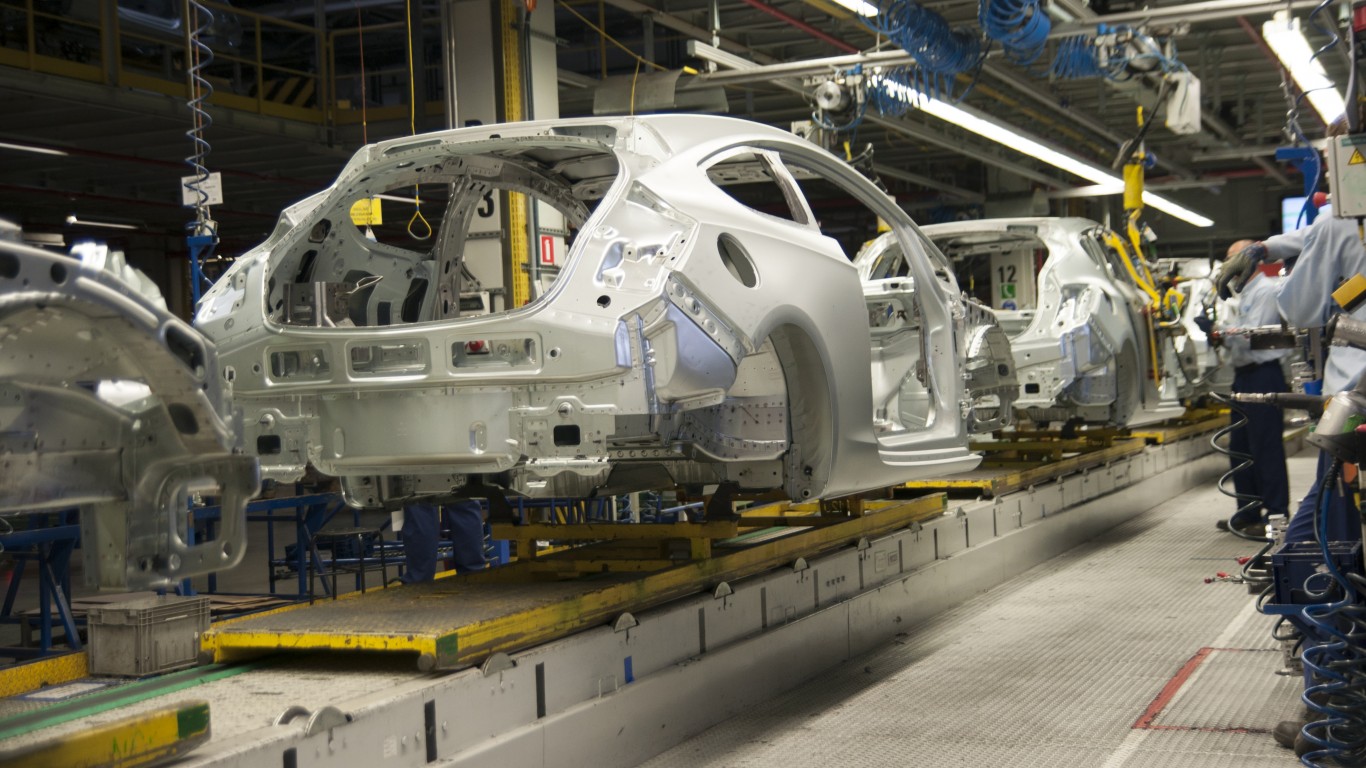
Last month, the U.S. Bureau of Labor Statistics reported that there were 12.84 million manufacturing jobs in the United States, more than a third below the 80-year high of 19.55 million in June of 1979. The loss of manufacturing jobs brings with it job losses in other sectors in a ripple effect that multiplies the impact of manufacturing job losses by a staggering amount.
According to a new paper by Josh Bivens of the Economic Policy Institute, for every 100 direct durable goods manufacturing jobs lost, a further 744 indirect jobs are also lost. In automobile production, for example, multiple suppliers of parts such as tires, windshields and steel feel the pinch when automakers fire workers. Those “backward linkages” are further enlarged by “forward linkages” that include less spending by former autoworkers (and suppliers’ employees), resulting in a slowing of consumer spending. Ultimately, the ripple effect may cost jobs in food service, retail stores and services, among other sectors.
The 744 indirect job losses spawned by 100 job cuts in durable goods manufacturing trails the nearly 958 indirect jobs lost when a utility company axes 100 employees and the nearly 898 indirect jobs lost for every 100 jobs lost in the real estate and rental leasing industry. Durable goods manufacturing job losses far outstrip the loss of 122 jobs for every 100 jobs lost in the retail trade and the nearly 206 indirect jobs lost for every 100 jobs lost in health care and social assistance.
[nativounit]
Because durable goods manufacturing jobs are more productive (that is, producing a higher dollar value per direct job than do retail jobs), lost manufacturing jobs ripple far more widely throughout the entire job market. In Bivens’s example, a loss of 16.5 indirect jobs per $1 million in the demand drop for durable goods is far higher than the loss of 10.6 indirect jobs per $1 million in the demand drop for retail.
These linkages are the reason Bivens concludes that the rescue of the auto industry following the financial crisis of 2008 was the correct policy for the federal government to adopt: “This belief [in the bailout] from policymakers was driven by the fully rational fear that the substantial backward and forward linkages from auto assembly jobs would be large enough to cause mammoth ripple effects throughout the economy.”
The full report and supporting data are available at the Economic Policy Institute website.
[recirclink id=522936]
[wallst_email_signup]








 Top Gaining Stocks
 Top Losing Stocks