


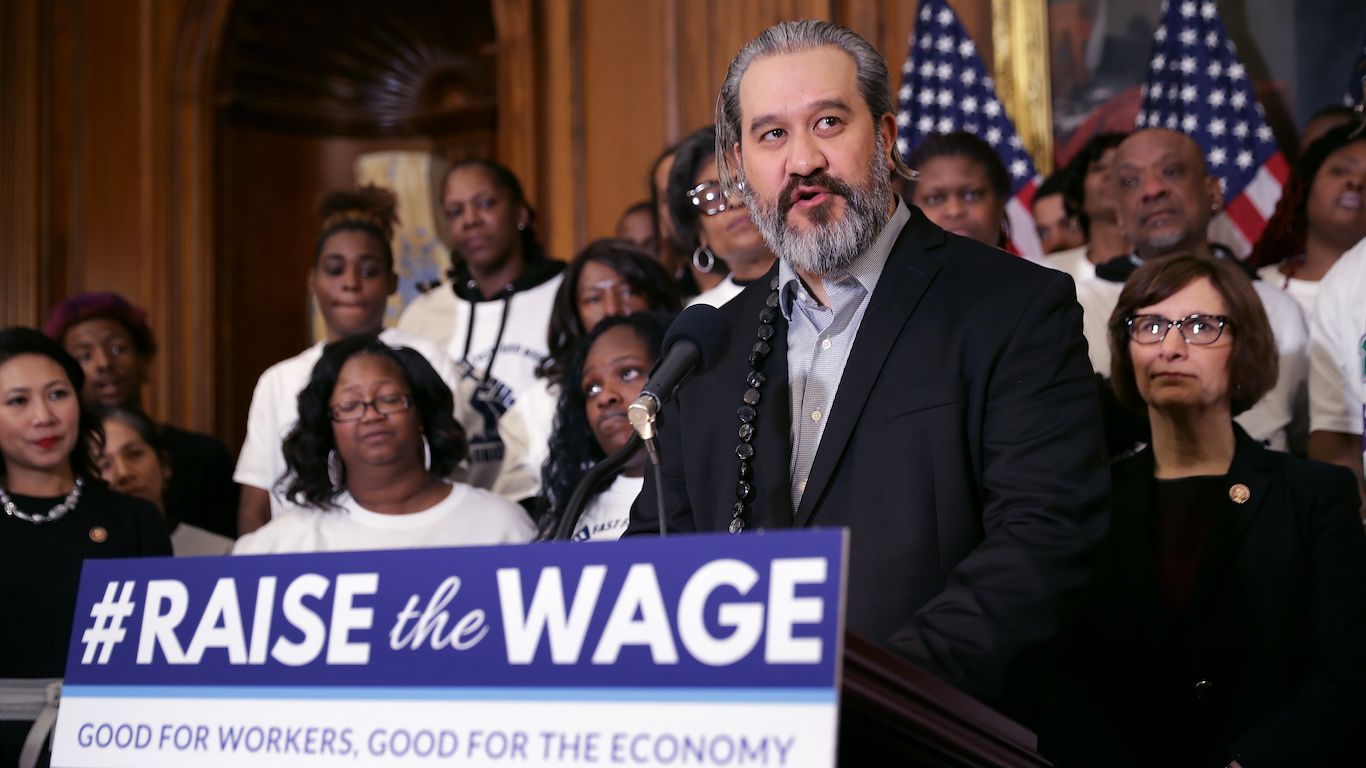
More than half the states (29) and the District of Columbia have enacted minimum wage legislation setting workers’ pay above the federal minimum of $7.25 an hour. Washington, D.C., currently has the highest minimum — $13.25 — and that is set to rise to $14 an hour on July 1 and to $15 on July 1, 2020.
Since the beginning of this year, three states — New Jersey, Illinois and Maryland — have enacted legislation phasing-in a minimum wage of $15 an hour in those states. California, Massachusetts and New York are the other three states that have passed legislation that gradually increases the state minimum wage to $15.
Five states — Alabama, Louisiana, Mississippi, South Carolina and Tennessee — have no minimum wage guarantee and a sixth, New Hampshire, has adopted the federal minimum. The current federal minimum was set in 2009.
[nativounit]
The move toward a $15 an hour minimum began in 2014 when the city of Seattle passed an ordinance phasing in a rise to $15 an hour by 2021. And despite warnings that the new, higher pay would cost jobs and economic growth, the data has been mostly positive. In a research paper published last October, economists from the University of Washington noted that Seattle’s pay increase had brought significant benefits to many workers but left some, primarily people with little or no experience who were looking for a job, worse off.
Another study published in February found that no significant price increases were associated with Seattle’s minimum wage ordinance. The lead researcher on the study commented, “[I]f local food prices remain steady while earnings increase for low and minimum wage workers, then that could mean increased purchasing power for things like fresh fruit and vegetables for the consumers that need it most.”
California’s minimum wage for 2019 is $12 an hour, rising in increments of $1 an hour until 2022, when it reaches $15. Annual increases based on the consumer price index (CPI) go into effect in 2023.
Massachusetts reaches $15 an hour in 2023, following raises from $12 an hour in 2019 to $12.75 in 2020, $13.50 in 2021 and $14.25 in 2022. No automatic increases were approved, although the minimum will be increased to 10 cents an hour more than the federal minimum if the federal minimum meets or exceeds the state’s minimum.
New York’s minimum wage is based on the size of the business and its location. Businesses in New York City with 11 or more employees began paying $15 an hour on December 31, 2018, while those with 10 or fewer employees currently pay $13.50 an hour, rising to $15 an hour at the end of this year. Downstate employers now pay $12 an hour, rising to $15 by the end of 2021.
New Jersey’s minimum wage also accommodates small employers, in this case, with six or fewer employees. The minimum for larger employers rises from $8.85 currently to $10 on July 1 and reaches $15 an hour in 2024 in dollar-per-year increments. Annual increases are then indexed to the CPI. Small employers will raise their minimum to $10.30 an hour on January 1, 2020, and reach $15 an hour on January 1, 2026.
Illinois raises its statewide minimum from its current level of $8.25 to $9.25 on January 1, 2020, and to $10 on July 1, 2020. After that, the pay level rises by $1 a year to $15 in January 2025.
Last week, Maryland passed legislation (over a gubernatorial veto) to raise its minimum wage above its current level of $10.10. The state adopted a two-tiered approach like New York’s and New Jersey’s: for companies with 15 or more employees, the minimum rises to $11 on January 1, 2020, and reaches $15 an hour in January 2025; smaller firms also must pay $11 next year, with pay rising to $15 by July 1, 2026.
There are adjustments in most of these six states that allow businesses to pay tipped workers less than the minimum and to pay less to employees under the age of 18.
A total of 13 U.S. cities and counties, of which 10 are located in California, now pay workers at least $15 an hour. The California cities are Sunnyvale, San Mateo, San Jose, Richmond, Palo Alto, Mountain View, Los Altos, El Cerrito, Cupertino and Santa Clara. The other three are Seattle, SeaTac (the Seattle-Tacoma Airport) and New York City.
[recirclink id=538012]
[wallst_email_signup]






 Top Gaining Stocks
 Top Losing Stocks