



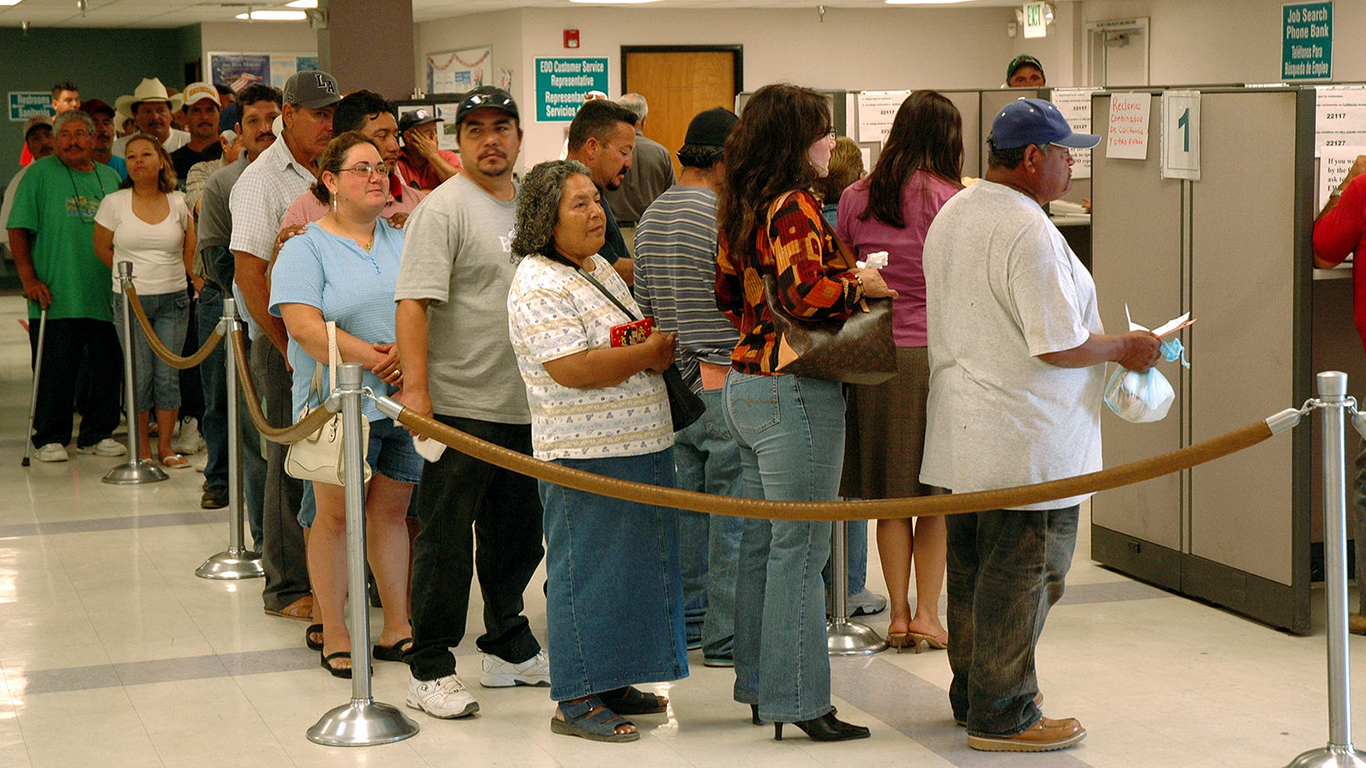
Treasury Secretary Steven Mnuchin told members of the U.S. Senate that without a highly aggressive stimulus package the U.S. jobless rate could hit 20%. That is the equivalent of 30 million Americans. The layoffs that would trigger this rate would not be even across the economy. In some industries, that rate could go to 35% or higher.
A 20% unemployment rate would be twice as high as the worst level during the Great Recession. That was reached in October 2009. The highest rate in the last half a century was 10.1% in September 1982. This data shows how rare an unemployment rate of 10% really is.
The five industries that would be hardest hit are hospitality, retail, manufacturing, construction and travel. Together, they employ 52 million people, according to the Bureau of Labor Statistics.
Hospitality
The hospitality industry’s jobless rate already has started to soar, with hotels, gambling establishments, movie theaters and media production initiating mass layoffs. This has been particularly massive in the hotel business. Marriott has furloughed tens of thousands of workers. It has 174,000 workers overall. Hilton has closed many of its hotels. It employs 175,000 workers. This does not include millions of people who work for other chains and smaller hotels, in some cases are single hotels and resorts with only one property.
[nativounit]
The cruise industry has all but shut down, with many of the largest employers docking their ships for two months. The four largest cruise lines together employ over a million people.
The total hospitality industry has 16.4 million workers. As the industry is shuttered across the United States, it is not hard to model that it could cut 40% of more of its jobs, or 8 million workers.
Retail
The retail industry employs 15.8 million people. A number of the nation’s largest retailers have closed their stores completely. So far, this includes Macy’s, Foot Locker and Nordstrom. Among smaller retailers, the risk that some will run out of money completely is high. Some of the weakest retailers, including what is left of J.C. Penney, which employs 90,000 people, and what is left of Sears, could close completely. If the industry cuts a third of its people, 5 million individuals are out of work.
The bright light of the retail industry is that several companies, like Walmart, may lay off no one. Amazon is adding 100,000 jobs to help with overflow due to a surge in orders. These may lessen the blow, but a third of the people in the sector could be out of work as weaker retailers downsize or fold. The industry certainly could lose those 5 million jobs.
Manufacturing
The manufacturing industry will be deeply dented. Car sales in the United States could be off by 20% this year. In the next several months, the figure is likely to be much higher. This will affect Ford, General Motors and Fiat Chrysler. Several of overseas carmakers have U.S. plants, including Toyota and BMW.
[recirclink id=652906]
Also at great risk are manufacturers that make heavy equipment. Caterpillar employs over 100,000 people. Deere employs 75,000. The entire manufacturing industry employs 12.7 million people. If a third of those jobs are at risk, that means at least 4 million people.
Construction
The industry employs 7.3 million Americans and is also at great risk. Demand for homes will plunge if the economy is decimated, just as it did during the Great Recession. Commercial real estate demand will drop as well. During the Great Recession, construction was among the hardest-hit industries. It could certainly lose 3 million jobs.
Travel
Airlines could be the industry hit the hardest. Delta employs 91,000 people and American Airlines has 134,000. Across the industry, airlines have over a million jobs. If the industry does not get a bailout, and much of the total American commercial air fleet is grounded, half a million jobs could be lost.
[wallst_email_signup]
Employment experts Challenger, Gray just estimated that job losses could be as many as 9 million across just 14 states and cities.
Taken together, the job losses within these five industries could be higher than 20 million. That is two-thirds of the figure Steven Mnuchin gave. That means across all other industries in the United States, 10 million jobs lost would get to his total. These examples make Mnuchin’s figure very possible.











 Top Gaining Stocks
 Top Losing Stocks