This Is the City Where People Expect to Make Less Money

Photo of Douglas A. McIntyre
By Douglas A. McIntyre Updated Published
This post may contain links from our sponsors and affiliates, and Flywheel Publishing may receive compensation for actions taken through them.
This Is the City Where People Expect to Make Less Money

© Joe Raedle / Getty Images

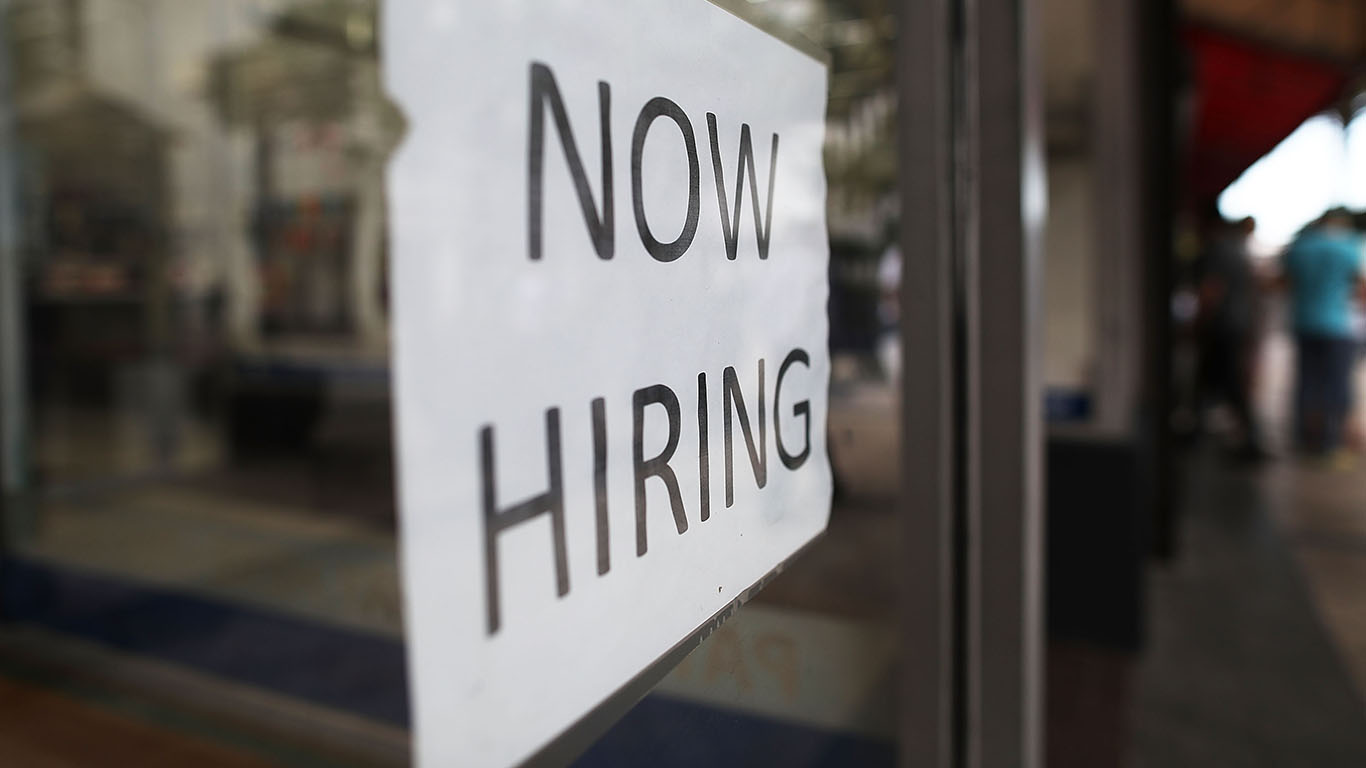
The unemployment situation in the United States has improved dramatically since the early days of the COVID-19 pandemic. The national jobless rate reached 14.7% in April 2020, well above the worst rates of the Great Recession. Slowly, the job market recovered. Last month, the national unemployment rate was 5.9% as the economy added 850,000 jobs.

One challenge for employers today is that there are more open jobs than there are people to fill them. The U.S. Bureau of Labor Statistics reports that at the end of May there we 9.2 million job openings. “Hires,” a BLS term, however, were only 5.9 million.  The spread shows just how difficult the labor market is for many American companies.

One fact remains for millions of job seekers. In June, 9.5 million Americans were out of work. The figure varies widely by both state and city.

Shortly after the outbreak of COVID-19, the Census Bureau launched a vast initiative to measure the effects of the disease on Americans. It is called the Household Pulse Survey. So far, the results have been released in three phases, which began with the first study that was in the field starting April 23, 2020. The data is released by about twice a month. The work is done in partnership with the Bureau of Labor Statistics (BLS), Bureau of Transportation Statistics, Centers for Disease Control and Prevention (CDC), Department of Housing and Urban Development, National Center for Education Statistics, National Center for Health Statistics, Social Security Administration and USDA Economic Research Service.

[nativounit]

The most recent release of data is for Week 32. It covers the period from June 9 to June 21. One of the questions asked is about “Expected Loss in Employment Income”. The specific question targets the “Percentage of adults who expect someone in their household to have a loss in employment income in the next 4 weeks.”

The city at the top of the list is Houston, where the figure is 18.9%. That compares to the national figure of 12.3%.

Click here to see the 25 lowest paying jobs in America.
[wallst_email_signup]

Photo of Douglas A. McIntyre
About the Author Douglas A. McIntyre →

Douglas A. McIntyre is the co-founder, chief executive officer and editor in chief of 24/7 Wall St. and 24/7 Tempo. He has held these jobs since 2006.

McIntyre has written thousands of articles for 24/7 Wall St. He is an expert on corporate finance, the automotive industry, media companies and international finance. He has edited articles on national demographics, sports, personal income and travel.

His work has been quoted or mentioned in The New York Times, The Wall Street Journal, Los Angeles Times, The Washington Post, NBC News, Time, The New Yorker, HuffPost USA Today, Business Insider, Yahoo, AOL, MarketWatch, The Atlantic, Bloomberg, New York Post, Chicago Tribune, Forbes, The Guardian and many other major publications. McIntyre has been a guest on CNBC, the BBC and television and radio stations across the country.

A magna cum laude graduate of Harvard College, McIntyre also was president of The Harvard Advocate. Founded in 1866, the Advocate is the oldest college publication in the United States.

TheStreet.com, Comps.com and Edgar Online are some of the public companies for which McIntyre served on the board of directors. He was a Vicinity Corporation board member when the company was sold to Microsoft in 2002. He served on the audit committees of some of these companies.

McIntyre has been the CEO of FutureSource, a provider of trading terminals and news to commodities and futures traders. He was president of Switchboard, the online phone directory company. He served as chairman and CEO of On2 Technologies, the video compression company that provided video compression software for Adobe’s Flash. Google bought On2 in 2009.

Continue Reading

Top Gaining Stocks

CBOE Vol: 1,568,143
PSKY Vol: 12,285,993
STX Vol: 7,378,346
ORCL Vol: 26,317,675
DDOG Vol: 6,247,779

Top Losing Stocks

LKQ
LKQ Vol: 4,367,433
CLX Vol: 13,260,523
SYK Vol: 4,519,455
MHK Vol: 1,859,865
AMGN Vol: 3,818,618