


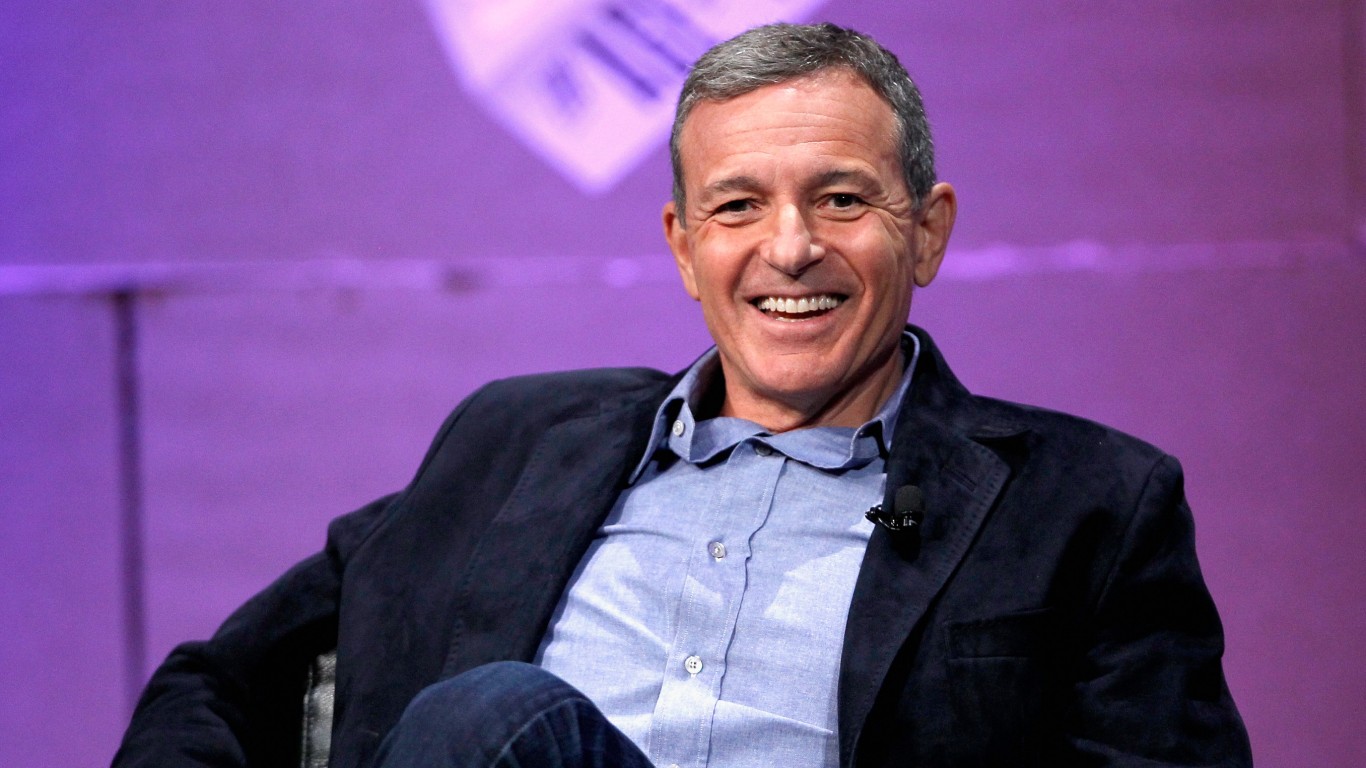
[cnxvideo id=”625449″ placement=”ros”]In a filing this morning with the U.S. Securities and Exchange Commission (SEC), Walt Disney Co. (NYSE: DIS) said it has extended Chairman and CEO Robert Iger’s contract from a previous expiration date of June 30, 2018, to a new expiration date of July 2, 2019. Iger has been Disney’s CEO for 11 years.
Iger’s annual base salary of $2.5 million remains unchanged under the terms of the new contract extension, but that’s not where most of his compensation comes from. According to the company’s February 2017 proxy statement, 92% of Iger’s salary is performance-based.
In 2016, Iger earned $43.9 million, about $1 million less than his total compensation in 2015. In 2014 Iger was paid $46.4 million in salary and bonuses, primarily stock and restricted stock units. Although Iger’s salary slipped last year, he was still the fifth-highest paid CEO among the S&P 500 index companies.
Iger presents a pretty strong case, both for his contract extension and his total compensation. In the period between 2005 and 2016, Disney’s total return to shareholders has increased by 350%, more than double the S&P 500’s 123% increase over the same period and nearly double the market-cap weighted return of Disney and six peers.
[nativounit]
During the 11-year period, Disney’s market cap has grown at a compound annual growth rate (CAGR) of 11%, from $45.8 billion to $147.8 billion. Revenue has grown over the same period at a CAGR of 8%, diluted earnings per share posted a CAGR of 15% and net operating income’s CAGR is 13%.
The two big deals Iger steered to completion were the acquisitions of Lucasfilm and Marvel. The Marvel Cinematic Universe franchise has generated more than $4.2 billion in gross receipts (not all were produced by Disney) from 14 movies, with another 10 due from Disney by 2020.
The $4 billion purchase of Lucasfilm brought the Star Wars franchise, the second-most popular franchise ever, to the House of Mouse. Only the first Star Wars movie, released in 1977, has higher gross receipts than Disney’s “Star Wars: The Force Awakens,” released in 2015.
Disney stock was up about 0.5% at noon Thursday, at $112.71 in a 52-week range of $90.32 to $113.16. The 12-month consensus share price is $117.27.
[wallst_email_signup]









 Top Gaining Stocks
 Top Losing Stocks