


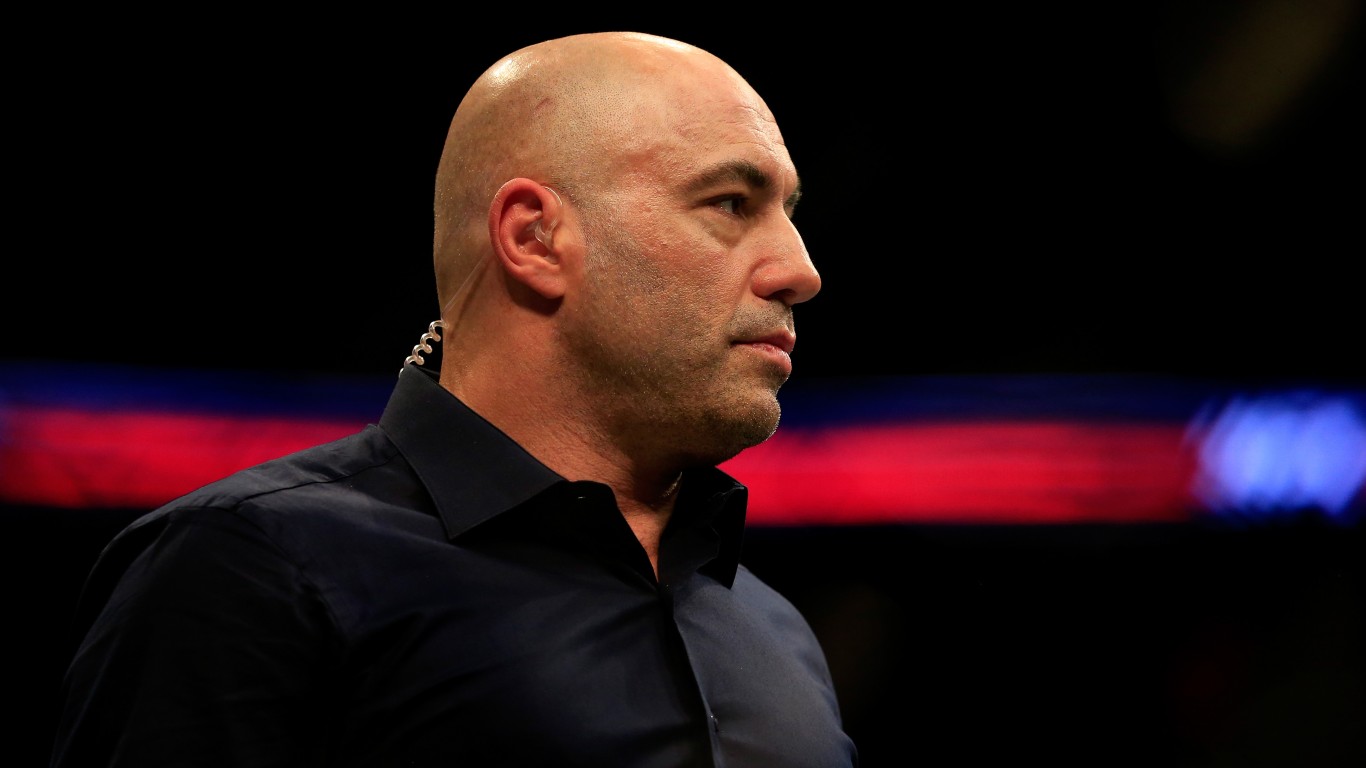
The Joe Rogan podcast project is moving to Spotify Technology S.A. (NYSE: SPOT | SPOT Price Prediction). Under a multiyear deal, the streaming service will have one of the most well-known audio broadcasters in the world.
His shows operate under the heading of The Joe Rogan Experience. Under that umbrella, he does comedy, commentary on mixed martial arts, and satire. What is not clear is exactly what Spotify paid for the deal to carry current content from past shows under the new licensing deal.
What Is Spotify?
Spotify has been in business for 16 years. Unlike most companies listed on U.S. exchanges, it is based in Sweden. Most of its streaming content is for its music services, but popular podcasts have become part of its products recently.
Spotify claims it has 286 million active monthly users (MAUs) and 130 million paid subscribers. To have some idea of how large this is, note that Netflix has about 180 million subscribers.
[nativounit]
Listeners can pay for their streaming. However, Spotify has a partially ad-supported model. People can listen “for free” if they are willing to have advertising as part of the service.
In its most recent earnings report for the period that ended in March, revenue was $1.85 billion, up 22% from a year earlier. The company made $1 million. Although the sum is paltry, it compares to a loss of $142 million in the same period the year before.
The company said it has about €1.8 billion in liquidity, and it expects to be free cash flow positive for the year. Total free cash flow was a negative €21 million in the first quarter.
The forecast for the current quarter has total MAUs at 289 million to 299 million, total premium subscribers of 133 million to 138 million, and total revenue between €1.75 billion and €1.95 billion. For the full year, the company’s forecast calls for total MAUs of 328 million to 348 million and total premium subscribers of 143 million to 153 million.
One of Spotify’s advantages is that the pandemic that kept so many people in their homes provided a boost. The company commented, “In fact, both new and reactivated MAUs grew substantially even during lockdown periods in major markets.”
Spotify’s user base is very evenly distributed across the world. It says 26% of its monthly active users are in North America, while 35% are in Europe and 22% are in Latin America. Just 17% are in “the rest of the world,” which largely means Asia.
Why Joe Rogan?
While Spotify has not given an exact figure for the Rogan deal, to get his podcast on Spotify, the rumored sum is $100 million. The key to the deal is that he is moving exclusively to Spotify. It is a long-term deal that includes his 11-year-old library.
Rogan has made much of his money in recent years via his presence on YouTube. A quick look at YouTube shows he has 8.42 million subscribers on the platform. Over 2 million people have listened to some of his podcasts. His videos carry advertising, which is how he makes his money.
Part of Rogan’s deal is that his content will remain free and accessible to all Spotify users.
[recirclink id=708016]
The Rogan deal is part of the movement by streaming media services, both audio and video, to cut exclusive deals for talent and programming. Some streaming media services actually create content of their own.
Amazon.com Inc. (NASDAQ: AMZN) Prime and Netflix Inc. (NASDAQ: NFLX) have spent hundreds of millions of dollars between them to offer content not available anywhere else. Apple Inc. (NASDAQ: AAPL), which entered the business more recently, also has begun to make a massive investment in unique shows.
The theory behind original content is that it will draw new subscribers and encourage a high percentage of current subscribers to renew.
The theory has not been entirely proven, and the major public companies do not release their data on how well this works or whether their investments were too large to get a strong return on investment
The Rogan deal is an experiment. The $100 million, even spread over several years, is a large sum for Spotify, which has about $8 billion in annual revenue. It also has the most modest of profits.
Historically, the Rogan deal is like the one that satellite broadcaster Sirius XM Holdings Inc. (NASDAQ: SIRI) made with Howard Stern in 2005. At the time, it was rumored to be worth $500 million for five years. He has signed several contracts since then, which have taken the total sum higher.
Does Rogan Help Spotify’s Stock? If So, for How Long?
The Rogan deal pushed Spotify’s stock to a 52-week high at almost $180 a share. That is up from a period low of $109. Spotify has handily outperformed the S&P 500 this year. Shares of Spotify are up 19%, against a drop in the index of just over 8%.
The Rogan deal also helped push Spotify to a strong two-year stock performance. Shares are higher by 20%, compared to the S&P 500 at 9%.
[wallst_email_signup]








 Top Gaining Stocks
 Top Losing Stocks