


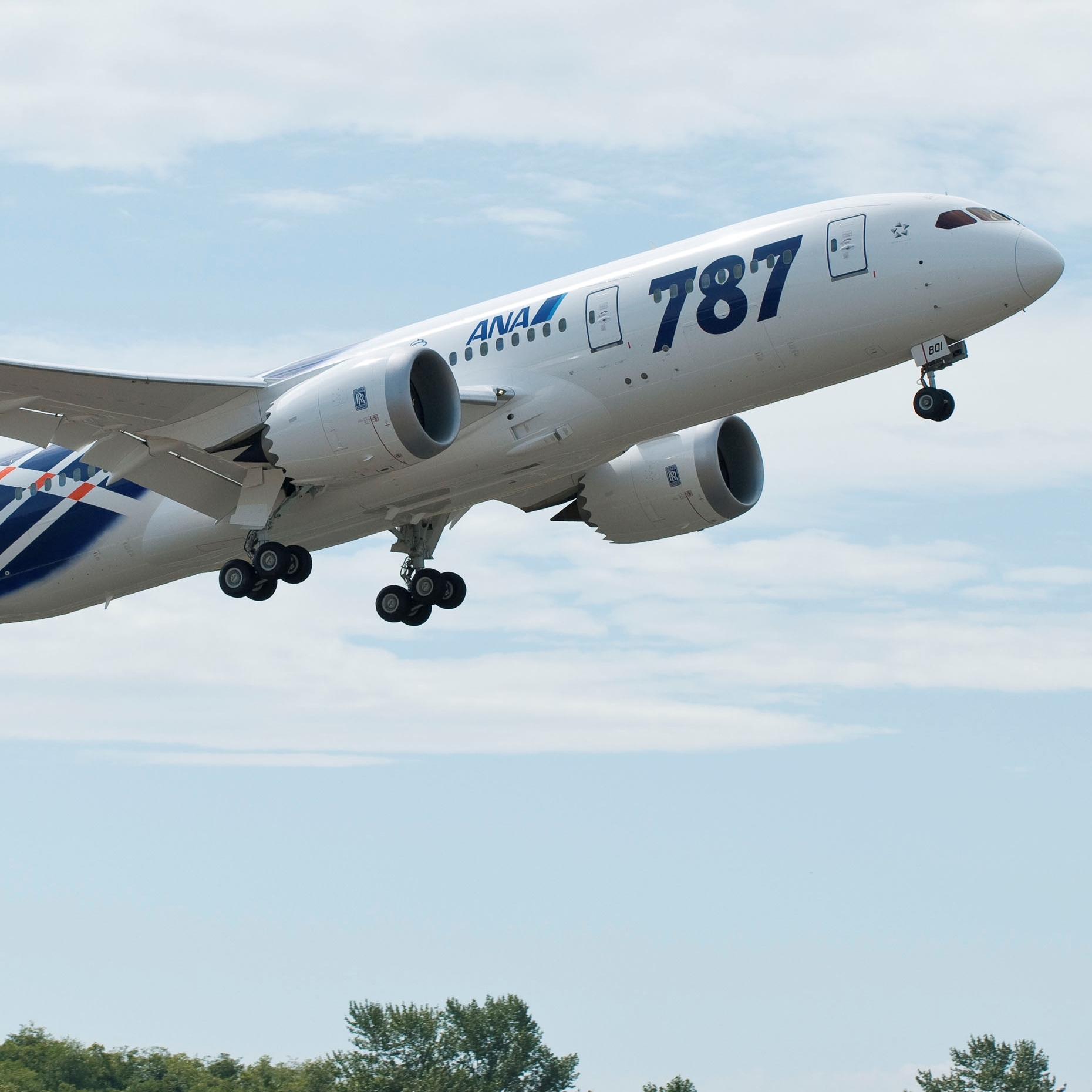
The U.S. Federal Aviation Administration (FAA) is expected to issue a new airworthiness directive (AD) this week that could severely limit the flight operations of Boeing Co.’s (NYSE: BA) 787 Dreamliner. The problem revolves around a continuing issue with the Rolls-Royce Trent 1000 engines that power about 25% of the 787’s customer fleets.
The FAA’s AD is expected to slash the long-range operations of the R-R-powered 787s by more than half and possibly by as much as 80%. Last Friday the European Aviation Safety Agency (EASA) issued an AD for all R-R-powered 787s requiring more inspections and limiting the plane’s operation to a distance of no more than 60-minutes flying time from the nearest airport.
The R-R engines have suffered from corrosion problems with the turbine’s fan blades for a couple of years now. All Nippon Airways (ANA) was forced to cancel flights in August of 2016 to replace the fan blades. ANA also said at the time that it could take three years to correct the problem fully. The Japanese carrier was the launch customer for Boeing’s 787 and currently has 64 787s in its fleet.
[nativounit]
In addition to more frequent engine inspections, the FAA is likely to reduce or suspend the R-R-powered 787s’ “Extended-range Twin-engine Operations,” known in the industry as ETOPS. Prior to about 2007, a twin-engine aircraft could not operate more than 60-minutes away from a diversionary airport due to the possibility of an engine failure. The new, more powerful engines could qualify for extended operations that would allow the aircraft to fly up to 330 minutes from a safe landing location.
The following illustration from aviation.stackexchange.com illustrates what this means. On a flight from New York’s JFK airport to London’s Heathrow, an aircraft with a 60-minute ETOPS rating would have to follow the dogleg path while a plane with a 120-minute ETOPS could fly the straight line path.
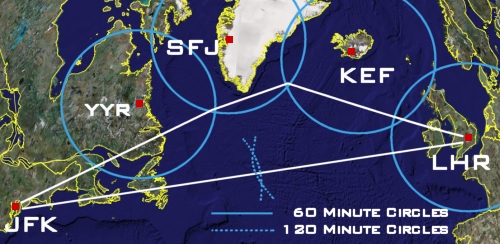
A 330-minute ETOPS means a twin-engine plane like the 787 could fly as much as 5.5 hours away from the nearest airport because a single engine is capable of powering the aircraft for that long in the event one engine failed and the plane had to be diverted from its original destination. That is virtually anyplace on the globe outside a few places in Antarctica.
According to a report from Leeham News, the FAA’s expected AD will require more inspections of the 787s and limit the ETOPS to 140 minutes. The inspections need to be completed by May 20 — the same date required by EASA. If an engine fails the inspections, the ETOPS on that plane could be reduced to 60 minutes.
Boeing has apparently begun to divert some of the R-R engines that would have been installed on new 787s rolling off the production line to customers with planes that have been grounded due to problems with previous versions of the engines.
The financial impact on Rolls-Royce likely will be greater than the impact on Boeing. In early March the engine maker said it would be paying $315 million for repairs to the Trent 1000 and 900 model engines. R-R has said that up to 500 of the affected Trent 1000 engines will be taken out of service and repaired between now and 2022.
If airlines are forced to wait for new 787s, however, that will have an impact on Boeing’s deliveries and cash flow. Some airlines may be forced to modify their flight paths or switch to another airplane if the ETOPS on the engines is reduced. That most likely means leasing planes and even crews, an unexpected expense that the airlines will want to recover from Rolls-Royce or Boeing or both.
[recirclink id=455367]
[wallst_email_signup]






 Top Gaining Stocks
 Top Losing Stocks