


Boeing Co. (NYSE: BA | BA Price Prediction) reported third-quarter 2019 results before markets opened Wednesday. The aerospace company posted diluted earnings per share (EPS) of $2.05 on revenues of $19.98 billion. In the same period a year ago, the company reported EPS of $4.08 per share on revenues of $25.15 billion. Third-quarter results also compare to consensus estimates for EPS of $2.09 and $19.67 billion in revenues.
The company’s net earnings totaled $1.17 billion in the quarter, compared with a profit of $2.36 billion in the third quarter of last year. On a non-GAAP basis, Boeing posted EPS of $1.45, down 59% year over year, and operating earnings of $895 million. Operating cash flow in the quarter was a negative $2.42 billion, and the company paid $1.2 billion in shareholder dividends in the quarter. In the second quarter, Boeing took a charge of $5.6 billion to provide a reserve to meet customer claims related to the grounding of the company’s 737 Max.
Boeing’s free cash flow for the quarter was negative $2.9 billion, and for the first nine months of the year it was negative $1.61 billion, compared with $11.12 billion in the first three quarters of last year. The company has $9.8 billion in cash and $1.1 billion in marketable securities. Total consolidated debt is $24.7 billion.
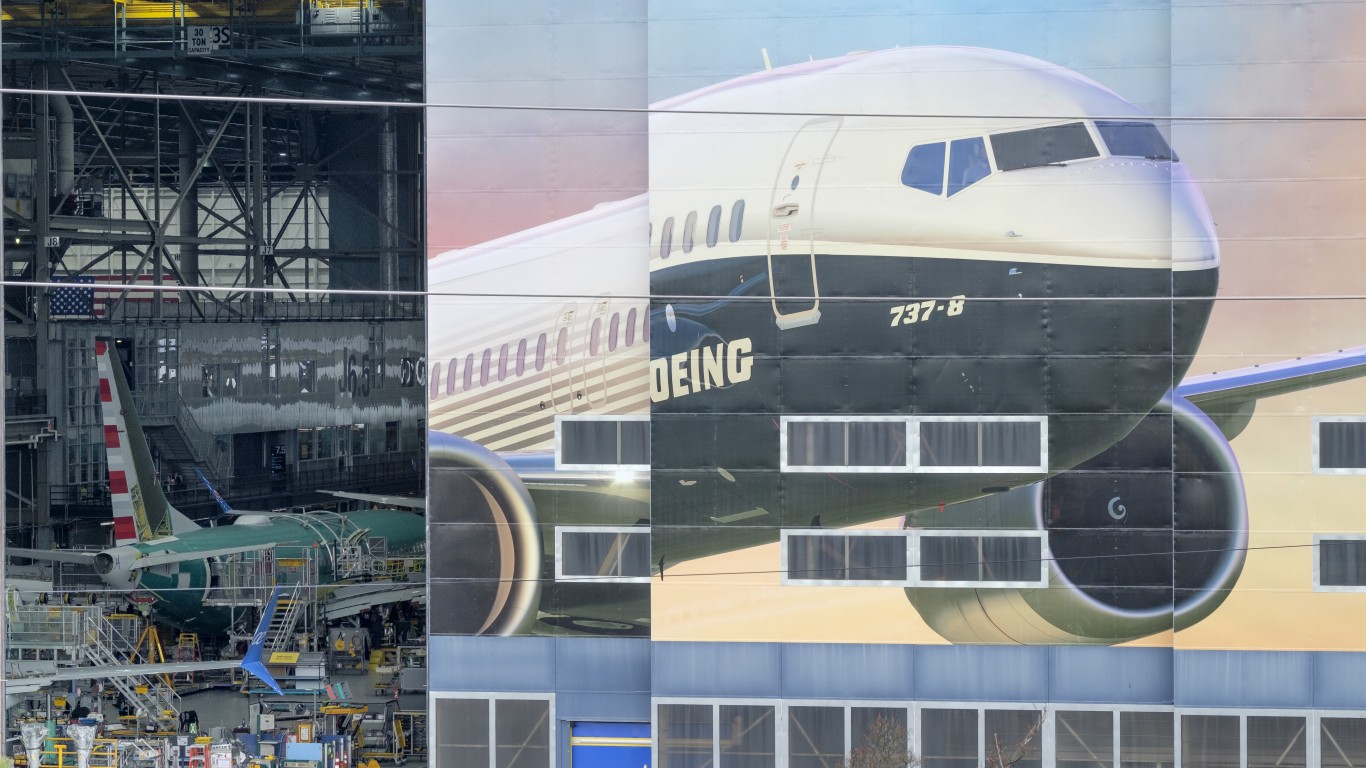
Turmoil surrounding recertification of the company’s 737 Max aircraft claimed its first Boeing executive on Tuesday. Kevin McAllister, CEO of Boeing’s commercial division, was replaced by Stan Deal, who had been chief executive of the company’s global services group. Ted Colbert will succeed Deal as CEO of the services organization. McAllister had been CEO of the commercial group since November 2016, just a few months before the 737 Max entered service. His fault appears to have been a failure to respond to the grounding of the plane with sufficient vigor.
The big issue for Boeing now is who’s next? CEO Dennis Muilenburg lost his role as board chair nearly two weeks ago, and calls for his firing have been heard. Chief Financial Officer Greg Smith, who Scott Hamilton at Leeham News credits with setting Boeing’s cost-cutting practices, is another candidate, as is the entire board of directors.
[nativounit]
While the company did not issue any financial guidance, Boeing did have something to say about its production plans. The production rate of the 787 Dreamliner will be cut from 14 a month to 12 a month late next year. The rate cut will be in effect for about two years. Boeing also expects the first flight of its new 777X dual-aisle plane to take place early next year with first delivery in early 2021. The 777X is about two years behind schedule.
The company’s defense, space and security segment reported revenues of $7 billion, up 2% year over year, with profits totaling $755 million, compared to a net loss of $247 million in the year-ago quarter. Boeing’s global services segment posted revenues of $4.66 billion, a jump of 14%, with profit rising 23% to $673 million.
Analysts have forecast fourth-quarter EPS of $3.19 and revenues of $23.57 billion. For the full year, current estimates call for EPS of $2.88 and revenues of $81.76 billion.
Boeing’s deferred production costs on the 787 program fell to $19.83 billion, down by $1.14 billion sequentially. Tooling and other non-recurring costs for the program also declined, from $2.35 billion at the end of the first quarter to $2.22 billion.
The company’s backlog of commercial jets now stands at nearly 5,500 airplanes valued at $470 billion at contract (not list) prices. The value of the backlog rose by $80 billion sequentially.
Regarding the return to service of the 737 Max, Boeing made this comment:
For purposes of the third-quarter results, the company has assumed that regulatory approval of the 737 MAX return to service begins in the fourth quarter of 2019 and that it will gradually increase the 737 production rate from 42 per month to 57 per month by late 2020.
Boeing’s shares traded up about 1% in premarket trading, at $340.60 in a 52-week range of $292.47 to $446.01. The consensus price target as of last night was $395.86.
[recirclink id=587143]
[wallst_email_signup]








 Top Gaining Stocks
 Top Losing Stocks